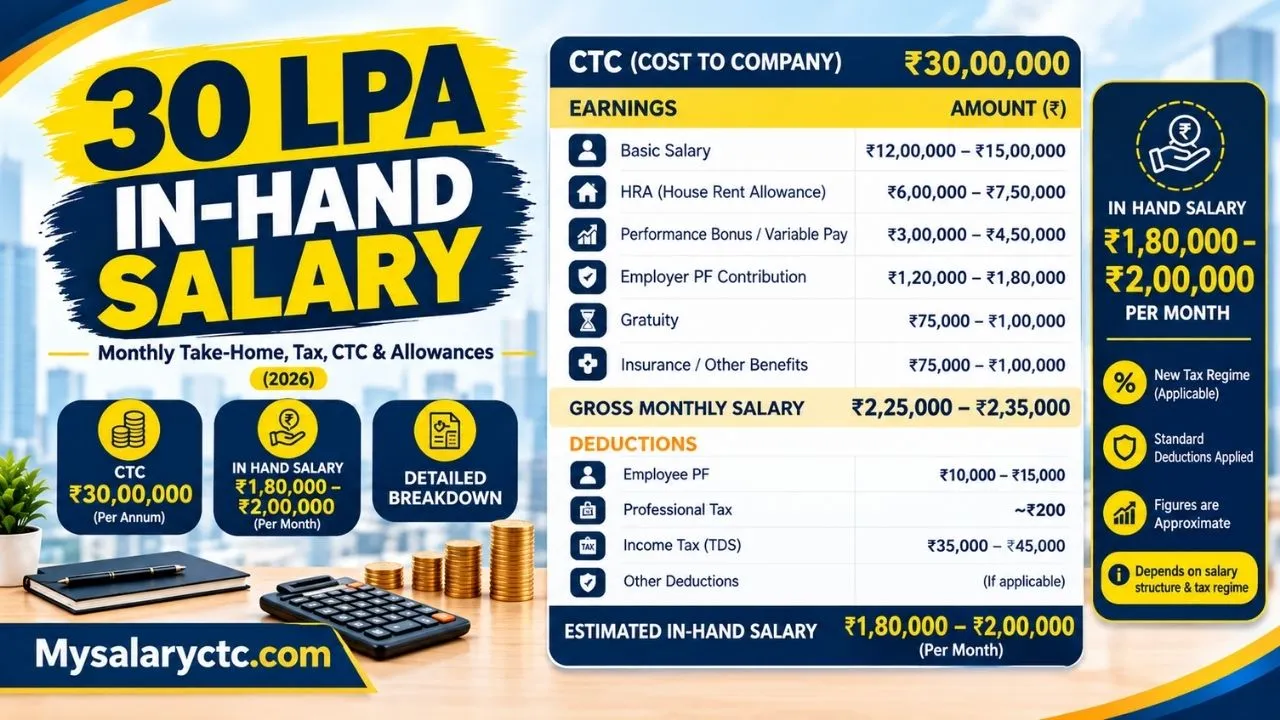

A 30 LPA offer is the kind of number that makes a resume feel real — but it also comes with the steepest tax bite you’ve dealt with yet if you’re moving up from a lower bracket. Once income tax, PF, and professional tax are all accounted for, your 30 LPA in hand salary typically settles between ₹1,80,000 and ₹2,00,000 per month, out of a gross monthly salary of roughly ₹2,25,000 to ₹2,35,000. The exact number depends heavily on your salary structure and which tax regime you’re under — at this income level, tax stops being a footnote and becomes the biggest deduction on your payslip. Here’s the full breakdown.
What Does 30 LPA Salary Actually Mean?
LPA stands for Lakhs Per Annum — the standard way Indian companies quote yearly compensation. A 30 LPA offer means your total annual package, as valued by the company, is ₹30,00,000. That’s your CTC (Cost to Company), not the amount that actually lands in your account each month. At this salary level especially, the gap between the two can feel bigger than people expect, mostly because of how much income tax kicks in once you cross into the higher slabs.
In simple terms:
30 LPA = ₹30,00,000 annual CTC
| Calculation | Amount |
| Annual CTC | ₹30,00,000 |
| Divided by 12 Months | ₹2,50,000 |
| Gross Monthly Salary | ₹2,25,000 – ₹2,35,000 |
Even this gross figure isn’t your take-home — it’s still before PF and tax deductions are applied.
30 LPA In Hand Salary Per Month: What You’ll Actually Get
If you’re specifically searching for 30 LPA in hand salary per month, here’s the realistic range: expect somewhere between ₹1,80,000 and ₹2,00,000 credited to your account monthly. Unlike lower salary brackets where PF is the main deduction, at 30 LPA, income tax becomes the single biggest chunk taken out of your paycheck — which is why the gap between your CTC and your in-hand pay is noticeably wider here than it would be at, say, 10 or 15 LPA.
What Components Make Up Your CTC?
Your CTC is a bundle of components, and several of them never actually reach your bank account. At the 30 LPA level, this typically includes:
- Basic salary, usually structured around 40-50% of CTC
- HRA and other allowances
- Performance bonus or variable pay, which can be a meaningful chunk at this level
- Employer’s Provident Fund contribution
- Gratuity provision, payable only after a minimum service period
- Insurance premiums covered by the company
- Stock options or ESOPs, in some product-based or MNC roles
Since variable pay, employer PF, and gratuity all inflate your CTC without directly boosting your monthly credit, it’s worth asking for a clear, fixed-vs-variable breakup before accepting an offer at this level — the “guaranteed” portion of a 30 LPA package can vary quite a bit between companies.
Check This Also: 4 LPA In Hand Salary – Monthly Take-Home Pay, & CTC Breakup
How Is Your 30 LPA In Hand Salary Calculated?
Start with the basic math — divide your annual CTC by 12:
₹30,00,000 ÷ 12 = ₹2,50,000 per month
From there, your employer deducts employer PF and gratuity provisions (which stay within your CTC but never reach your account), bringing your actual gross monthly pay down to roughly ₹2,25,000–₹2,35,000. After employee PF, professional tax, and income tax are further deducted, your final in-hand salary typically lands between ₹1,80,000 and ₹2,00,000 a month.
Deductions That Reduce Your Gross Pay
Here’s what typically comes out of your salary before it reaches you at this income level:
- Employee Provident Fund (EPF): Usually 12% of basic salary, which works out to roughly ₹10,000–₹15,000 a month depending on how your basic is structured
- Professional Tax: A small state-level deduction, generally around ₹200 a month
- Income Tax (TDS): The largest deduction by far at this level — typically ₹35,000–₹45,000 a month, depending on your tax regime and any deductions you claim
- Insurance Deductions: Applicable only if your employer runs a group insurance scheme
| Salary Component | Approximate Amount |
| Gross Monthly Salary | ₹2,25,000 – ₹2,35,000 |
| Employee PF Contribution | ₹10,000 – ₹15,000 |
| Professional Tax | ~₹200 |
| Income Tax (TDS) | ₹35,000 – ₹45,000 |
| Estimated In-Hand Salary | ₹1,80,000 – ₹2,00,000 |
CTC vs Take-Home Pay: Why the Confusion Happens
The CTC-vs-take-home gap catches almost everyone off guard at some point, but it’s especially noticeable once you cross into higher salary brackets like 30 LPA. Companies quote CTC because it reflects their total spend on you — PF contributions, insurance, gratuity, and all — while your payslip only shows what’s left once every deduction, including a meaningfully higher tax bill, has been applied.
Two people on an identical 30 LPA offer can end up with fairly different in-hand amounts, mainly because of how much of the package is fixed versus variable, and how aggressively each one claims deductions under the old regime (if they’ve chosen it). That’s exactly why the CTC number alone tells you very little about your actual monthly cash flow at this level — always ask for a full breakup before signing.
Income Tax On 30 LPA Salary
This is where a 30 LPA salary looks very different from something like 9 or 10 LPA: you will pay meaningful income tax here, and it’s worth understanding why.
Under the New Tax Regime (as revised in the Union Budget 2025), the slab structure works like this:
| Annual Income Slab | Tax Rate |
| Up to ₹4,00,000 | Nil |
| ₹4,00,001 – ₹8,00,000 | 5% |
| ₹8,00,001 – ₹12,00,000 | 10% |
| ₹12,00,001 – ₹16,00,000 | 15% |
| ₹16,00,001 – ₹20,00,000 | 20% |
| ₹20,00,001 – ₹24,00,000 | 25% |
| Above ₹24,00,000 | 30% |
A 30 LPA salary crosses well into the top 30% slab, since roughly ₹5–6 lakh of your taxable income falls above the ₹24 lakh mark. After the ₹75,000 standard deduction available to salaried employees, your effective annual tax liability (including 4% cess) usually works out to somewhere in the ₹4.5–4.8 lakh range, translating to a monthly TDS deduction of roughly ₹35,000–₹40,000.
If you’re on the Old Tax Regime, your final liability could be lower — but only if you’re actively claiming deductions like:
- HRA exemption (if you’re renting)
- Section 80C investments (up to ₹1.5 lakh)
- Section 80D health insurance premiums
- Home loan interest under Section 24(b), if applicable
At 30 LPA, the choice of tax regime genuinely matters and is worth running through a calculator with your specific numbers rather than assuming one is automatically better.
30 LPA Salary Per Day And Per Hour
Breaking this down into smaller units gives you a useful reference point, especially for comparing against consulting or freelance rates.
| Time Unit | Approximate Amount |
| Per Day | ₹8,219 |
| Per Hour (8-hour workday) | ₹1,027+ |
These are gross figures based on a 365-day year, so they don’t reflect weekends, holidays, or any deductions — treat them as a rough benchmark rather than an exact calculation.
Check This Also: 3 LPA In-Hand Salary = ₹21,000–₹24,000/month 2026 (CTC & Tax)
Job Roles That Typically Offer 30 LPA Salary
A 30 LPA package generally sits in the senior or specialist bracket, typically requiring 6-10+ years of experience or a strong niche skill set. Common roles at this level include:
- Senior Software Engineer / Engineering Manager
- Data Science Lead / Machine Learning Engineer
- Product Manager
- Solutions Architect
- Senior DevOps / Cloud Architect
- Investment Banking Associate
- Management Consultant
- Senior Cybersecurity Manager
Is 30 LPA A Good Salary For Freshers?
For the overwhelming majority of freshers, 30 LPA is an exceptional outlier rather than a realistic first-job expectation. It’s typically reserved for graduates from top-tier institutes (IITs, IIMs, and similar) hired into highly competitive tech, product, or consulting roles, or freshers who negotiate a strong package after multiple offers. If you’re earlier in your career, treat 30 LPA as a strong long-term target rather than a baseline to expect immediately.
How Location Affects Your 30 LPA Take-Home Value
Where you’re based still shapes your day-to-day lifestyle at this income level, though a 30 LPA salary offers considerably more cushion against city costs than lower brackets do.
In Metro Cities: Bengaluru, Mumbai, Hyderabad, Pune, and Delhi NCR carry higher rent and lifestyle costs, but a 30 LPA salary comfortably absorbs this for most people, while still allowing strong monthly savings.
In Tier-2 and Tier-3 Cities: The same salary goes considerably further here, often supporting a genuinely premium lifestyle alongside substantial investment capacity.
30 LPA vs 40 LPA: How Take-Home Pay Scales
Seeing how take-home pay scales at the next bracket up is useful if you’re negotiating your next role or planning a career move.
| Package | Gross Monthly | Net In-Hand Monthly |
| 30 LPA | ₹2,25,000 – ₹2,35,000 | ₹1,80,000 – ₹2,00,000 |
| 40 LPA | ₹3,05,000 – ₹3,15,000 | ₹2,25,000 – ₹2,35,000 |
Notice that the jump in take-home pay is proportionally smaller than the jump in CTC — that’s the 30% tax slab doing its work on every additional rupee earned above ₹24 lakh.
How To Save Money On A 30 LPA Salary
At this income level, saving well is less about tight budgeting and more about deliberate tax and investment planning. A few things that genuinely move the needle:
- Max out Section 80C (₹1.5 lakh) and consider NPS under Section 80CCD(1B) for an extra ₹50,000 deduction if you’re on the old regime
- Automate a significant SIP allocation before lifestyle spending catches up with your new income
- Build a 6-9 month emergency fund, given the higher fixed costs that tend to come with a higher salary
- Review whether the old or new tax regime actually saves you more, rather than defaulting to whichever your employer pre-selects
- Avoid letting lifestyle inflation quietly absorb the entire jump between your last salary and this one
Career Growth After 30 LPA Salary
A 30 LPA package usually marks a genuine inflection point — you’re now competing for leadership, specialist, or high-impact individual contributor roles rather than general mid-level positions.
Typical growth path: 30 LPA → 45 LPA → 60 LPA → 80 LPA+
To keep progressing from here, it typically helps to focus on:
- Building deep expertise in a high-demand specialization
- Taking on people management or cross-functional leadership
- Demonstrating measurable business impact, not just technical output
- Building a visible professional network and reputation in your field
- Considering global certifications or an MBA if you’re aiming for leadership tracks
Industries With Faster Salary Growth
Not every sector scales at the same pace once you’re past the 30 LPA mark. Industries that tend to offer faster progression from here include:
- Artificial Intelligence and Machine Learning
- Product Management at scaled tech companies
- Investment Banking and Private Equity
- Cybersecurity Leadership
- Cloud Architecture and Platform Engineering
Challenges Of A 30 LPA Salary
Higher pay comes with its own set of pressures. Professionals at this level often deal with a significantly higher tax burden, greater accountability and visibility within the organization, and the risk of lifestyle inflation eating into what should be substantial savings. It’s also common to face higher expectations around availability and decision-making, which can affect work-life balance more than the salary jump might suggest.
Why Experience Matters More Than Salary Initially
Getting to 30 LPA is rarely about the number itself — it’s a reflection of the expertise, judgment, and track record you’ve built along the way. The skills that got you here (technical depth, leadership, the ability to navigate ambiguity) are what will keep compounding your value going forward, regardless of what the next offer letter says.
Check This Also: 6 LPA In-Hand Salary: Monthly Take-Home, Tax & PF Breakup
Conclusion
To sum up: your 30 LPA in hand salary typically lands between ₹1,80,000 and ₹2,00,000 per month, against a gross monthly salary of roughly ₹2,25,000 to ₹2,35,000. Unlike lower salary brackets, income tax — not PF — is the dominant deduction here, since a meaningful portion of a 30 LPA income falls into the 30% slab under the New Tax Regime (per the Union Budget 2025 slab structure). It’s a genuinely strong package, and with deliberate tax planning and continued skill-building, your 30 LPA in hand salary per month can serve as a solid foundation for the next stage of your career.
Frequently Asked Questions
Your monthly take-home typically ranges between ₹1,80,000 and ₹2,00,000, depending on your salary structure, tax regime, and any deductions you claim.
Under the New Tax Regime, annual tax liability (including cess) typically works out to around ₹4.5–4.8 lakh, or roughly ₹35,000–₹40,000 per month, since a significant portion of the income falls into the 30% slab above ₹24 lakh.
Your gross monthly salary comes to approximately ₹2,25,000 to ₹2,35,000, after employer PF and gratuity are set aside from the CTC but before your own deductions.
Yes, it’s considered a very strong, senior-level salary in India, typically associated with 6-10+ years of experience or specialized, in-demand skills.
It’s rare. Most freshers earning close to 30 LPA come from top-tier institutes and highly competitive tech, product, or consulting hiring processes rather than typical campus placements.
Your daily earnings come to roughly ₹8,219 on a gross basis, calculated over a 365-day year.
It depends on how many deductions you can claim. If you have significant HRA, home loan interest, or 80C investments, the old regime may work out better; otherwise, the new regime’s simpler structure often ends up more efficient. Running both scenarios through a calculator with your actual numbers is the only reliable way to decide.
40 LPA typically offers ₹2,25,000 to ₹2,35,000 monthly in-hand, a solid step up from the ₹1,80,000 to ₹2,00,000 range at 30 LPA, though the 30% tax slab means the increase is proportionally smaller than the CTC jump itself.
Read Our Tools: CTC Calculator | Download Salary Slip | Salary Tax Calculator

Hi, I’m Kashish Arora, an SEO specialist and finance content researcher passionate about simplifying salary and compensation topics. I create well-researched content on CTC, in-hand salary, salary structure, pay scales, salary slips, tax calculations, EPF, gratuity, bonuses, deductions, and employee benefits.
My articles are based on official government guidelines, employer policies, tax regulations, and other reliable public sources. I aim to explain complex payroll and taxation concepts in simple language so that employees, job seekers, HR professionals, and students can easily understand how salaries are calculated and how deductions affect take-home pay.
Along with payroll and taxation topics, I also cover salary insights for government employees, private-sector professionals, executives, and public personalities whenever reliable information is available.

Leave a Reply