CTC to In-Hand Salary Calculator
Enter your CTC and get an instant breakup of Basic, HRA, PF and take-home salary.
| Salary Component | Yearly (₹) | Monthly (₹) |
|---|
A job offer with a big CTC number feels exciting until the first payslip lands. The salary in hand often looks smaller than expected, and this gap creates real confusion for most employees. A CTC calculator solves this problem by showing exactly how much money reaches your account after every deduction gets applied. This confusion happens because CTC bundles several things together, not just your salary. Employer contributions, bonus amounts, and other benefits sit inside that one number, yet none of them arrive as cash every month. Once you run your offer through a CTC to in-hand salary calculator, the picture becomes clear, and you stop relying on rough guesses while planning your finances or comparing job offers.
What CTC Really Means For Employees?
CTC is Cost to Company, and its value reflects the total salary that an employer pays you in one year. Basic remuneration, allowances, the employer contribution to the PF and even the gratuity are all included within this figure, and hence the figure puts a bigger figure within your salary.
An enormous CTC does not necessarily translate into an enormous paycheck since it is impossible to access in your bank account with employer contributions. Two people with the same CTC can receive different in-hand amounts depending on how their salary structure is built. This is exactly why a CTC calculator matters before accepting any offer.
What Is an In-Hand Salary?
In-hand salary reflects in your bank account as the actual amount upon applying all deductions are made every month. It is also known as take-home pay, and it is the amount that will determine your monthly budget on rent, groceries, savings, etc. The gross salary minus the deductions such as contribution to the provident fund, professional tax, and income tax is then the gross salary on which you receive your in-hand salary.
Unlike CTC, this figure never includes employer-side contributions or non-cash perks, since you don’t receive those as spendable money during your employment. Because of this difference, planning your monthly budget around CTC often leads to financial miscalculation.
Gross Salary vs CTC vs In-Hand Salary
It is important to note that these three terms are quite close yet have different meanings, and when they are combined, they may create misplaced expectations in the form of salaries.
| Term | What It Means | Includes Employer Contributions | Cash You Actually Receive |
| CTC | Total yearly cost to the company | Yes | Partial, spread across benefits and cash |
| Gross Salary | Earnings before deductions | No | Before tax and PF deductions |
| In-Hand Salary | Final amount credited to your account | No | Full amount, ready to spend |
How A CTC Calculator Breaks Down Your Salary
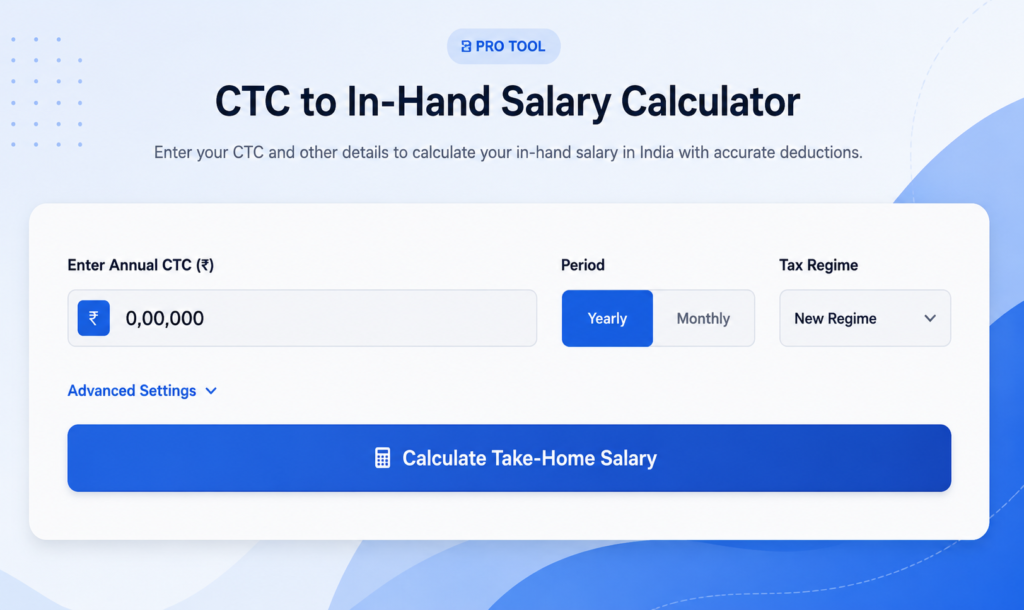
A CTC calculator takes your total package and removes items that don’t reach your bank account directly. The first thing to be calculated is the bonus gets, next is the statutory deductions, at a time till the last take-home figure pops up. It is done in a specific sequence, and having knowledge of this sequence enables you to read your own payslip easily.
Calculation Steps Followed By Most Tools
Step 1: Remove the bonus from CTC to get gross salary
Bonuses are part of CTC but are often paid separately or annually, so calculators first isolate them.
Step 2: Deduct professional tax
State governments levy this tax on salaried individuals, capped at ₹2,500 per year across India.
Step 3: Subtract EPF contributions.
Both the employee and employer contribute 12% of basic salary toward EPF, but this is mandatory only up to a basic salary ceiling of ₹15,000 per month, which works out to ₹1,800 monthly from each side under the EPF Scheme, 2026 rules confirmed by EPFO.
Step 4: Apply any additional deductions
Such as insurance premiums or loan repayments, to reach the final take-home figure.
A Sample Calculation Worth Reviewing
Suppose your annual CTC is ₹8,40,000, and it includes a performance bonus of ₹60,000. Since the bonus is paid separately, subtract it first to get a gross salary of ₹7,80,000.
Next, deduct professional tax of ₹2,400 per year (where applicable). Then account for EPF contributions. Under the current EPF rules, both the employee and employer contribute up to ₹1,800 per month when the basic salary reaches the statutory ceiling, resulting in ₹21,600 annually from each side.
Assume you also pay ₹6,000 annually toward a group health insurance plan through payroll deductions. After subtracting these deductions, your estimated annual take-home salary comes to approximately ₹5,90,400. This example shows why a CTC calculator provides a much clearer picture than simply dividing your CTC by twelve.
Sample Output From A Real CTC Calculation
The table below shows how a CTC calculator processes actual input values, moving from gross CTC to final take-home pay.
| Field | Value |
| Cost to Company (CTC) | ₹9,60,000 |
| Bonus Included in CTC | 10% |
| Monthly Professional Tax | ₹200 |
| Monthly Employer PF | ₹1,800 |
| Monthly Employee PF | ₹1,800 |
| Monthly Additional Deduction | ₹750 |
| Monthly Take-Home Salary | ₹61,250 |
| Annual Take-Home Salary | ₹7,35,000 |
| Total Monthly Deductions | ₹18,750 |
| Total Annual Deductions | ₹2,25,000 |
Key Components of Salary Structure That Shape Your Pay
Salary slips have several elements, and all of them contribute differently to the final salary you take home. It is much easier to know what every section entails, so any offer letter.
- Basic salary normally constitutes 40% to 50% of your total CTC and determines the amount of your HRA, PF, and gratuity.
- House Rent Allowance can be applied to employees who pay rent and is tax-exempt under Section 10(13A) provided with valid rent receipts.
- Leave Travel Allowance covers travel costs but requires proof of travel to claim any tax benefit.
- Professional tax is charged by state governments and stays capped at ₹2,500 per year across India.
- Special allowance covers whatever remains in the salary structure and stays fully taxable.
- Employee Provident Fund requires both you and your employer to contribute 12% of basic salary, though only up to a ₹15,000 monthly ceiling.
A higher basic salary raises your PF contribution and lowers your monthly cash in hand, yet it also builds a stronger retirement fund over time. Because of this trade-off, some employees prefer negotiating a higher special allowance instead of a higher basic salary.
CTC To In-Hand Salary Calculator V/s Manual Math
Manual salary calculation often skips small details that change the final number. A ctc to in-hand salary calculator, however, applies every rule correctly and removes guesswork from the process.
| Method | Accuracy | Time Required | Common Errors |
| Manual calculation | Often inaccurate | Longer, since every deduction needs separate math | Skipping PF ceiling, wrong professional tax rate |
| CTC calculator tool | Highly accurate | Instant results | Rare, mostly input errors |
Since the calculator applies the PF ceiling and correct tax slabs automatically, it saves both time and avoids costly mistakes during salary negotiations.
Common Mistakes People Make While Calculating Salary
This is the reason why many employees tend to get the wrong salary expectations: they take shortcuts and do not want to use the right way of calculation. These shortcuts are fast, but they hardly correspond to reality.
- Dividing CTC by twelve and assuming that number equals monthly salary, without accounting for bonus or deductions.
- Assuming full HRA exemption without checking whether rent receipts actually exist.
- Applying the 12% PF rate to the entire basic salary instead of capping it at ₹15,000 per month.
- Using a flat professional tax figure instead of checking the exact rate for their state.
- Ignoring tax rebate benefits that could bring their actual tax liability down to zero.
Each of these mistakes pushes the estimated salary higher than what actually reaches the bank account, so correcting them early prevents disappointment later.
Getting An Accurate Number From Salary Tools
A calculator only gives correct results when the right inputs go into it. Small adjustments in how you enter data can change the accuracy of your final take-home figure significantly.
Practical Steps For Better Accuracy
- Enter basic salary separately from gross salary, since PF depends only on basic pay.
- Confirm your state’s professional tax slab instead of assuming the national maximum applies.
- Compare results under both tax regimes before deciding which one suits your income better.
- Recalculate whenever your CTC structure changes, especially after an appraisal or a role change.
- Compare the result of the calculator with a copy of your payslip after the credit of the first salary.
These steps will help you stay within close reach of the actual figure, and they will help in preparing you to negotiate salaries using real figures rather than estimates.
Practical Use Beyond Job Offers
A CTC calculator isn’t only useful while accepting a new job. It also helps existing employees understand how appraisals affect their monthly income, since a percentage hike on CTC doesn’t always translate into the same percentage increase in take-home pay.
For example, imagine an employee whose CTC increases from ₹9 lakh to ₹10 lakh per year. Although the annual package rises by ₹1 lakh, the monthly take-home salary may increase by only ₹5,000–₹6,000 after accounting for revised PF contributions, tax deductions, and any changes in bonus or benefits. Running both salary structures through a CTC to in-hand salary calculator before accepting the revised package provides a much more realistic estimate of the actual monthly income.
Final Thought on Salary Planning
Reading a CTC figure without breaking it down leads to false expectations, whether during hiring, appraisal season, or loan planning. A CTC calculator turns a confusing package into clear, usable numbers, and that clarity helps with everything from rent budgeting to EMI planning. Before accepting your next offer or celebrating a raise, run the actual figures through a proper calculator instead of relying on quick math, since the real value of any salary lies in what finally reaches your account, not what the offer letter promises.
FAQs
CTC is the total yearly cost an employer bears for an employee, including salary, benefits, and contributions.
It means the full annual package value quoted by the employer, not the monthly cash salary.
No, Gross salary is a component within CTC and excludes employer-only contributions like retirement matching or insurance premiums.
Because CTC includes non-cash benefits, employer contributions, and deductions like PF and income tax, all of which reduce the actual cash you receive.
Subtract employer-only contributions from CTC to get gross salary, then subtract employee deductions like PF, professional tax, and income tax to get your net in-hand salary.
You need your CTC, bonus percentage, monthly professional tax, employer and employee PF contributions, and any additional monthly deductions like insurance or loan EMIs.
Basic CTC calculators typically compute PF and professional tax but may not factor in income tax unless the tool specifically includes a tax module based on your chosen regime.
Basic salary, HRA, LTA, special allowance, bonus, and employer PF contribution make up the core components, along with statutory deductions like professional tax.
Basic salary is generally calculated as 40% to 50% of total CTC, though the exact percentage depends on company policy and industry norms.
CTC is the total amount an employer spends annually on an employee, including salary, bonus, employer PF contribution, gratuity, and other benefits.
EPF is mandatory for employees earning up to ₹15,000 basic salary per month in establishments with 20 or more employees, while contributions above that threshold are voluntary under EPFO’s 2026 framework.
Because CTC includes non-cash components like employer PF and gratuity, plus your annual bonus, none of which appear in your monthly bank credit.
No, professional tax varies by state, and some states like Delhi and Haryana don’t levy it at all, while others charge close to the ₹2,500 annual cap.
Since EPF is mandatory only up to a ₹15,000 basic salary ceiling, most employees already contribute the minimum unless they’ve opted for voluntary higher contributions, which can be adjusted with employer agreement.
Use it whenever you receive a new job offer, get a salary revision, or your company restructures its CTC components, since even small changes affect your net pay.