
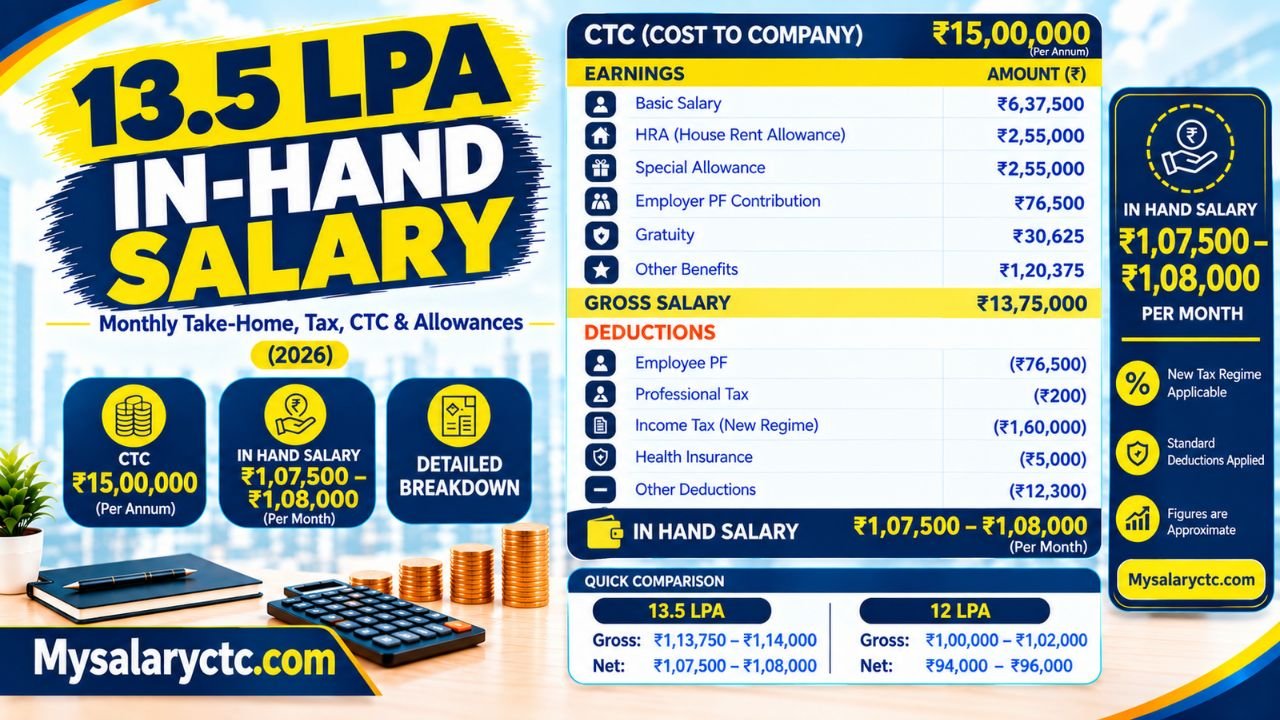

A job offer showing ₹13.5 LPA looks attractive on paper. But there is one question most candidates ask immediately after seeing the package:
“How much will I actually receive in my bank account every month?”
This is where salary calculations become confusing.
A package of ₹13.5 lakh does not mean your monthly salary will automatically be ₹1,12,500. That number only comes from dividing the annual package by 12. Your employer may include provident fund, gratuity, insurance, bonuses, or other benefits in the advertised CTC.
So, the amount mentioned in your offer letter and the amount credited to your bank account can be quite different.
For someone researching 13.5 LPA in hand salary per month, the realistic answer is usually somewhere around the high-₹90,000s to ₹1 lakh-plus, depending on the salary structure, PF arrangement, tax treatment and variable compensation.
This guide explains the calculation from the ground up so you can understand your actual earning potential before accepting a ₹13.5 LPA offer.
First, Understand the Difference Between CTC and Salary
Before calculating your take-home pay, you need to understand what the company means by “13.5 LPA.”
CTC stands for Cost to Company.
It represents the total annual cost associated with employing you. It does not necessarily represent the amount of cash you receive.
Think about your salary as three different layers.
Layer 1: CTC
This is the headline number recruiters normally discuss.
13.5 LPA = ₹13,50,000 per year
Layer 2: Gross Salary
This is the amount you earn before employee-side deductions.
It can exclude certain employer-paid components that are included in CTC.
Layer 3: Take-Home Salary
This is what remains after deductions such as:
- Employee PF
- Professional tax where applicable
- Income-tax withholding
- Other payroll deductions
Therefore:
CTC ≠ Gross Salary ≠ In-Hand Salary
[Reference Source: Employer compensation structures / EPFO / Income Tax Department]
This distinction is the starting point for calculating your actual monthly income.
13.5 LPA In Hand Salary Per Month: The Basic Calculation
Let’s start with the easiest calculation.
Annual package:
₹13,50,000
Divide it by 12:
₹13,50,000 ÷ 12 = ₹1,12,500
So, ₹1,12,500 is your monthly CTC equivalent.
But you should not assume that ₹1,12,500 will appear in your salary account.
For example, imagine that your employer includes the following inside your CTC:
- Employer PF contribution
- Gratuity
- Insurance
- Performance bonus
Those amounts can form part of the company’s total cost but may not be paid to you as monthly cash.
This is why a person earning ₹13.5 LPA may have a bank credit closer to ₹96,000–₹1,04,000 rather than ₹1,12,500.
[Reference Source: Salary calculator methodologies and employer compensation structures]
A Simple Way to Visualize Your ₹13.5 LPA Package
Imagine your annual CTC as a large pie.
The entire pie is worth:
₹13,50,000
But different pieces have different purposes.
One part could be your basic salary.
Another could be HRA.
Another could be special allowance.
Another may go toward employer PF.
A small portion could represent gratuity.
There may also be a bonus component.
Only the portions treated as regular cash earnings contribute directly to your monthly gross salary.
After that, employee-side deductions are applied.
The final piece is your take-home salary.
This is why two people working at different companies can both have a ₹13.5 lakh package but receive different monthly amounts.
What Could a ₹13.5 LPA Salary Structure Look Like?
Let’s consider an illustrative example.
Suppose a company creates a compensation package like this:
| Component | Approx. Annual Value |
| Basic salary | ₹6,75,000 |
| HRA | ₹3,37,500 |
| Other allowances | ₹2,24,000 |
| Employer PF | ₹81,000 |
| Gratuity/other CTC components | ~₹32,500 |
| Total CTC | ₹13,50,000 |
The numbers above are an example rather than a standard industry formula.
The important observation is that the complete ₹13.5 lakh is not necessarily available as monthly cash.
If employer contributions and other CTC components account for roughly ₹1 lakh-plus of the package, the salary available for monthly payroll becomes lower.
Then employee deductions are applied.
[Reference Source: Illustrative salary structure; actual employer structures vary]
Why Your Friend’s ₹13.5 LPA Salary May Be Different
This is one of the most confusing parts of salary discussions.
You may ask a friend:
“You also earn 13.5 LPA. How much do you get?”
They may answer:
“Around ₹1.03 lakh.”
Another person may say:
“I receive around ₹96,000.”
Someone else could report an even different number.
All three answers can be correct.
Why?
Because the CTC number alone doesn’t tell us enough.
Consider these differences:
Company A
- High fixed salary
- Lower variable component
- Different PF arrangement
- Limited CTC benefits
Company B
- Lower monthly fixed component
- Large performance bonus
- Employer PF included
- Gratuity included
Company C
- Different basic-to-total salary ratio
- Different payroll deductions
- Insurance included in CTC
All three companies can advertise the package as:
₹13.5 LPA
But their payslips will not necessarily look the same.
Employee PF: The Deduction You Should Check First
Provident Fund is one of the biggest items that can affect monthly take-home pay.
Under the standard EPF framework, the employee contribution is generally linked to applicable PF wages, with the commonly used contribution rate being 12% under the standard framework. [Reference Source: EPFO]
For example, suppose your PF-eligible basic salary is:
₹56,250 per month
If the employee contribution is calculated at 12%:
₹56,250 × 12% = ₹6,750
That means approximately ₹6,750 could be deducted from monthly salary under this illustrative structure.
Over a year:
₹6,750 × 12 = ₹81,000
However, don’t make the mistake of calculating:
₹13,50,000 × 12%
That is not how you should automatically calculate PF.
PF treatment depends on the applicable PF wage structure and employer payroll arrangement.
[Reference Source: Employees’ Provident Fund Organisation]
Why PF Is Not Simply “Lost Money”
It is easy to look at a salary slip and think:
“Why is my take-home lower?”
But PF is different from an ordinary expense.
The employee contribution goes toward your provident-fund account, subject to the applicable EPF rules. Employer contributions may also form part of the overall retirement benefit structure.
So if ₹6,750 is deducted from your salary, you should not simply consider the entire amount as disappearing.
It is part of your long-term compensation and savings structure.
For someone comparing two jobs, however, it still matters because it changes the amount available for monthly spending.
[Reference Source: EPFO]
What About Income Tax on 13.5 LPA?
Tax calculations are another area where online salary articles often become misleading.
A package of ₹13.5 lakh does not automatically tell you the exact tax you will pay.
The calculation depends on your taxable income, salary components, deductions and the tax regime applicable to you.
For Tax Year/FY 2026–27, the new-regime slab structure starts with:
- Up to ₹4 lakh: Nil
- ₹4 lakh–₹8 lakh: 5%
- ₹8 lakh–₹12 lakh: 10%
- ₹12 lakh–₹16 lakh: 15%
- ₹16 lakh–₹20 lakh: 20%
- ₹20 lakh–₹24 lakh: 25%
- Above ₹24 lakh: 30%
[Reference Source: Ministry of Finance, Union Budget 2026–27]
There is also a Section 87A rebate for eligible resident individuals meeting the specified taxable-income conditions under the new regime. [Reference Source: Income Tax Department]
That is why you may find online calculators showing very different tax numbers for salaries around this level.
Important:
Do not assume that every person earning ₹13.5 LPA will have exactly the same TDS.
Your salary structure and overall taxable income matter.
Does ₹13.5 LPA Mean Zero Income Tax?
This question deserves a careful answer.
Some salary calculators can show little or no income-tax liability at this salary level under particular assumptions.
That does not mean:
“Everyone earning ₹13.5 LPA pays zero tax.”
A calculator may assume that part of the CTC consists of employer PF or gratuity and therefore does not treat the entire ₹13.5 lakh as taxable salary.
Your personal circumstances may also include other taxable income.
For example, your total taxable income could change if you receive:
- Interest income
- Capital gains
- Additional employment income
- Taxable bonuses
- Other taxable receipts
Therefore, use online salary calculators to understand the mechanics, not as a replacement for your actual tax computation.
[Reference Source: Income Tax Department]
Read More: 12.5 LPA In Hand Salary in India 2026: Monthly Take-Home, CTC, PF, Tax & Salary Breakdown
The Biggest Difference: Fixed Pay vs Variable Pay
Suppose you receive two offers.
Offer A
Total CTC: ₹13.5 lakh
Fixed: ₹13.2 lakh
Variable: ₹30,000
Offer B
Total CTC: ₹13.5 lakh
Fixed: ₹10.5 lakh
Variable: ₹3 lakh
At first glance, both offers look identical.
They are not.
Offer B may have a much lower predictable monthly salary because a larger part of the package depends on performance, company results or another payout condition.
This is why experienced candidates ask:
“How much of the CTC is fixed?”
rather than only asking:
“What is the package?”
A Better Question to Ask HR
Instead of asking:
“What is the in-hand salary for 13.5 LPA?”
Ask HR these five questions:
- What is my annual fixed CTC?
- How much is variable pay?
- What will my monthly gross salary be?
- How much employee PF will be deducted?
- What is the approximate monthly bank credit?
These questions give you much more useful information.
If HR provides a salary breakup, you can calculate your approximate take-home yourself.
Three Possible Take-Home Outcomes
There isn’t one universal answer to the question:
“13.5 LPA in hand salary per month?”
Instead, think in scenarios.
Lower Take-Home Structure
If the package includes employer PF, gratuity and other CTC components and your employee PF deduction is relatively high, your monthly credit could be around the mid-to-high ₹90,000 range under certain assumptions.
Middle Scenario
With a different basic salary and PF structure, take-home could move toward approximately ₹1 lakh per month.
Higher Take-Home Structure
If the package has fewer non-cash components and lower employee-side deductions, monthly take-home can move above ₹1 lakh.
These should be treated as illustrative ranges, not promises.
What If the Company Says “₹13.5 LPA Fixed”?
That’s a much more interesting offer.
If the employer genuinely means ₹13.5 lakh is fixed compensation, the calculation can be different from a package where bonuses and employer contributions are included in CTC.
But even then, you should ask:
“Does the ₹13.5 lakh fixed amount include employer PF and gratuity?”
This single question can reveal a significant difference in the actual salary structure.
Never rely only on the word “fixed.”
Read the breakup.
Is 13.5 LPA a Good Salary?
For many professionals, ₹13.5 LPA can represent a strong career milestone.
But whether it is “good” depends on where you live and how you spend.
Someone living with family in a city with moderate expenses may save considerably more than someone paying high rent in a major metropolitan area.
Consider two employees receiving approximately ₹1 lakh monthly:
Employee A
- Lives with family
- Low commuting cost
- Controlled lifestyle expenses
- Saves aggressively
Employee B
- Pays high rent
- Has significant commuting costs
- Eats outside frequently
- Has loans and other obligations
Their financial situations can be completely different despite earning similar salaries.
So salary should always be evaluated alongside monthly expenses and savings capacity.
How to Use a ₹13.5 LPA Salary More Effectively
Once your take-home reaches around the ₹1 lakh mark, lifestyle inflation becomes an important consideration.
A common mistake is increasing every expense immediately after receiving a raise.
Instead, consider creating three financial buckets:
Bucket 1: Monthly Living
Rent, food, transportation, utilities and routine expenses.
Bucket 2: Future Goals
Investments, emergency savings, education, home purchase or other long-term goals.
Bucket 3: Lifestyle
Travel, shopping, entertainment and hobbies.
The exact percentages should depend on your personal situation.
The goal is not to avoid spending.
The goal is to make sure your salary increase also improves your financial position.
Read More: 13 LPA In Hand Salary in India 2026: Monthly Take-Home, CTC, PF, Tax & Salary Breakup
Common Errors People Make With 13.5 LPA
1. Assuming ₹1,12,500 Is Take-Home
It is the monthly CTC equivalent.
Fix: Check gross salary and deductions.
2. Ignoring Variable Pay
A ₹13.5 LPA package containing ₹2–3 lakh variable pay cannot be compared directly with a mostly-fixed ₹13.5 LPA package.
Fix: Separate fixed and variable components.
3. Treating Employer PF as Cash
Employer contributions can be included in CTC without being paid as monthly cash.
Fix: Remove non-cash CTC components before estimating take-home.
4. Assuming Everyone Pays the Same Tax
Tax depends on taxable income and individual circumstances.
Fix: Use your actual salary structure.
5. Comparing Only CTC
A higher CTC isn’t automatically the better offer.
Fix: Compare fixed pay, take-home, variable pay, benefits and career growth together.
What Should You Look for in Your Offer Letter?
Before signing your employment contract, find these figures:
| Item | Why It Matters |
| Annual CTC | Headline package |
| Fixed CTC | Predictable compensation |
| Variable pay | Potential but not always guaranteed |
| Basic salary | Important for several payroll calculations |
| HRA | Relevant to salary structure/tax treatment |
| Employee PF | Reduces monthly bank credit |
| Employer PF | May be part of CTC |
| Gratuity | May be included in CTC |
| Insurance | May be included in total package |
| Monthly gross | Useful for estimating take-home |
| Notice-period terms | Important when changing jobs |
This table is more useful than simply looking at the ₹13.5 lakh figure.
Final Answer: How Much Is 13.5 LPA In Hand?
If you want the shortest possible answer:
₹13.5 LPA = ₹13,50,000 annually.
Dividing that by 12 gives:
₹1,12,500 monthly CTC equivalent.
Your actual 13.5 LPA in hand salary per month will be lower because the package may include employer PF, gratuity, insurance, variable pay and other components, while employee-side deductions can further reduce the amount credited to your bank account.
For many salary structures, a practical expectation is around ₹96,000 to ₹1.04 lakh+ per month, but your exact figure can only be determined from the employer’s salary breakup.
The smartest approach is therefore not to ask only:
“Is the package ₹13.5 LPA?”
Ask:
“What is my fixed pay, monthly gross, employee PF, variable component and expected monthly take-home?”
That is the information that tells you what the job is really worth.
Quick FAQ 13.5 LPA in hand salary
Depending on the salary structure, a ₹13.5 LPA package can result in approximately ₹96,000 to ₹1.04 lakh or more in monthly take-home under different assumptions.
₹13.5 lakh divided by 12 equals ₹1,12,500 per month. This is the monthly CTC equivalent, not necessarily the bank-credit amount.
It can be a strong salary, but its value depends on your location, living costs, financial commitments, experience and savings goals.
There is no single answer. PF depends on applicable PF wages and the employer’s contribution structure. Under an illustrative ₹56,250 basic salary, 12% would equal ₹6,750 per month.
It can. Employer PF is commonly shown as part of CTC in many compensation structures, so always check the salary breakup.
No. ₹13.5 LPA works out to ₹1,12,500 per month before considering the structure. Actual take-home can be around ₹1 lakh or lower depending on deductions.
Take your offer letter and identify the fixed gross salary, employee PF, professional tax, TDS, variable pay and other deductions. Your payroll slip will provide the most accurate figure once you join.
Read Our Tools: CTC Calculator | Download Salary Slip | Salary Tax Calculator

Hi, I’m Kashish Arora, an SEO specialist and finance content researcher passionate about simplifying salary and compensation topics. I create well-researched content on CTC, in-hand salary, salary structure, pay scales, salary slips, tax calculations, EPF, gratuity, bonuses, deductions, and employee benefits.
My articles are based on official government guidelines, employer policies, tax regulations, and other reliable public sources. I aim to explain complex payroll and taxation concepts in simple language so that employees, job seekers, HR professionals, and students can easily understand how salaries are calculated and how deductions affect take-home pay.
Along with payroll and taxation topics, I also cover salary insights for government employees, private-sector professionals, executives, and public personalities whenever reliable information is available.


Leave a Reply