
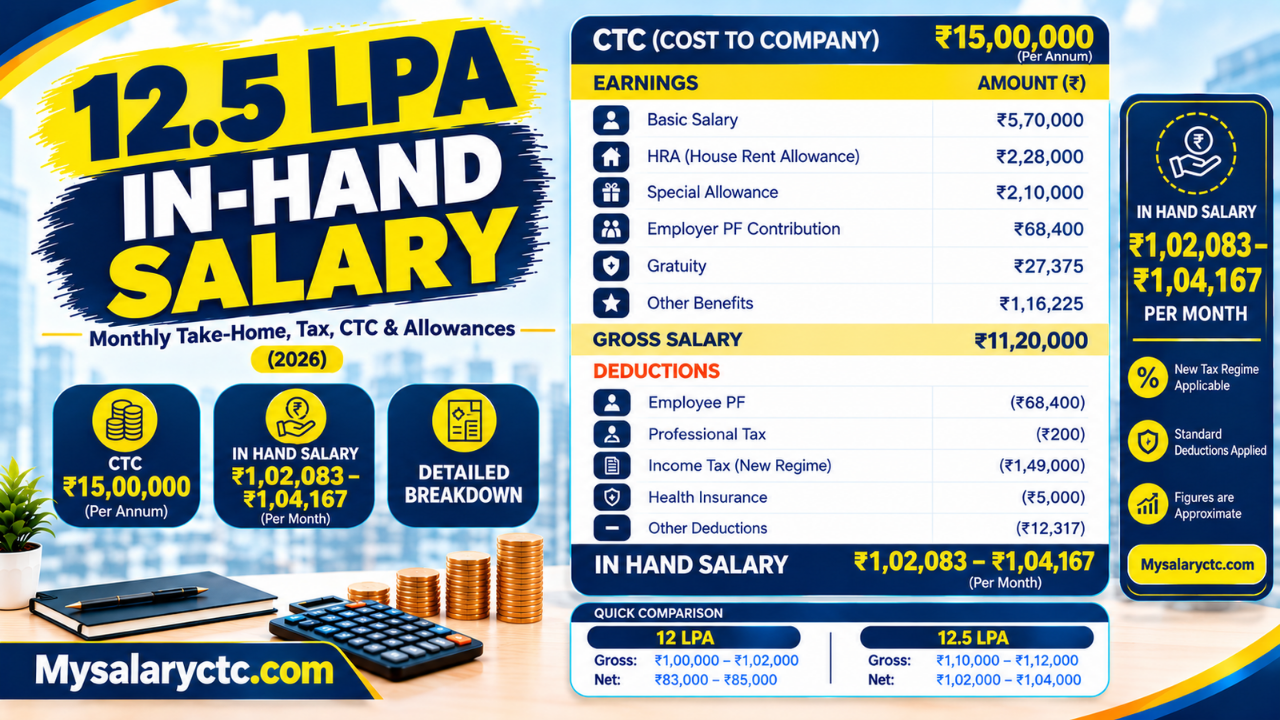

An offer letter saying ₹12.5 LPA sounds clear enough—until you receive your first payslip.
At first glance, ₹12.5 lakh per year appears to mean:
₹12,50,000 ÷ 12 = ₹1,04,167 per month.
But that ₹1.04 lakh is only the monthly equivalent of the annual CTC. It does not automatically mean ₹1.04 lakh will be credited to your bank account.
This is where many employees get confused.
Your employer may include provident fund, gratuity, insurance, variable compensation and other benefits inside the advertised CTC. Your monthly salary can then be reduced further by employee PF, professional tax, tax deducted at source and other applicable payroll deductions.
For that reason, the 12.5 LPA in hand salary can be significantly different from the headline package.
Current salary calculators also produce different estimates. For example, one current model estimates approximately ₹88,962 per month, while another salary calculator gives a higher range of around ₹97,853–₹1,00,567, depending on its assumptions. [Reference Source: SalaryInHand / GreyHR]
So the right question is not simply, “What is 12.5 LPA divided by 12?”
The better question is:
“How is my ₹12.5 lakh CTC structured, and how much of it will actually become monthly take-home pay?”
This guide answers that question step by step.
12.5 LPA In Hand Salary Per Month: Quick Answer
If your annual CTC is ₹12.5 lakh, the basic mathematical conversion is:
₹12,50,000 ÷ 12 = ₹1,04,166.67
So the monthly CTC equivalent is approximately:
₹1,04,167 per month
However, this is not the same as in-hand salary.
Depending on your company’s compensation structure, PF treatment, variable pay, gratuity, professional tax and applicable tax calculation, your actual monthly bank credit can be different.
Current online salary models show this clearly:
| Calculation approach | Approx. monthly figure |
| Annual CTC ÷ 12 | ₹1,04,167 |
| One current illustrative take-home model | ₹88,962 |
| Another current calculator range | ₹97,853–₹1,00,567 |
| Possible actual take-home | Depends on employer structure |
[Reference Source: SalaryInHand / GreyHR]
A current SalaryInHand example uses a ₹12.5 lakh CTC, 50% basic salary, employer PF, gratuity and professional tax and arrives at ₹88,962 monthly take-home under its stated assumptions. [Reference Source: SalaryInHand]
Meanwhile, the difference between that result and other calculators demonstrates an important point:
There is no single universal 12.5 LPA in-hand salary.
Your salary breakup determines the answer.
What Does 12.5 LPA Actually Mean?
Before calculating take-home salary, you need to understand what LPA means.
LPA stands for Lakhs Per Annum.
Therefore:
12.5 LPA = ₹12,50,000 per year
If ₹12.5 lakh is quoted as CTC, it generally represents the employer’s stated annual cost for your employment package rather than the exact cash salary you receive.
A compensation package can contain several elements.
Common components include:
- Basic salary
- House Rent Allowance (HRA)
- Special allowance
- Employer provident fund
- Gratuity
- Performance bonus
- Variable pay
- Medical insurance
- Other employer-provided benefits
Not every component behaves like monthly cash salary.
For example, employer PF may be included in CTC but deposited into your provident-fund account rather than being paid directly into your salary account. Gratuity can also be included in CTC without becoming part of your regular monthly bank credit.
That creates three different numbers:
CTC
The overall compensation figure presented by the employer.
Gross Salary
The salary considered before employee-side deductions.
In-Hand Salary
The amount that remains after applicable deductions and is actually credited to your account.
A useful mental model is:
CTC → Salary Components → Gross Pay → Employee Deductions → Net Salary
This distinction is essential when comparing job offers.
[Reference Source: Employer Salary Structure / EPFO / Income Tax Department]
Why ₹1,04,167 Is Not Necessarily Your Monthly Salary
Suppose you accept a job advertised at 12.5 LPA.
You might calculate:
₹12,50,000 ÷ 12 = ₹1,04,167
That calculation is mathematically correct.
But imagine the company has included:
- ₹75,000 employer PF
- ₹30,000 gratuity
- ₹50,000 insurance and other benefits
- ₹1,00,000 performance-linked compensation
inside the annual CTC.
Those amounts don’t necessarily become regular monthly cash.
The remaining fixed salary is then distributed among basic pay, HRA and other allowances.
After that, employee PF and other deductions can reduce the amount further.
This is why someone earning 12.5 LPA CTC may see a bank credit substantially below ₹1 lakh in some salary structures, while another employee with the same CTC may receive a figure much closer to that level.
[Reference Source: SalaryInHand / GreyHR]
A Practical 12.5 LPA Salary Structure
There is no mandatory salary breakup that every private employer must use.
To understand the mechanics, consider an illustrative structure based on a current published salary model:
| Component | Annual amount |
| Basic salary | ₹6,25,000 |
| HRA | ₹3,12,500 |
| Special allowance | ₹2,07,438 |
| Employer PF | ₹75,000 |
| Gratuity | ₹30,062 |
| Total CTC | ₹12,50,000 |
[Reference Source: SalaryInHand]
This example uses basic salary at approximately 50% of CTC.
It is important to understand that this is an example, not an industry-wide rule.
Another company could use a different basic salary percentage, different HRA, a higher variable component, capped PF or different benefits.
That’s why copying a salary breakup from someone else’s offer letter will not necessarily predict your own take-home pay.
How to Calculate 12.5 LPA In Hand Salary Step by Step
Let’s make the calculation easier by following the money rather than simply applying a percentage.
Step 1: Start With CTC
Your annual package:
₹12,50,000
Monthly CTC equivalent:
₹12,50,000 ÷ 12 = ₹1,04,167
This is the starting point.
It is not yet the bank-credit figure.
Step 2: Identify Employer-Side Components
Now check whether the CTC includes:
- Employer PF
- Gratuity
- Insurance
- Annual bonus
- Retention benefits
- Other company-paid benefits
For example, suppose ₹1,05,062 of the package consists of employer PF and gratuity.
The remaining amount available for the salary components would be approximately:
₹12,50,000 − ₹1,05,062 = ₹11,44,938
This is an illustrative calculation based on one current published model. [Reference Source: SalaryInHand]
Step 3: Find Your Gross Monthly Salary
Under that example:
₹11,44,938 ÷ 12 ≈ ₹95,412
So the gross monthly amount is approximately:
₹95,412
That is already lower than the ₹1,04,167 monthly CTC equivalent because some CTC components aren’t monthly cash salary.
Step 4: Deduct Employee PF
In the same example, employee PF is:
₹75,000 annually
or:
₹6,250 per month
The employee’s monthly salary therefore becomes approximately:
₹95,412 − ₹6,250 = ₹89,162
Step 5: Consider Professional Tax
Professional tax is not identical across India. It depends on applicable state rules.
In the published example, the annual professional-tax assumption is ₹2,400, equivalent to ₹200 per month. [Reference Source: SalaryInHand / Applicable State Professional Tax Rules]
So:
₹89,162 − ₹200 = ₹88,962
Under that specific structure, the estimated monthly take-home becomes:
₹88,962
This is why an online calculator can show a result below ₹1 lakh even though the original CTC is ₹12.5 lakh.
How PF Affects a 12.5 LPA Salary
Provident Fund deserves special attention because employees often calculate it incorrectly.
A common mistake is to think:
12% of ₹12.5 lakh = PF deduction
That is not how you should approach a normal salary breakup.
EPFO’s published contribution framework states an employee contribution rate of 12% of applicable PF wages, with specific rules concerning wage ceilings and higher-wage contributions. [Reference Source: Employees’ Provident Fund Organisation]
The official EPFO material also explains that employees contributing on higher wages can be subject to specific conditions, and voluntary higher contributions do not necessarily require the employer to match the employee’s additional contribution. [Reference Source: EPFO]
So PF depends on the relevant salary structure.
Example
Suppose basic salary is:
₹52,083 per month
A simplified 12% calculation would be:
₹52,083 × 12% ≈ ₹6,250
That produces an annual employee PF contribution of approximately:
₹6,250 × 12 = ₹75,000
This is the assumption used in one current 12.5 LPA salary model. [Reference Source: SalaryInHand]
But another employer might structure PF differently.
That single difference can change your monthly take-home.
Does 12.5 LPA Attract Income Tax?
This question needs more care than simply applying an income-tax percentage to ₹12.5 lakh.
Income tax is calculated using taxable income and the rules applicable to the relevant financial year.
For the current tax framework introduced from FY 2025–26 onward, the new regime has slabs beginning at:
- Up to ₹4 lakh — Nil
- ₹4 lakh–₹8 lakh — 5%
- ₹8 lakh–₹12 lakh — 10%
- ₹12 lakh–₹16 lakh — 15%
- ₹16 lakh–₹20 lakh — 20%
- ₹20 lakh–₹24 lakh — 25%
- Above ₹24 lakh — 30%
The Income Tax Department also states that eligible resident individuals can receive a Section 87A rebate of up to ₹60,000 where total income falls within the specified ₹12 lakh threshold under the new regime. [Reference Source: Income Tax Department]
A standard deduction of ₹75,000 for salaried taxpayers under the new regime is also part of the current framework. [Reference Source: Income Tax Department]
This creates an interesting situation for a ₹12.5 lakh CTC employee.
If the employee’s actual taxable salary income remains within the relevant rebate threshold after the applicable standard deduction and salary-structure adjustments, the tax payable can potentially be nil under the new regime.
One current 12.5 LPA model, for example, estimates taxable income at ₹10,69,938 and shows zero income tax under its assumptions. [Reference Source: SalaryInHand]
But this should not be interpreted as:
“Everyone earning 12.5 LPA pays zero tax.”
That statement would be too broad.
Your actual taxable income can be affected by other income, bonuses, benefits, capital gains and other factors.
The correct approach is to calculate your individual taxable income for the relevant year.
New Tax Regime vs Old Tax Regime at 12.5 LPA
The new tax regime is the default regime for eligible individual taxpayers, although eligible taxpayers can opt for the old regime under the applicable rules. [Reference Source: Income Tax Department]
At around 12.5 LPA, the new regime can be attractive because the current slabs and Section 87A rebate can substantially reduce tax for taxpayers whose taxable income remains within the relevant threshold.
The old regime can still matter for someone with substantial eligible deductions and exemptions.
For example, a person may have significant:
- HRA-related exemption eligibility
- Home-loan interest
- Section 80C investments
- Eligible health-insurance deductions
- Other permitted deductions
[Reference Source: Income Tax Department]
The important point is not to choose a regime because a salary calculator says one is “better.”
Compare the two regimes using your actual taxable income and eligible deductions.
Why Online 12.5 LPA Salary Calculators Disagree
If you search for 12.5 LPA in hand salary, you may see several different answers.
That is normal.
For example:
- SalaryInHand currently shows approximately ₹88,962/month under one detailed model.
- GreyHR lists approximately ₹97,853–₹1,00,567/month under its calculator assumptions.
- Other calculators can show still different numbers depending on PF treatment and salary components.
[Reference Source: SalaryInHand / GreyHR / Other Salary Calculators]
Why does this happen?
Different Basic Salary
One calculator might assume basic pay is 50% of CTC. Another may use a different percentage.
Different PF Treatment
Some structures calculate PF on higher wages; others may use the applicable wage ceiling where permitted.
Employer PF Included in CTC
If employer PF is included inside CTC, it reduces the amount available for gross salary.
Gratuity Included in CTC
Some employers include gratuity in CTC even though it isn’t monthly cash compensation.
Variable Pay
A bonus can be part of the advertised CTC but not part of every month’s salary.
Professional Tax
State-specific payroll deductions can differ.
Tax Assumptions
The calculator may assume a particular tax regime, financial year and taxable income.
So, rather than asking:
“Which website has the correct 12.5 LPA number?”
ask:
“Which calculator is using assumptions closest to my offer letter?”
That is a much more useful question.
Fixed Pay Matters More Than the Headline CTC
Consider these two fictional offers.
Offer A
12.5 LPA CTC
- Fixed compensation: ₹11.8 lakh
- Variable pay: ₹70,000
Offer B
12.5 LPA CTC
- Fixed compensation: ₹9.8 lakh
- Variable pay: ₹2.7 lakh
Both companies can advertise:
12.5 LPA package
But the employee experience can be very different.
Offer A gives you a much larger predictable compensation base.
Offer B depends more heavily on performance-linked compensation.
Before joining, ask:
“How much of the CTC is fixed?”
Then ask:
“How much variable compensation was actually paid to employees last year?”
That second question is particularly useful because a theoretical bonus is not the same thing as guaranteed income.
12.5 LPA Salary: A Realistic Monthly Budget
Suppose your actual take-home salary is around ₹89,000 per month.
A possible budget could look like this:
| Expense category | Illustrative amount |
| Rent | ₹20,000 |
| Food and groceries | ₹9,000 |
| Transport | ₹5,000 |
| Utilities and mobile | ₹3,000 |
| Personal expenses | ₹5,000 |
| Family contribution | ₹10,000 |
| Investments | ₹20,000 |
| Emergency fund | ₹5,000 |
| Leisure/shopping | ₹5,000 |
| Remaining buffer | ₹7,000 |
This is not a recommended universal budget. A person’s expenses depend on city, housing, family responsibilities and lifestyle.
But it demonstrates why in-hand salary is more useful than CTC when planning your life.
Your landlord doesn’t care that your CTC is ₹12.5 lakh.
Your monthly budget has to work with the money actually available after payroll deductions.
Real-World Case Study: Same CTC, Different Bank Credit
Imagine two professionals receive offers from different companies.
Both offers say:
CTC: ₹12.5 LPA
Employee A has:
- Lower variable pay
- Moderate basic salary
- Employer PF included in CTC
- Standard benefits
Employee B has:
- Higher basic salary
- Larger employer PF contribution
- Significant annual variable compensation
- Gratuity included in CTC
Although both can say they earn 12.5 LPA, their regular monthly bank credits can differ.
Employee B might have a lower recurring salary but receive a larger annual performance payout.
Employee A might have a more predictable monthly cash flow.
This is why experienced candidates compare the salary architecture, not merely the LPA number.
[Reference Source: Employer Compensation Structure / Salary Calculator Methodology]
How to Check an 12.5 LPA Offer Before Joining
When HR sends the compensation sheet, don’t just look at the total.
Create a small checklist.
Check 1: Total CTC
Is it actually ₹12.5 lakh?
Check 2: Fixed CTC
How much is guaranteed?
Check 3: Variable Pay
How much depends on performance?
Check 4: Basic Salary
What percentage of the package is basic?
Check 5: Employee PF
How much will be deducted every month?
Check 6: Employer PF
Is it included in CTC?
Check 7: Gratuity
Is gratuity included in CTC?
Check 8: Insurance
Is employer insurance included in the package?
Check 9: Monthly Gross
What will appear as gross earnings on your payslip?
Check 10: Expected Net Pay
What amount does the payroll team estimate will reach your account?
If HR provides these figures, calculating your approximate take-home becomes much easier.
Read More: 11.5 LPA In Hand Salary in India 2026: Monthly Take-Home, CTC, PF, Tax & Salary Breakdown
Common Mistakes When Calculating 12.5 LPA In Hand Salary
Mistake 1: Assuming ₹1,04,167 is take-home
It is only the annual CTC divided by 12.
Mistake 2: Applying PF directly to CTC
PF depends on applicable PF wages and the employer’s contribution arrangement. [Reference Source: EPFO]
Mistake 3: Ignoring variable compensation
A performance bonus may be part of CTC without appearing every month.
Mistake 4: Treating gratuity as monthly salary
Gratuity can be part of CTC without becoming monthly cash income.
Mistake 5: Assuming every employee has the same tax result
Tax depends on the applicable year, regime and taxable income.
Mistake 6: Trusting one online calculator blindly
Calculators are models. Your offer letter and payslip reflect your actual compensation.
How to Get a More Accurate 12.5 LPA Take-Home Estimate
If you want to calculate your salary yourself, collect these numbers first:
- Annual CTC
- Annual fixed salary
- Annual variable salary
- Monthly basic salary
- HRA
- Employer PF
- Employee PF
- Gratuity
- Professional tax
- Expected TDS
- Insurance deduction, if any
- Other payroll deductions
Then use this simplified workflow:
Annual CTC
↓
Subtract employer-side CTC components
↓
Find annual gross salary
↓
Divide gross by 12
↓
Subtract employee PF
↓
Subtract professional tax
↓
Subtract applicable TDS
↓
Estimated monthly in-hand salary
This method is much more reliable than searching for one fixed “12.5 LPA in-hand” number.
Future Trends in Salary Structures
Salary packages are becoming increasingly structured around a mixture of fixed compensation, variable incentives, benefits and employer-funded components.
At the same time, employees are becoming more interested in actual take-home pay rather than headline CTC.
For salary research in 2026 and beyond, candidates should therefore compare three things together:
CTC + fixed compensation + monthly net pay
Tax and payroll rules can change, so salary calculations should always be checked against the rules applicable to the relevant financial year. [Reference Source: Income Tax Department / EPFO]
The future of salary comparison is likely to be less about “Who offers the biggest LPA?” and more about “Which offer gives me the best combination of predictable cash flow, benefits and long-term compensation?”
Frequently Asked Questions About 12.5 LPA In Hand Salary
There is no universal amount because the result depends on salary structure and deductions. Current published calculators show substantially different estimates, including approximately ₹88,962 under one detailed model and around ₹97,853–₹1,00,567 under another calculator’s assumptions. [Reference Source: SalaryInHand / GreyHR]
It can be a strong salary depending on your experience, city, lifestyle and financial responsibilities. The quality of the offer also depends on how much is fixed versus variable.
There is no single PF deduction for every 12.5 LPA employee. It depends on applicable PF wages and the employer’s contribution arrangement. EPFO’s published framework lists a standard employee contribution rate of 12% under the applicable rules.
Tax depends on taxable income and the applicable tax regime. Under the current new-regime framework, eligible taxpayers within the specified rebate threshold can receive a Section 87A rebate.
Your CTC may include employer PF, gratuity, insurance or variable compensation. Employee PF, professional tax and any applicable TDS can reduce the amount that reaches your bank.
Yes. Different basic salaries, PF arrangements, variable pay, benefits and deductions can produce different monthly net salaries.
No. CTC can contain variable compensation and employer-paid components. Fixed salary is generally more useful for understanding predictable recurring income.
Ask for the fixed CTC, variable component, basic salary, monthly gross, employee PF, employer PF, gratuity, insurance, expected TDS and approximate monthly take-home.
Final Verdict: What Should You Expect From a 12.5 LPA Package?
The headline calculation is easy:
₹12,50,000 per year = approximately ₹1,04,167 per month in CTC terms.
But your actual 12.5 LPA in hand salary can be quite different.
A current published salary model estimates around ₹88,962 per month after accounting for its assumed PF, gratuity and professional-tax structure, while another major salary calculator produces a significantly higher range. [Reference Source: SalaryInHand / GreyHR]
That difference tells us something important:
The CTC number alone cannot tell you your take-home salary.
To calculate your real 12.5 LPA in hand salary per month, examine your:
Fixed pay → Basic salary → Employer PF → Gratuity → Variable pay → Employee PF → Professional tax → TDS → Final bank credit
If you’re evaluating a job offer, don’t ask HR only:
“Is this a 12.5 LPA package?”
Ask the question that actually affects your monthly life:
“What will be my fixed monthly gross salary and approximate net amount credited to my bank account?”
That answer is far more valuable than the headline CTC.
Before accepting any offer, always verify the detailed compensation breakup and applicable tax/PF assumptions for your specific employment situation.
Read Our Tools: CTC Calculator | Download Salary Slip | Salary Tax Calculator

Hi, I’m Kashish Arora, an SEO specialist and finance content researcher passionate about simplifying salary and compensation topics. I create well-researched content on CTC, in-hand salary, salary structure, pay scales, salary slips, tax calculations, EPF, gratuity, bonuses, deductions, and employee benefits.
My articles are based on official government guidelines, employer policies, tax regulations, and other reliable public sources. I aim to explain complex payroll and taxation concepts in simple language so that employees, job seekers, HR professionals, and students can easily understand how salaries are calculated and how deductions affect take-home pay.
Along with payroll and taxation topics, I also cover salary insights for government employees, private-sector professionals, executives, and public personalities whenever reliable information is available.


Leave a Reply