
Last updated: October 12, 2026
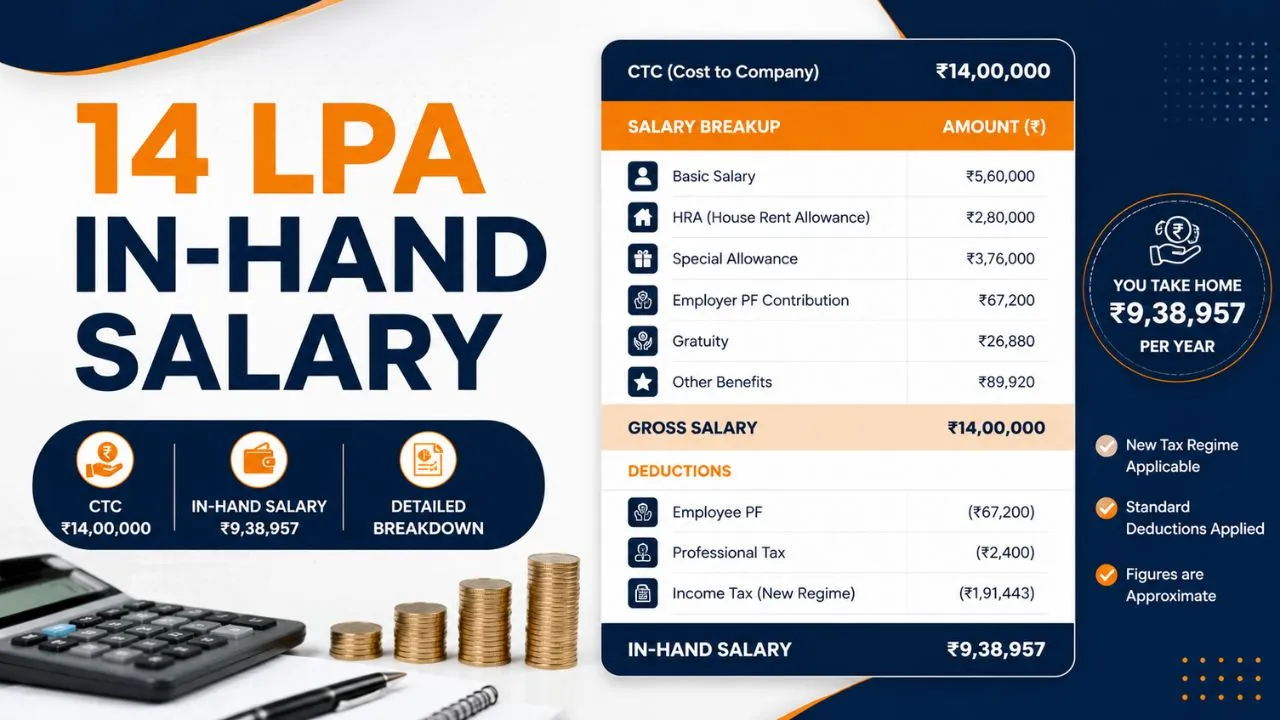
If your annual CTC is ₹14 lakh, your 14 LPA in hand salary per month can be approximately ₹94,000 to ₹1,06,000, depending on your salary structure, provident fund (PF) contributions, income tax and other deductions.
Under a representative salary structure for FY 2026–27, a ₹14 LPA package can provide around ₹1,00,347 per month in hand under the new tax regime. However, this is an estimate rather than a fixed amount applicable to every employee.
A ₹14 lakh annual package equals ₹1,16,667 per month in CTC. The amount credited to your bank account is lower because CTC includes employer contributions, gratuity and other components that may not form part of your monthly cash salary.
14 LPA In Hand Salary Per Month
For an employee earning ₹14 LPA, the monthly take-home salary depends on how the employer structures the compensation package.
- Annual CTC: ₹14,00,000
- Monthly CTC: ₹1,16,667
- Estimated Monthly Gross Cash Salary: ₹1,08,822
- Employee PF Contribution: ₹5,600
- Professional Tax: ₹200
- Estimated Income Tax/TDS: ₹2,675
- Estimated Monthly In-Hand Salary: ₹1,00,347
- Estimated Annual Take-Home Salary: ₹12,04,164
Note: This illustration assumes basic salary at 40% of CTC, employer PF and gratuity included in CTC, and the new tax regime for FY 2026–27. Actual deductions depend on your employer’s payroll structure and applicable rules.
Therefore, the answer to how much 14 LPA pays per month is approximately ₹1 lakh in hand under this example. Employees with higher PF deductions or a different salary structure may receive less.
14 LPA Salary Breakup
A company generally divides a ₹14 lakh CTC package into basic salary, house rent allowance (HRA), special allowance, employer PF and gratuity. These components collectively make up the annual cost of employing you.
Here is an illustrative salary structure for a ₹14 LPA package.
| Salary Component | Annual Amount | Monthly Equivalent |
| Basic salary | ₹5,60,000 | ₹46,667 |
| House Rent Allowance (HRA) | ₹2,80,000 | ₹23,333 |
| Special allowance | ₹4,65,864 | ₹38,822 |
| Employer PF contribution | ₹67,200 | ₹5,600 |
| Gratuity provision | ₹26,936 | ₹2,245 |
| Total CTC | ₹14,00,000 | ₹1,16,667 |
The amounts above are illustrative and rounded to the nearest rupee. Employer PF and gratuity are included in the annual CTC but are not normally paid as monthly cash salary.
Your actual offer letter may have a different basic salary percentage, HRA amount, variable-pay component or employer contribution structure.
14 LPA In Hand Salary After Tax
Income tax is an important factor when calculating the actual take-home salary from a ₹14 lakh package.
For FY 2026–27, the new tax regime has progressive income tax slabs. For eligible resident individuals, the Section 87A rebate applies to qualifying total income up to ₹12 lakh, subject to the applicable conditions. A standard deduction of ₹75,000 is available to salaried employees under the new regime.
For the representative salary structure above, the calculation is approximately as follows.
| Tax Calculation | Annual Amount |
| Annual CTC | ₹14,00,000 |
| Less: Employer PF | ₹67,200 |
| Less: Gratuity provision | ₹26,936 |
| Gross salary before employee deductions | ₹13,05,864 |
| Less: Standard deduction | ₹75,000 |
| Estimated taxable income | ₹12,30,864 |
| Estimated income tax and cess after applicable marginal relief | ₹32,100 |
The tax calculation assumes eligibility for the applicable marginal relief and no additional taxable income or adjustments. The exact amount depends on the final taxable income and applicable tax provisions.
Since the taxable income in this example is only slightly above ₹12 lakh, marginal relief can substantially reduce the tax payable. This is why the estimated TDS is lower than it would be without marginal relief.
For an accurate estimate, check the latest rules on the Income Tax Department website and compare them with your employer’s tax calculation.
Deductions From a 14 LPA Salary
Your monthly salary is reduced by several deductions before it reaches your bank account. Understanding each component helps you compare offers and estimate your actual earnings.
1. Employee Provident Fund (PF)
Employee PF is deducted from your salary and deposited into your provident fund account. The applicable contribution depends on your PF wage base and the employer’s arrangement.
In the example above, employee PF is ₹5,600 per month. Another employer may calculate PF using a different eligible wage base or applicable contribution arrangement, which can change your monthly take-home pay.
Remember that employee PF is a deduction from your salary, while employer PF is a separate contribution that may be included in your CTC.
2. Income Tax and TDS
Tax Deducted at Source (TDS) is the income tax your employer deducts from your salary and deposits with the government.
For a ₹14 LPA package, the TDS amount depends on your taxable salary, chosen tax regime, eligible deductions and other income. The new tax regime is the default regime, but eligible taxpayers may be able to choose the old regime according to the applicable rules.
At this income level, the Section 87A marginal relief rules can also affect the final tax calculation when eligible taxable income is only slightly above ₹12 lakh.
3. Professional Tax
Professional tax is a state-level levy on employment income, where applicable. The amount depends on the state and its rules.
The illustration uses ₹200 per month, or ₹2,400 annually. This should not be treated as a universal deduction because the applicable amount varies by location.
4. Gratuity
Gratuity is an employment benefit calculated according to the applicable rules and eligibility conditions. Employers may include an estimated gratuity provision in CTC.
Although this provision forms part of your compensation package, it is not normally credited to your bank account every month. It is therefore important to distinguish annual CTC from monthly cash earnings.
5. Variable Pay and Performance Bonus
Some employers include performance bonuses, incentives or variable pay in the advertised ₹14 LPA package.
For example, if ₹1.4 lakh of your annual CTC is variable pay, the fixed component would be lower than ₹14 lakh. Your monthly fixed salary would consequently be lower, even if the advertised annual package remains unchanged.
Always check whether the offer specifies fixed CTC, total CTC or target compensation that includes a bonus.
14 LPA In Hand Salary Under the New and Old Tax Regimes
Your tax regime can influence your annual tax liability and monthly take-home salary.
The new tax regime generally offers lower slab rates with fewer exemptions and deductions. The old tax regime may be beneficial for some employees who qualify for substantial deductions and exemptions, such as eligible Section 80C investments and HRA exemptions.
| Factor | New Tax Regime | Old Tax Regime |
| Standard deduction | ₹75,000 for eligible salaried employees | ₹50,000 for eligible salaried employees |
| Section 80C deductions | Generally unavailable | Available subject to applicable limits |
| HRA exemption | Generally unavailable | Available subject to eligibility |
| Section 87A rebate | Available subject to eligibility | Separate rules and lower rebate limits apply |
| Best choice | Depends on taxable income and applicable relief | Depends on eligible exemptions and deductions |
There is no single in-hand salary figure that applies to both regimes. The final result depends on the salary structure and the deductions available to the employee.
If you pay rent, make eligible tax-saving investments or have other qualifying deductions, calculate your tax under both regimes before choosing the one that provides the better outcome.
Why Does 14 LPA In Hand Salary Differ Between Companies?
Two employees with the same ₹14 lakh CTC can receive different monthly salaries. This happens because CTC is the total employment cost, not necessarily the amount paid directly to an employee.
The main reasons include:
- Basic salary structure: A higher basic salary can increase PF deductions when contributions are linked to basic wages.
- Employer PF: The employer’s contribution may be included in CTC, reducing the cash salary available within the package.
- Gratuity: An annual gratuity provision can form part of the advertised CTC.
- Variable pay: A performance bonus may be included in the package but paid separately or only after meeting specific conditions.
- Income tax: TDS depends on taxable income, the tax regime and applicable reliefs.
- Professional tax: The applicable amount varies by state.
- Other deductions: Insurance premiums, meal benefits or other payroll deductions can affect the amount credited to your bank account.
This explains why some salary calculators show monthly take-home pay below ₹1 lakh, while others estimate more than ₹1 lakh for a ₹14 LPA package.
When comparing two offers, focus on the fixed annual cash salary and estimated monthly take-home rather than the CTC figure alone.
Is 14 LPA a Good Salary in India?
A ₹14 LPA package can provide a comfortable income for many professionals in India, particularly when most of the compensation is fixed and monthly expenses are controlled.
With an estimated monthly take-home of around ₹1 lakh, you can budget for rent, food, transportation, insurance, family responsibilities and long-term investments. Your savings potential will depend on your city, housing costs, existing loans and lifestyle.
In cities with higher rents, such as Mumbai or Bengaluru, housing can consume a significant portion of monthly income. In many smaller cities, the same take-home salary may provide greater flexibility for savings and discretionary spending.
A useful starting point is to prepare a monthly budget based on your actual credited salary rather than your annual CTC. Account for essential expenses first, then allocate money to an emergency fund, insurance and investments.
Monthly Budget With a 14 LPA Salary
Assuming a monthly take-home salary of ₹1,00,347, the following is an illustrative budget for a salaried professional.
| Expense Category | Monthly Budget |
| Rent and housing | ₹20,000 |
| Food and groceries | ₹10,000 |
| Transportation | ₹5,000 |
| Utilities and mobile bills | ₹3,000 |
| Insurance and healthcare | ₹3,000 |
| Personal expenses and entertainment | ₹9,000 |
| Family support and miscellaneous costs | ₹10,000 |
| Savings and investments | ₹40,347 |
| Total | ₹1,00,347 |
This budget is only an example. You can adjust the amounts based on your city, family responsibilities and financial goals.
If your rent or family expenses are higher, reduce discretionary spending before cutting essential insurance or emergency savings. If your living expenses are lower, you can direct more money towards investments, debt repayment or a future home purchase.
How to Increase Your Savings on a 14 LPA Salary
A good salary becomes more valuable when you manage it consistently. Consider these steps to improve your financial position.
Build an emergency fund: Aim to save enough to cover several months of essential expenses. Keep this money accessible rather than investing all of it in market-linked products.
Invest regularly: Set up a monthly investment plan that fits your risk tolerance, time horizon and financial goals. Avoid committing to a large investment before accounting for rent, EMIs and other essential expenses.
Review your tax regime: Compare the tax payable under both regimes when you have eligible exemptions or deductions. Use the actual salary breakup rather than a generic online estimate.
Avoid unnecessary debt: High-interest credit card balances and personal loans can reduce the amount available for savings.
Review your salary slip: Check your basic salary, HRA, PF, TDS, variable pay and other deductions. Report discrepancies to your payroll team promptly.
Negotiate fixed pay: When evaluating a new job offer, ask how much of the ₹14 LPA package is fixed, how much is variable and whether employer PF and gratuity are included in CTC.
Final Verdict
The 14 LPA in hand salary per month is not fixed for every employee. Although ₹14 lakh CTC equals ₹1,16,667 per month before deductions and CTC exclusions, the actual amount credited to your bank account may be around ₹94,000 to ₹1,06,000 under common illustrative salary structures. A representative FY 2026–27 calculation gives approximately ₹1,00,347 per month under the new tax regime. Your final take-home depends on basic salary, employer PF, gratuity, variable pay, income tax and professional tax. Before accepting an offer, review the salary breakup and confirm the fixed monthly cash component with the employer.
Frequently Asked Questions
A ₹14 LPA package can provide approximately ₹94,000 to ₹1,06,000 per month in hand under different illustrative salary structures. A representative calculation gives around ₹1,00,347 per month under the new tax regime for FY 2026–27.
₹14 lakh per annum equals approximately ₹1,16,667 per month in CTC. This is not necessarily your take-home salary because CTC can include employer PF, gratuity and variable pay.
Income tax depends on taxable income, the chosen tax regime and applicable reliefs. Under the representative FY 2026–27 example in this article, annual income tax and cess are approximately ₹32,100 after applicable marginal relief. Other salary structures can produce a different tax liability.
Yes, ₹14 LPA can be a good salary for many professionals. Whether it provides a comfortable lifestyle depends on housing costs, city, family responsibilities, loan repayments and savings goals.
Check your offer letter for the annual fixed CTC, basic salary, HRA, employer PF, gratuity and variable pay. Then subtract employee PF, applicable professional tax, income tax and other payroll deductions from your monthly cash salary.
It can, particularly for employees who do not claim substantial deductions under the old regime. However, the better option depends on your eligible exemptions, investments and taxable income. Calculate both regimes using your actual salary structure before deciding.
Explore Our Tools: CTC Calculator | Download Salary Slip | Free Payslip Generator | Salary Slip Format | Salary Tax Calculator

Hi, I’m Kashish Arora, an SEO specialist and finance content researcher passionate about simplifying salary and compensation topics. I create well-researched content on CTC, in-hand salary, salary structure, pay scales, salary slips, tax calculations, EPF, gratuity, bonuses, deductions, and employee benefits.
My articles are based on official government guidelines, employer policies, tax regulations, and other reliable public sources. I aim to explain complex payroll and taxation concepts in simple language so that employees, job seekers, HR professionals, and students can easily understand how salaries are calculated and how deductions affect take-home pay.
Along with payroll and taxation topics, I also cover salary insights for government employees, private-sector professionals, executives, and public personalities whenever reliable information is available.

Leave a Reply