
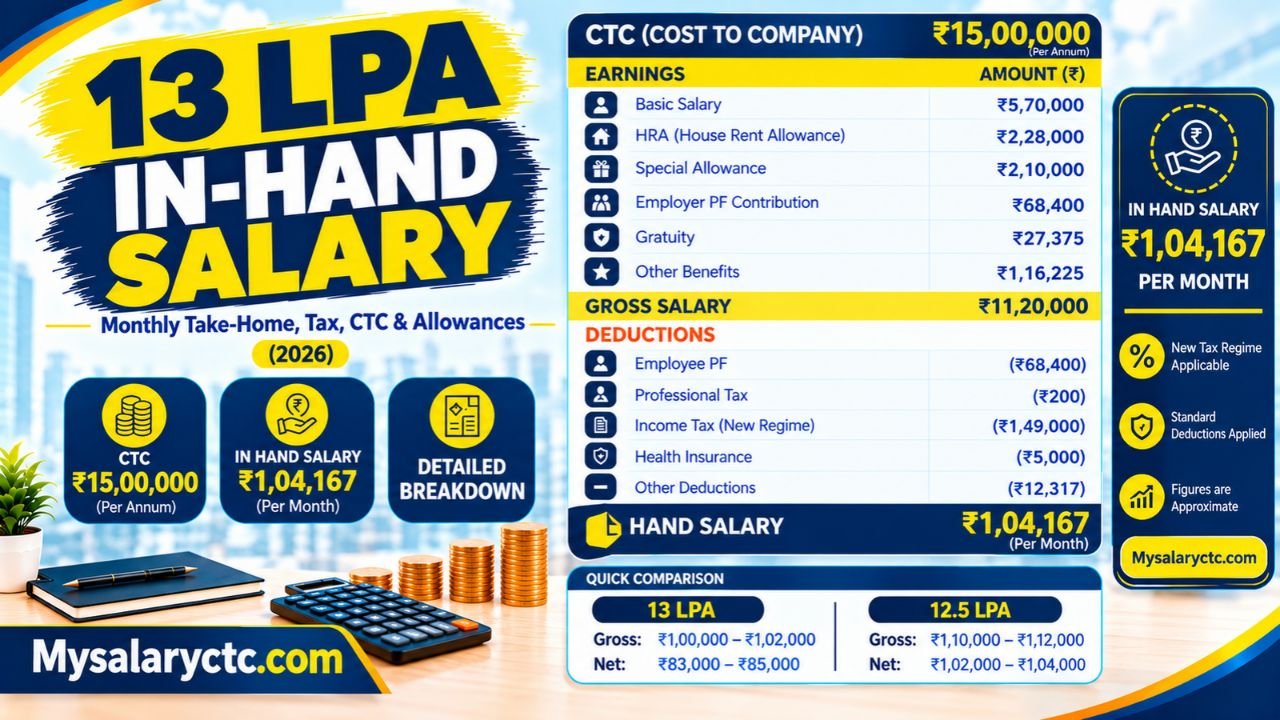

Getting a 13 LPA offer can feel like a major career milestone. But once you start calculating your monthly expenses, one question becomes much more important than the headline CTC:
How much of that ₹13 lakh will actually reach my bank account every month?
If you simply divide ₹13,00,000 by 12, you get approximately ₹1,08,333 per month.
That calculation is correct—but it represents the monthly equivalent of the CTC, not necessarily your take-home salary.
Your actual 13 LPA in hand salary depends on how your employer has designed the compensation package. Employer PF, gratuity, variable pay, insurance, employee PF, professional tax and income-tax treatment can all change the final amount.
Current online salary calculators demonstrate this difference. One current model estimates about ₹96,108/month, another gives approximately ₹95,649/month, while another calculator shows a range around ₹1,01,920–₹1,04,439, depending on assumptions.
That variation is exactly why a good salary guide should not give you one unexplained number.
This guide explains the 13 LPA in hand salary per month, how CTC becomes take-home pay, what PF can deduct, how the current tax regime affects the calculation, and how to read your offer letter before accepting the job.
[Reference Source: Income Tax Department / EPFO / Current Salary Calculator Models]
13 LPA In Hand Salary Per Month: Quick Answer
A package of 13 LPA means:
₹13,00,000 annual CTC
Dividing it by 12:
₹13,00,000 ÷ 12 = ₹1,08,333 per month
But this ₹1,08,333 should not automatically be treated as your monthly bank credit.
Current published models provide several different estimates:
| Salary measure | Approximate amount |
| Annual CTC | ₹13,00,000 |
| Monthly CTC equivalent | ₹1,08,333 |
| Example take-home model | ₹95,649–₹96,108 |
| Other calculator range | ₹1,01,920–₹1,04,439 |
| Actual salary | Depends on offer structure |
[Reference Source: Current salary calculator models]
For example, one current salary model assumes basic salary at 45%, employee EPF at 12% of basic, professional tax and a particular new-regime tax calculation and estimates ₹96,108 monthly take-home.
Another model assumes basic salary at 40% and estimates ₹95,649/month under its stated assumptions.
Meanwhile, GreyHR currently presents a broader ₹1,01,920–₹1,04,439 range for a ₹13 lakh CTC, demonstrating that the salary structure itself can materially change the answer.
The practical answer
For planning purposes, an employee with a 13 LPA CTC may see roughly ₹95,000–₹1,04,000+ per month in take-home pay under commonly modelled structures, but your actual payslip can be outside this range.
[Reference Source: Salary calculator comparison; illustrative only]
What Does 13 LPA Actually Mean?
The abbreviation LPA means Lakhs Per Annum.
Therefore:
13 LPA = ₹13 lakh per year = ₹13,00,000 annually
But when a company says:
“Your CTC is ₹13 LPA.”
it is not necessarily saying:
“We will deposit ₹1,08,333 into your bank account every month.”
CTC stands for Cost to Company. Depending on the employer, the figure may include components that are not paid to you as regular monthly cash.
A typical package can contain:
- Basic salary
- HRA
- Special allowance
- Employer PF
- Gratuity
- Performance bonus
- Variable pay
- Insurance
- Other employer-paid benefits
Your payslip, meanwhile, focuses on the compensation actually processed through payroll.
This creates three numbers that should never be confused:
CTC
The overall annual employment-cost figure.
Gross Salary
The salary amount before employee-side deductions.
In-Hand Salary
The amount left after applicable deductions and credited to your bank account.
A simple way to visualize the process is:
₹13 LPA CTC
↓
Remove/identify employer-side CTC components
↓
Gross salary
↓
Subtract employee deductions
↓
Monthly take-home
[Reference Source: Employer compensation structure / EPFO / Income Tax Department]
Why ₹1,08,333 Is Not Automatically Your Salary
Suppose your company offers:
₹13,00,000 CTC
and includes:
- Employer PF
- Gratuity
- Insurance
- Annual performance pay
inside that amount.
Those components can consume part of the CTC without becoming regular monthly cash.
For example, a company could have ₹13 lakh CTC but only around ₹12 lakh as salary-related gross compensation after employer-side components.
That would immediately reduce the monthly gross below ₹1,08,333.
Then employee PF and other deductions can reduce the bank credit again.
This is why the question:
“13 LPA means how much salary per month?”
does not have a single answer without knowing the compensation structure.
Understanding a 13 LPA Salary Structure
There is no universal salary breakup used by every Indian employer.
To understand the mechanics, consider an illustrative structure:
| Component | Example annual amount |
| Basic salary | ₹5,20,000 |
| HRA | ₹2,60,000 |
| Special allowance | ₹4,02,600 |
| Employer PF | ₹62,400 |
| Gratuity/other CTC component | ₹55,000 |
| Total CTC | ₹13,00,000 |
This is an illustrative structure, not a prescribed salary format.
Another employer could give you:
- Higher basic pay
- Lower HRA
- More special allowance
- Larger variable pay
- No gratuity inside CTC
- Different PF treatment
- Employer NPS contribution
That is why two employees can both have a 13 LPA package but receive different amounts every month.
[Reference Source: Employer-specific compensation structure]
The Most Important Number: Fixed Pay
When comparing job offers, fixed compensation deserves more attention than the headline CTC.
Imagine two companies offer the following:
Company A
13 LPA CTC
- Fixed: ₹12 lakh
- Variable: ₹1 lakh
Company B
13 LPA CTC
- Fixed: ₹10 lakh
- Variable: ₹3 lakh
Both companies can advertise:
13 LPA package
But they are not equivalent from a monthly cash-flow perspective.
Company B is asking you to rely more heavily on performance-linked compensation.
Before accepting the offer, ask:
“What percentage of the 13 LPA is fixed?”
Then ask:
“How much variable compensation was actually paid to employees last year?”
That second question can reveal more than the advertised CTC.
[Reference Source: Employer compensation documentation]
Read More: 11.5 LPA In Hand Salary in India 2026: Monthly Take-Home, CTC, PF, Tax & Salary Breakdown
How to Calculate 13 LPA In Hand Salary Step by Step
Let’s build the calculation logically.
Step 1: Start With Annual CTC
Annual package:
₹13,00,000
Monthly CTC equivalent:
₹1,08,333
This is simply the annual package divided by 12.
Step 2: Identify Amounts Inside CTC That Are Not Monthly Cash
Check the compensation sheet for:
- Employer PF
- Gratuity
- Insurance
- Variable bonus
- Retention bonus
- Employer NPS contribution
- Other benefits
For example, if ₹80,000 of your CTC represents employer-side contributions and benefits, your regular salary pool would not be the full ₹13 lakh.
The exact amount depends on the offer.
[Reference Source: Employer offer letter]
Step 3: Calculate Gross Salary
Suppose your annual gross salary after CTC-side components is approximately:
₹12,37,600
Then:
₹12,37,600 ÷ 12 ≈ ₹1,03,133
That is your approximate monthly gross before employee-side deductions.
One current calculator uses a similar structure and reports gross salary around ₹12,37,600 annually for a ₹13 lakh CTC.
Step 4: Deduct Employee PF
If employee PF is calculated at 12% of a basic salary of ₹43,333 per month:
₹43,333 × 12% ≈ ₹5,200
Annual employee PF:
₹5,200 × 12 = ₹62,400
EPFO’s published contribution framework lists the employee contribution rate as 12% of applicable wages, with specific rules around the wage base and higher-wage contributions.
Therefore, you should never assume that PF is automatically 12% of your entire CTC.
PF on a 13 LPA Salary: What You Should Know
Provident Fund can be confusing because salary packages often contain two PF figures:
Employee PF
This is deducted from your salary and reduces your monthly cash in hand.
Employer PF
This is the employer’s contribution and may be included within your CTC.
The two figures can therefore affect your salary in different ways.
Suppose your basic salary is:
₹43,333/month
At an illustrative 12% employee contribution:
₹43,333 × 12% = ₹5,200/month
Your annual employee contribution would be:
₹62,400
A current 13 LPA salary model uses exactly this type of assumption.
But PF treatment can differ depending on the employee’s circumstances and the employer’s arrangement.
EPFO’s current portal also references a recent revision of the EPF wage ceiling, so older articles that blindly apply an old ceiling should be treated carefully.
Practical rule
Do not calculate your PF from CTC alone.
Look at the PF wage/basic component mentioned in your offer letter or payroll documentation.
[Reference Source: EPFO]
Income Tax on 13 LPA: What Changes in 2026?
Tax treatment is one of the biggest reasons older salary articles can become outdated.
For the 2026–27 tax year, the new-regime slabs are:
| Taxable income | New-regime rate |
| Up to ₹4 lakh | Nil |
| ₹4–8 lakh | 5% |
| ₹8–12 lakh | 10% |
| ₹12–16 lakh | 15% |
| ₹16–20 lakh | 20% |
| ₹20–24 lakh | 25% |
| Above ₹24 lakh | 30% |
[Reference Source: Ministry of Finance, Union Budget 2026–27]
For eligible resident individuals, the Section 87A rebate can provide up to ₹60,000 when taxable income does not exceed ₹12 lakh under the new regime. [Reference Source: Income Tax Department / Finance Act 2025]
This is important for a 13 LPA salary.
Why?
Because CTC and taxable income are not necessarily identical.
Employer PF, certain CTC components and the standard deduction can mean that the taxable salary is below the headline ₹13 lakh.
The new-regime standard deduction for salaried taxpayers was increased to ₹75,000. [Reference Source: Union Budget / Income Tax Department]
As a result, several current 13 LPA salary calculators model zero income tax under the new regime for their assumed salary structures. For example, SalaryInHand reports ₹0 income tax under its model, and CTCInHand similarly reports ₹0 under its assumptions.
But don’t misunderstand this.
It does not mean:
“Everyone earning 13 LPA pays zero tax.”
Your actual tax depends on taxable income and the applicable rules.
Other income, bonuses, capital gains and other taxable receipts can change the result.
So the correct E-E-A-T-friendly statement is:
A 13 LPA salary may result in zero income tax under certain new-regime salary structures, but the employee’s actual taxable income must be calculated before concluding that no tax is payable.
[Reference Source: Income Tax Department]
New Regime vs Old Regime for a 13 LPA Employee
The new tax regime is the default regime for eligible taxpayers, although eligible individuals can opt for the old regime under the applicable rules.
For someone earning 13 LPA, the new regime may be attractive because the current rebate threshold can cover taxable income up to ₹12 lakh for eligible resident individuals.
The old regime can become more relevant when the employee has substantial eligible deductions and exemptions.
Potential old-regime considerations can include:
- HRA exemption
- Eligible 80C investments
- Health-insurance deduction
- Home-loan interest
- Other permitted deductions
[Reference Source: Income Tax Department]
The mistake is choosing a regime just because someone online says:
“New regime is always better.”
Your circumstances determine the better result.
Why 13 LPA Salary Calculators Show Different Results
Search for “13 LPA in hand salary” and you will quickly notice something unusual.
The answers don’t match.
Current results include approximately:
- ₹96,108/month — In-Hand model
- ₹95,649/month — MoneyRadar model
- ₹92,528/month — another SalaryInHand model
- ₹97,733/month — CTCInHand model
- ₹1,01,920–₹1,04,439/month — GreyHR range
This is not necessarily a sign that the calculators are unreliable.
They are answering slightly different hypothetical questions.
The assumptions can change:
Basic salary percentage
40% basic and 50% basic can produce different PF deductions.
Employer PF
If employer PF is part of CTC, less of the CTC becomes gross salary.
Gratuity
Including gratuity in CTC changes the cash component.
Variable pay
Annual performance pay does not necessarily appear in monthly salary.
Professional tax
The applicable state and payroll rules matter.
Tax regime
Old and new regimes can produce significantly different results.
This is why a salary calculator should be used as an estimator, not as your official payslip.
13 LPA In Hand Salary: Three Practical Scenarios
Instead of pretending there is one exact answer, consider three common structures.
Scenario A: Mostly Fixed Salary
Suppose:
- CTC = ₹13 lakh
- Fixed component is high
- Variable pay is small
- PF is deducted on the relevant basic salary
- New tax regime applies
Your take-home could be toward the higher end of the commonly published estimates.
Scenario B: Employer PF + Gratuity Included
Now suppose:
- Employer PF is inside CTC
- Gratuity is also inside CTC
- Basic is around 40–50%
- Employee PF is deducted monthly
- Variable pay is limited
Your monthly take-home could move toward the mid-₹90,000 range under current calculator assumptions.
For example, one current model estimates ₹95,649/month under a 40%-basic structure.
Scenario C: Higher Cash Component
Suppose:
- Employer PF is structured differently
- Gratuity is excluded or treated separately
- Variable pay is low
- Basic/PF arrangement produces lower employee-side deductions
The monthly bank credit could move closer to ₹1 lakh or above.
GreyHR’s current calculator range for a ₹13 lakh CTC is approximately ₹1,01,920–₹1,04,439, illustrating how different assumptions can move the result.
Real-World Example: Two Employees With 13 LPA
Imagine two professionals receive offers from different companies.
Employee A
CTC: ₹13 lakh
- Fixed: ₹12 lakh
- Variable: ₹1 lakh
- Employer PF included
- Moderate basic salary
- Standard benefits
Employee B
CTC: ₹13 lakh
- Fixed: ₹10 lakh
- Variable: ₹3 lakh
- Higher basic salary
- Employer PF included
- Gratuity included
Both can truthfully say:
“I have a 13 LPA package.”
But their monthly experience can be very different.
Employee A has more predictable monthly cash flow.
Employee B may receive a lower recurring salary but potentially a larger annual performance payout.
This is why experienced job seekers compare the fixed-versus-variable composition before comparing CTC numbers.
[Reference Source: Employer compensation structure]
What Does a 13 LPA Salary Look Like in Your Monthly Budget?
Suppose your take-home works out to approximately ₹96,000 per month.
A hypothetical budget could be:
| Expense | Illustrative monthly amount |
| Rent | ₹22,000 |
| Groceries & food | ₹9,000 |
| Transport | ₹5,000 |
| Utilities/mobile | ₹3,000 |
| Personal expenses | ₹5,000 |
| Family support | ₹10,000 |
| Investments | ₹20,000 |
| Emergency savings | ₹7,000 |
| Entertainment/shopping | ₹5,000 |
| Remaining buffer | ₹10,000 |
This is not financial advice or a recommended fixed budget.
Your actual spending depends on your city, rent, family responsibilities, loans and lifestyle.
But there is a useful lesson here:
Budget from your take-home salary, not your CTC.
If you plan your expenses around ₹1,08,333 simply because your offer says 13 LPA, you may end up spending money that never actually reaches your account.
Is 13 LPA a Good Salary in India?
There is no universal answer because “good salary” depends heavily on location and personal circumstances.
A person living with family and paying little rent can have very different disposable income from someone renting a premium apartment in a major metro.
Likewise, an employee with:
- No loans
- Low family obligations
- Employer health insurance
- Low housing expenses
may save substantially more than someone earning the same CTC with a large EMI.
Therefore, instead of asking only:
“Is 13 LPA good?”
ask:
“How much can I save from my 13 LPA take-home?”
That is a much more meaningful financial question.
[Reference Source: Personal budgeting framework; individual circumstances]
How to Read a 13 LPA Offer Letter
Before accepting the job, look for these numbers.
1. Total CTC
Confirm that it is actually ₹13 lakh.
2. Fixed CTC
Find out how much is guaranteed.
3. Variable Pay
Check whether it is performance-linked.
4. Basic Salary
This can influence PF and other salary calculations.
5. Employer PF
Check whether it is included in CTC.
6. Employee PF
Ask how much will be deducted every month.
7. Gratuity
Find out whether it is part of CTC.
8. Insurance
Check whether insurance premiums are included.
9. Monthly Gross
This is more useful for estimating regular bank credit.
10. Expected Net Salary
Ask payroll/HR for the approximate monthly take-home.
A simple question to HR can be:
“Could you please share the detailed compensation breakup, including fixed CTC, variable pay, monthly gross, employee PF, employer PF, gratuity and estimated monthly in-hand salary?”
That gives you much more information than the phrase “13 LPA package.”
Read More: 12.5 LPA In Hand Salary in India 2026: Monthly Take-Home, CTC, PF, Tax & Salary Breakdown
Common Mistakes When Calculating 13 LPA In Hand Salary
Mistake 1: Dividing ₹13 lakh by 12 and calling it take-home
₹1,08,333 is the monthly CTC equivalent.
Mistake 2: Assuming PF is 12% of CTC
PF generally relates to applicable PF wages/basic salary, not simply total CTC. [Reference Source: EPFO]
Mistake 3: Ignoring employer contributions
Employer PF can be part of CTC without becoming monthly spendable income.
Mistake 4: Forgetting variable pay
A ₹2 lakh annual bonus is not the same as ₹2 lakh of guaranteed fixed salary.
Mistake 5: Using an outdated tax article
Tax rules can change. Use the rules applicable to the relevant tax year.
Mistake 6: Treating an online calculator as an official salary statement
A calculator provides an estimate based on assumptions.
Your offer letter and payslip provide the actual numbers.
How to Calculate Your Own 13 LPA Take-Home Salary
If you want the closest possible estimate, collect these figures from your offer letter:
- Total CTC
- Fixed CTC
- Variable CTC
- Basic salary
- HRA
- Employer PF
- Employee PF
- Gratuity
- Insurance
- Professional tax
- Expected TDS
- Other deductions
Then follow this workflow:
Total CTC
↓
Identify employer-side CTC components
↓
Calculate gross salary
↓
Divide gross salary by 12
↓
Subtract employee PF
↓
Subtract professional tax
↓
Subtract applicable TDS
↓
Estimated monthly in-hand salary
This is a much better approach than searching for a single generic number.
Future of Salary Structures in India
Salary packages are increasingly being evaluated not just by their headline CTC but by fixed compensation, variable pay, benefits and actual take-home value.
Employees are also becoming more aware of the difference between an attractive offer letter and a strong monthly cash flow.
For 2026 and beyond, salary comparison should therefore move toward a complete compensation view:
CTC + fixed pay + variable pay + benefits + monthly net salary
Tax rules and payroll rules can change, so salary articles should be updated regularly rather than relying on old salary calculators. [Reference Source: Ministry of Finance / Income Tax Department / EPFO]
The most useful salary calculator of the future will not simply ask:
“What is your CTC?”
It will ask:
“What exactly is inside your CTC?”
Frequently Asked Questions About 13 LPA In Hand Salary
There is no single fixed figure. Current calculators show different estimates depending on salary assumptions. Examples range from approximately ₹95,000 to ₹1.04 lakh per month.
₹13,00,000 divided by 12 equals approximately:
₹1,08,333 per month.
This is the monthly CTC equivalent, not necessarily the bank-credit amount.
It can be a strong compensation package, but whether it is “good” depends on your city, experience, housing costs, loans, family responsibilities and the fixed/variable composition of the offer.
There is no universal deduction. Under the standard EPFO framework, the employee contribution is generally 12% of applicable wages, subject to the applicable rules and contribution arrangement.
It can, depending on taxable income and the applicable tax regime. Under the current new-regime framework, eligible resident individuals can receive a Section 87A rebate up to ₹60,000 when taxable income does not exceed ₹12 lakh.
Because they use different assumptions for basic salary, PF, gratuity, employer contributions, variable pay, professional tax and tax treatment.
Not necessarily. ₹1,08,333 is simply ₹13 lakh divided by 12. Your monthly bank credit depends on the actual salary structure.
CTC can include employer PF, gratuity, variable compensation and benefits. A 13 LPA fixed salary indicates a much larger portion of the package is recurring compensation.
Ask for fixed CTC, variable pay, basic salary, monthly gross, employee PF, employer PF, gratuity, insurance, expected TDS and estimated monthly in-hand salary.
Conclusion: What Is the Real 13 LPA In Hand Salary?
A 13 LPA package equals ₹13,00,000 annually, which works out to approximately ₹1,08,333 per month when divided by 12.
But that does not mean ₹1,08,333 will automatically reach your bank account.
Current salary calculators produce different estimates because they use different assumptions. Some current models put the take-home around ₹95,000–₹97,000, while others show figures above ₹1 lakh.
The most accurate way to understand your 13 LPA in hand salary per month is to examine:
CTC → Fixed Pay → Basic Salary → Employer PF → Gratuity → Variable Pay → Employee PF → Tax → Professional Tax → Final Bank Credit
So, before accepting a 13 LPA offer, don’t ask only:
“What is the CTC?”
Ask:
“What is my fixed monthly gross salary, what deductions will apply, and approximately how much will be credited to my bank every month?”
That is the number that should drive your monthly budget, savings plan and job-offer comparison.
Read Our Tools: CTC Calculator | Download Salary Slip | Salary Tax Calculator

Hi, I’m Kashish Arora, an SEO specialist and finance content researcher passionate about simplifying salary and compensation topics. I create well-researched content on CTC, in-hand salary, salary structure, pay scales, salary slips, tax calculations, EPF, gratuity, bonuses, deductions, and employee benefits.
My articles are based on official government guidelines, employer policies, tax regulations, and other reliable public sources. I aim to explain complex payroll and taxation concepts in simple language so that employees, job seekers, HR professionals, and students can easily understand how salaries are calculated and how deductions affect take-home pay.
Along with payroll and taxation topics, I also cover salary insights for government employees, private-sector professionals, executives, and public personalities whenever reliable information is available.


Leave a Reply