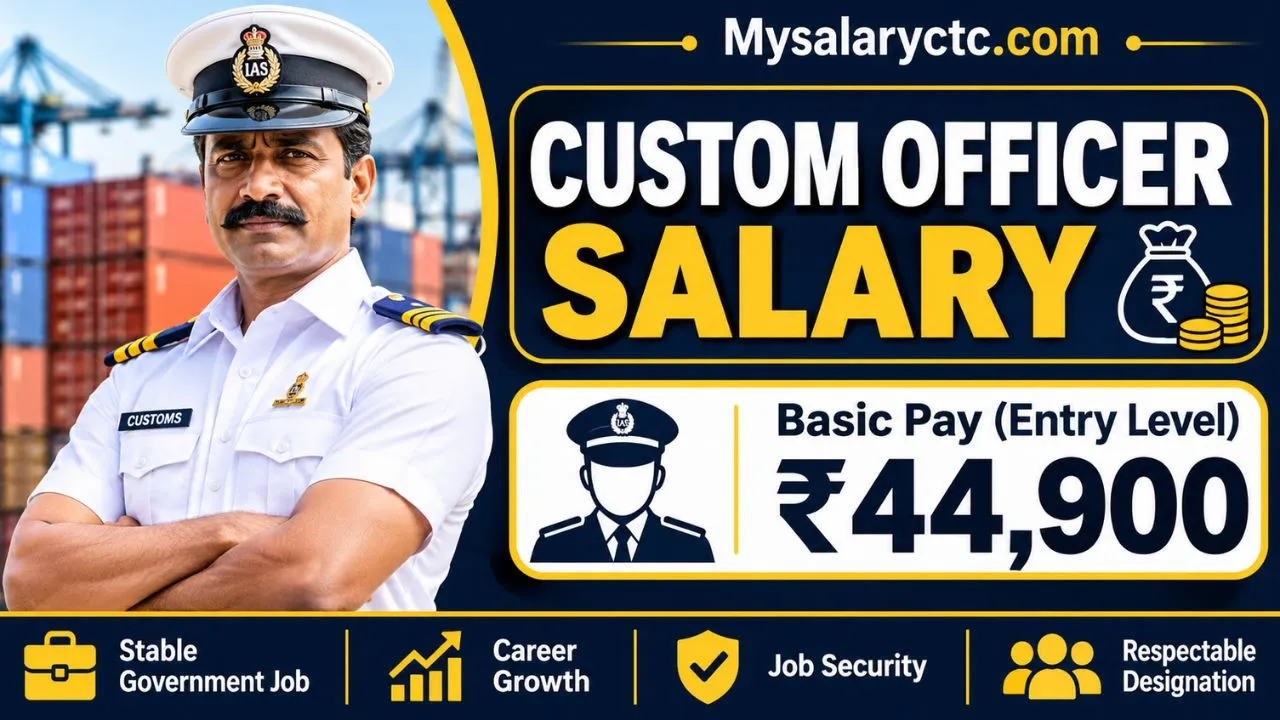

The custom officer salary in India is an important consideration for candidates preparing for the Staff Selection Commission Combined Graduate Level (SSC CGL) examination. A Customs Officer working under the Central Board of Indirect Taxes and Customs (CBIC) receives a competitive government salary, along with allowances, medical facilities, pension benefits and opportunities for career advancement.
The starting basic salary of an Inspector (Central Excise), Inspector (Preventive Officer) or Inspector (Examiner) is ₹44,900 per month under Pay Level 7 of the 7th Central Pay Commission (CPC). Depending on the city of posting, applicable allowances and deductions, the estimated starting in-hand salary can be approximately ₹55,000 to ₹85,000 per month.
However, the actual custom officer salary per month varies according to designation, seniority, posting location and prevailing government allowance rates. This article explains the salary structure, pay levels, allowances, deductions, promotion opportunities and other financial benefits available to Customs Officers in India.
Custom Officer Salary Structure Under the 7th Pay Commission
The salary of a Customs Officer is determined by the pay level assigned to the particular designation. Candidates selected through SSC CGL for Inspector-level positions in CBIC generally enter at Pay Level 7.
The starting basic pay is ₹44,900, while the maximum basic pay within this level is ₹1,42,400. The salary increases through annual increments, promotions and applicable revisions in government allowances.
| Designation | Pay Level | Starting Basic Pay |
| Tax Assistant | Level 4 | ₹25,500 |
| Executive Assistant (CBIC) | Level 6 | ₹35,400 |
| Inspector (Central Excise) | Level 7 | ₹44,900 |
| Inspector (Preventive Officer) | Level 7 | ₹44,900 |
| Inspector (Examiner) | Level 7 | ₹44,900 |
| Superintendent | Level 8 | ₹47,600 |
| Assistant Commissioner | Level 10 | ₹56,100 |
| Deputy Commissioner | Level 11 | ₹67,700 |
| Joint Commissioner | Level 12 | ₹78,800 |
| Additional Commissioner | Level 13 | ₹1,23,100 |
| Commissioner | Level 14 | ₹1,44,200 |
It is important to understand that Tax Assistant and Executive Assistant are separate recruitment positions, not necessarily the first stages of an Inspector’s promotion ladder. Similarly, actual promotional designations and pay levels depend on the applicable cadre rules.
Custom Officer Salary Per Month: In-Hand Salary Breakdown
The custom officer salary per month consists of basic pay and several allowances. The final amount credited to an employee’s bank account is lower than the gross salary because of deductions.
For a newly appointed Inspector with a starting basic pay of ₹44,900, the estimated monthly salary components are:
| Salary Component | Estimated Monthly Amount |
| Basic Pay | ₹44,900 |
| Dearness Allowance (DA – 63%) | ₹28,287 |
| House Rent Allowance (HRA – 10%–30%) | ₹4,490–₹13,470 |
| Transport Allowance (TA, including DA) | ₹2,934–₹5,868 |
| Gross Salary | ₹80,611–₹92,525 |
| NPS Contribution | ₹7,319 |
| Income Tax | Depends on taxable income and tax regime |
| Other Deductions (CGHS, CGEGIS, etc.) | Depends on applicable rates and eligibility |
| Estimated In-Hand Salary | ₹73,292–₹85,206 before income tax and other variable deductions |
These estimates use a DA rate of 63% and the applicable HRA and transport allowance rates. The actual in-hand amount may vary depending on the posting city, government accommodation, tax regime and other deductions.
City-Wise Custom Officer Salary in India
For a Customs Inspector at Pay Level 7 with a starting basic pay of ₹44,900, the table below compares estimated monthly gross and in-hand salary across X, Y and Z category cities.
The estimates include 63% DA, the applicable HRA rate and transport allowance. The in-hand estimate deducts the employee’s assumed NPS contribution of 10% of basic pay plus DA. Income tax and other variable deductions are shown separately because they depend on individual circumstances.
| Salary Component | X Category Cities | Y Category Cities | Z Category Cities |
| Basic Pay | ₹44,900 | ₹44,900 | ₹44,900 |
| Dearness Allowance (63%) | ₹28,287 | ₹28,287 | ₹28,287 |
| House Rent Allowance (HRA) | ₹13,470 (30%) | ₹8,980 (20%) | ₹4,490 (10%) |
| Transport Allowance (including DA) | ₹5,868 | ₹2,934–₹5,868 | ₹2,934 |
| Estimated Gross Salary | ₹92,525 | ₹85,101–₹88,035 | ₹80,611 |
| NPS Contribution (10% of Basic + DA) | ₹7,319 | ₹7,319 | ₹7,319 |
| Estimated In-Hand Salary | ₹85,206 | ₹77,782–₹80,716 | ₹73,292 |
Figures are monthly estimates for a newly appointed Level 7 Inspector, using the 63% DA rate effective from 1 July 2026. HRA rates are based on the 7th CPC structure after DA crossed 50%.
Important points:
- X category cities receive 30% HRA and are generally in the higher transport allowance category.
- Y category cities receive 20% HRA. Transport allowance can vary because some Y cities qualify for the higher rate while others do not.
- Z category cities receive 10% HRA and generally fall under the lower transport allowance category.
- In-hand salary figures above are after the estimated employee NPS contribution but before income tax, CGHS, CGEGIS and other applicable deductions. Actual bank credit will therefore be lower.
- HRA may not be payable if government accommodation is provided.
The DA rate is based on the latest applicable government order, while HRA rates follow the Department of Expenditure’s 7th CPC rules.
Allowances and Benefits for Customs Officers
Apart from basic pay, Customs Officers receive several allowances and employment benefits under Central Government service rules. For a newly appointed Customs Inspector at Pay Level 7 with a basic salary of ₹44,900, the major allowances can be estimated as follows.
1. Dearness Allowance (DA): DA compensates employees for inflation and rising living costs. At the rate of 63% of basic pay, a Customs Inspector receives approximately ₹28,287 per month. The government revises this allowance periodically.
2. House Rent Allowance (HRA): Employees who are eligible and are not provided government accommodation receive HRA according to their city classification.
| City Classification | HRA Rate | Monthly Amount |
| X Category | 30% | ₹13,470 |
| Y Category | 20% | ₹8,980 |
| Z Category | 10% | ₹4,490 |
3. Transport Allowance (TA): This allowance helps officers manage commuting expenses. For Pay Level 7, the estimated monthly amounts, including DA at 63%, are:
| Posting Category | Basic TA | TA Including DA |
| Higher-rate cities | ₹3,600 | ₹5,868 |
| Other eligible locations | ₹1,800 | ₹2,934 |
4. Medical Facilities: Employees can access healthcare benefits through CGHS or other applicable medical arrangements. Under CGHS, the monthly contribution for Pay Levels 7–11 is generally ₹650. The applicable contribution depends on the employee’s pay level and coverage.
5. Pension and Retirement Benefits: Employees covered under the National Pension System (NPS) contribute 10% of basic pay plus DA, with the government generally contributing 14%. For an Inspector receiving ₹44,900 basic pay and ₹28,287 DA, the estimated monthly contributions are:
- Employee contribution: ₹7,319
- Government contribution: ₹10,246
The applicable retirement framework depends on the employee’s appointment date and service rules.
6. Leave and Travel Benefits: Customs Officers receive paid leave and Leave Travel Concession (LTC) under Central Government rules. Eligible employees generally receive 30 days of Earned Leave and 20 days of Half Pay Leave annually, along with applicable Casual Leave and other leave entitlements. LTC benefits depend on the prescribed block period and travel eligibility.
7. Government Accommodation: Eligible officers can apply for government residential accommodation through the applicable allotment system. No fixed cash amount is provided as this benefit depends on the accommodation type, city, availability and applicable licence fee. Officers occupying government accommodation generally do not receive HRA.
These allowances and benefits increase the overall value of the employment package beyond monthly basic pay. Actual entitlements may vary according to posting location, service conditions and government orders.
Custom Officer Salary After Promotion
A Customs Inspector can progress to higher positions through departmental promotions, subject to seniority, vacancies, service requirements and applicable recruitment rules.
The career progression generally includes the following positions:
| Designation / Rank | Pay Level | Starting Basic Pay |
| Inspector | Level 7 | ₹44,900 |
| Superintendent | Level 8 | ₹47,600 |
| Assistant Commissioner | Level 10 | ₹56,100 |
| Deputy Commissioner | Level 11 | ₹67,700 |
| Joint Commissioner | Level 12 | ₹78,800 |
| Additional Commissioner | Level 13 | ₹1,23,100 |
| Commissioner | Level 14 | ₹1,44,200 |
Note: The figures represent the starting basic pay under the 7th Central Pay Commission (CPC), excluding applicable allowances and deductions.
Job Roles and Responsibilities of a Customs Officer
Customs Officers work under the Central Board of Indirect Taxes and Customs (CBIC), which functions under the Ministry of Finance. Their roles vary by designation, department, and place of posting. Their primary responsibilities include regulating international trade, protecting government revenue, preventing smuggling and enforcing customs laws.
| Job Role | Key Responsibilities |
| Customs Inspector (Central Excise) | Monitors compliance with indirect tax regulations, conducts inspections, verifies records and assists in revenue enforcement. |
| Preventive Officer | Works at airports, seaports and coastal areas to prevent smuggling, detect prohibited goods and monitor the illegal movement of gold, narcotics, foreign currency and restricted items. |
| Examiner | Examines imported and exported consignments, verifies cargo declarations and shipping documents, and identifies misdeclaration or prohibited goods. |
| Superintendent | Supervises inspectors and departmental staff, oversees customs operations, monitors duty assessment and ensures proper implementation of departmental procedures. |
| Appraising Officer | Assesses the value and classification of imported goods, determines applicable customs duties and scrutinises import documents to ensure accurate duty collection. |
| Intelligence and Investigation Officer | Gathers intelligence, investigates suspected customs violations, identifies smuggling networks, conducts authorised searches and assists in enforcement operations. |
| Airport and Seaport Operations | Monitors passenger baggage, examines cargo shipments, checks customs declarations and ensures compliance with applicable regulations. |
| Trade Compliance and Revenue Protection | Ensures that importers and exporters follow customs procedures, assesses applicable duties and safeguards government revenue against illegal trade. |
Customs Officers could be posted at international airports, major seaports, land customs stations, inland container depots, coastal areas and departmental offices. Their daily responsibilities, working conditions and field exposure depend on their designation, department and posting location.
How to Become a Customs Officer in India?
The most common way to become a Customs Officer in India is through the Staff Selection Commission Combined Graduate Level (SSC CGL) examination. SSC recruits candidates for Inspector-level posts in the Central Board of Indirect Taxes and Customs (CBIC), including Inspector (Central Excise), Preventive Officer and Examiner.
Candidates must meet the following eligibility requirements:
1. Educational Qualification: A bachelor’s degree from a recognised university is mandatory. Graduates from any stream can apply.
2. Age Limit: The general age limit for these Inspector posts is 18–30 years. Age relaxation is available for reserved categories:
| Category | Age Relaxation |
| OBC | 3 years |
| SC/ST | 5 years |
| PwBD (General) | 10 years |
| PwBD (OBC) | 13 years |
| PwBD (SC/ST) | 15 years |
3. Selection Process: Candidates must clear both stages of the SSC CGL examination:
- Tier 1: Tests General Intelligence, General Awareness, Quantitative Aptitude and English.
- Tier 2: Covers Mathematical Abilities, Reasoning, English, General Awareness, Computer Knowledge and Data Entry Speed Test.
Final selection depends on merit, category, vacancies and post preferences, followed by document verification.
4. Physical Standards: Inspector (Central Excise), Preventive Officer and Examiner posts have prescribed physical requirements. Generally, male candidates must meet a minimum height of 157.5 cm and female candidates 152 cm. Certain posts also require physical tests, including walking and cycling.
5. Final Appointment: Selected candidates undergo document verification, medical assessment and other applicable departmental formalities before receiving their appointment.
Candidates should check the latest SSC CGL notification for updated eligibility conditions, physical standards, vacancies and application dates.
Conclusion
The custom officer salary in India makes this position an attractive career option for graduates seeking a stable Central Government job. With a starting basic pay of ₹44,900, additional allowances, medical benefits and opportunities for promotion, a Customs Inspector enjoys a competitive compensation package. The opportunity to progress to senior positions in CBIC further strengthens its career prospects, making it a desirable choice for SSC CGL aspirants.
FAQs
1. What is the starting custom officer salary in India?
The starting basic pay of a Customs Inspector recruited through SSC CGL is ₹44,900 per month under Pay Level 7. The estimated in-hand salary generally varies according to the posting city, allowances and deductions.
2. What is the custom officer salary per month?
A newly appointed Customs Inspector can expect an approximate in-hand salary of ₹55,000–₹85,000 per month, depending on applicable allowances, location and deductions. The actual amount may differ.
3. What is the basic salary of a Customs Inspector?
The starting basic salary is ₹44,900 under Level 7 of the 7th CPC pay matrix. The pay scale extends up to ₹1,42,400.
4. Does a Customs Officer receive HRA and DA?
Yes. Eligible Customs Officers receive Dearness Allowance and House Rent Allowance, along with Transport Allowance and other admissible benefits under Central Government rules.
5. What is the highest salary of a Customs Officer?
A Commissioner in the CBIC hierarchy is associated with Pay Level 14, which has a starting basic pay of ₹1,44,200 and a maximum of ₹2,18,200. Senior officers can receive additional allowances depending on their eligibility.
6. How can I become a Customs Inspector?
Candidates can qualify for an Inspector position in CBIC by clearing the SSC CGL examination, meeting the educational and age requirements, and completing the applicable selection and appointment formalities.
Read Also: Agniveer Salary | Data Scientist Salary | GST Inspector Salary | Train Manager Salary | IPS Officer Salary | SRPF Salary | AIIMS Nursing Officer Salary

Hi, I’m Kashish Arora, an SEO specialist and finance content researcher passionate about simplifying salary and compensation topics. I create well-researched content on CTC, in-hand salary, salary structure, pay scales, salary slips, tax calculations, EPF, gratuity, bonuses, deductions, and employee benefits.
My articles are based on official government guidelines, employer policies, tax regulations, and other reliable public sources. I aim to explain complex payroll and taxation concepts in simple language so that employees, job seekers, HR professionals, and students can easily understand how salaries are calculated and how deductions affect take-home pay.
Along with payroll and taxation topics, I also cover salary insights for government employees, private-sector professionals, executives, and public personalities whenever reliable information is available.


One response to “Custom Officer Salary in India 2026: Pay Scale, In-Hand Salary, Allowances and Career Growth”
[…] Also: Custom Officer Salary | AIIMS Nursing Officer | Agniveer Salary | GST Inspector Salary | Train Manager Salary | IPS […]