

Last updated: September 2, 2026
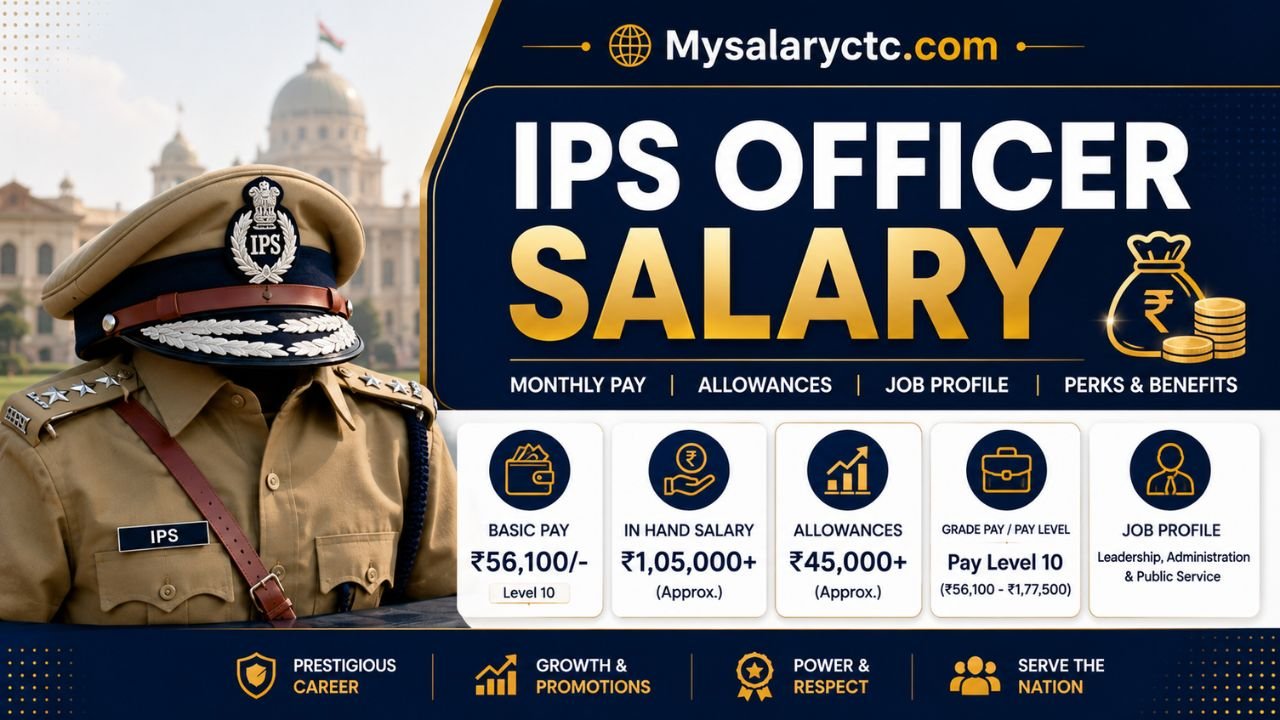
Every year, lakhs of students sit for the UPSC exam, and a good number of them dream specifically about the police uniform. I get asked constantly what an IPS officer actually earns each month, and the honest answer involves more than just one number. IPS Officer Salary depends on rank, years of service, and the allowances tied to a particular posting.
This article walks through the exact pay structure, rank by rank, along with the perks that come attached to the role. I have kept the numbers straight from the official Pay Matrix, so you get a clear, accurate picture instead of vague estimates floating around online.
IPS Officer Salary In Basic Pay Structure Under The 7th Pay Commission
The prevailing system of remuneration of the IPS is based on the 7th Central Pay Commission that was implemented in January 2016. This commission, instead of the older grade pay system, led to a Pay Matrix, and to date, that Pay Matrix is the sole determinant of how much an officer earns based solely on rank.
Junior Scale Starting Pay
An officer joining as Deputy Superintendent of Police starts at Rs 56,100 per month. This is the base figure for every fresh IPS recruit, regardless of which state cadre they get allotted to. Since the Pay Matrix applies uniformly across India, two officers joining in different states still start at the same basic pay.
Progression Through Higher Scales
As officers gain experience, they move through four broad scales. These are Junior Scale, Senior Time Scale, Super Time Scale, and Above Super Time Scale. Movement between these scales depends on years served and cadre vacancy in the officer’s allotted state, not a fixed annual promotion cycle.
IPS Officer Salary Per Month By Rank
Pay grows steadily as an officer climbs the ranks, and the jump between certain levels is quite significant. I have listed the exact monthly basic pay for every rank so you can see where each promotion actually lands you financially.
| IPS Rank | Pay Level | Monthly Basic Pay |
| Deputy Superintendent of Police | Level 10 | Rs 56,100 |
| Additional Superintendent of Police | Level 11 | Rs 67,700 |
| Superintendent of Police | Level 12 | Rs 78,800 |
| Deputy Inspector General of Police | Level 13A | Rs 1,31,000 |
| Inspector General of Police | Level 14 | Rs 1,44,200 |
| Additional Director General of Police | Level 15 | Rs 1,82,200 – Rs 2,24,100 |
| Director General of Police | Level 17 | Rs 2,25,000 |
The difference between the Superintendent of Police and the Deputy Inspector General is the most striking. Often, that leap indicates more than ten years spent in field service and, thus, officers do not make it to DIG in a short period. It normally takes nearly thirty years of steadfast, inculcable service to reach the DGP post.
What is the salary of an IPS officer at the entry level?
The basic pay of a new IPS officer is initially Rs 56,100 per month. This figure is commonly misunderstood to mean the total amount of salary to be taken home at the end of the day, when in actual fact, it is simply the underlying element before the addition of allowances.
Once Dearness Allowance and House Rent Allowance join the calculation, the actual monthly earnings turn out meaningfully higher than the basic figure suggests. So anyone assuming an entry-level officer takes home exactly Rs 56,100 is missing a large chunk of the real number.
Allowances That Boost IPS Officer Salary Beyond Basic Pay
Basic pay tells only part of the story. IPS salary includes several allowances that genuinely raise the total value of the compensation package. These exist to support officers financially across different city postings and duty requirements.
Core Allowances Every Officer Receives
- Dearness Allowance considers inflation and is updated after several years in accordance with the Consumer Price Index.
- HR allowance also depends on your city, so those officers posted in the metro are paid higher than those in small towns.
- Travel Allowance covers official movement, whether within the state or across the country.
- Medical Benefits provide comprehensive healthcare coverage for the officer and their immediate family.
Additional Perks At Senior Levels
- Senior officers get security personnel along with dedicated support staff for official duties.
- Government accommodation or a housing allowance comes attached to most postings.
- Subsidised electricity, water bills, and telephone expenses reduce personal costs significantly.
- Access to recreational facilities like clubs and gymnasiums adds further value to the package.
Salary Of An IPS Officer V/s IAS Officer
A common assumption is that IAS officers earn far more than IPS officers throughout their careers. That’s actually not accurate. The same remuneration is given to both services in the case of junior and mid-level ranks, and the only difference is seen when you are at the very top.
| Salary Scale | IAS Officer Salary | IPS Officer Salary |
| Junior Scale | Rs 56,100 | Rs 56,100 |
| Senior Time Scale | Rs 67,700 | Rs 67,700 |
| Junior Administrative Grade | Rs 78,800 | Rs 78,800 |
| Selection Grade | Rs 1,18,500 | Rs 1,18,500 |
| Super Time Scale | Rs 1,13,100 | Rs 1,13,100 |
| Above Super Time Scale | Rs 1,44,200 | Rs 1,44,200 |
| Apex Scale | Rs 2,50,000 | Rs 2,25,000 |
| Cabinet Secretary Grade | Rs 2,50,000 | Rs 2,25,000 |
At the Apex Scale, IAS officers earn Rs 25,000 more per month than IPS officers. This gap exists because top IAS positions carry authority across multiple government ministries, while senior police roles stay concentrated within law enforcement and internal security matters.
How IPS Officer’s Salary Grow With Experience?
Pay growth in the IPS does not follow a yearly appraisal system like private companies use. Rather, increases in pay occur when an officer enters one pay scale and leaves the next, and directly relies on years in service as well as the availability of vacancies in the cadres.
Scale-Wise Movement Pattern
Consider such a progress as the steps of a staircase, besides the steps of a smooth rise. The difference in basic pay jumps sharply with each promotional step, though to achieve such a step, years of uninterrupted promotion are required. This differs sharply from corporate roles where increments arrive automatically every twelve months.
Role Of Dearness Allowance Between Promotions
Revisions in regard to DA also occur significantly more than literal promotion in terms of rank. That way, at least when an officer happens to serve a few years in the same rank, his/her salary in hand, at least, continues to increase slowly due to the regular updates of the DA rates that keep up with the inflationary rates.
Practical Example Of Total Monthly Earnings
Consider an IPS officer posted as a Superintendent of Police (SP) with a basic pay of Rs 78,800 per month. Along with this, the officer receives additional components such as Dearness Allowance, House Rent Allowance, and other eligible benefits.
For example, if the Dearness Allowance is calculated at around 48% of basic pay, it adds approximately Rs 37,824 to the monthly salary. If the officer is posted in a city where House Rent Allowance is around 16%, the HRA component comes to nearly Rs 12,608.
Adding these major components:
| Salary Component | Amount (Approx.) |
| Basic Pay | Rs 78,800 |
| Dearness Allowance (48%) | Rs 37,824 |
| House Rent Allowance (16%) | Rs 12,608 |
| Travel Allowance & Other Benefits | Variable |
With these additions, the gross monthly earnings of an SP-rank IPS officer can move close to Rs 1,30,000 or more, depending on the posting location, current allowance rates, and deductions applicable at that time.
This example highlights why looking only at basic pay does not provide the complete picture of an IPS officer’s actual financial benefits. The final in-hand amount changes according to allowances, government facilities, and deductions linked to the officer’s posting and service conditions.
Common Errors Aspirants Make While Checking Pay Figures
Many candidates compare only the basic pay between IPS and IAS, completely skipping the allowance structure attached to each rank. That comparison misses half the real picture, since allowances shift based on posting city and current DA rates.
Misreading The Annual Hike Pattern
Some aspirants assume salary rises every single year automatically, similar to a corporate appraisal cycle. That assumption is incorrect here. Progression depends strictly on scale-based promotions tied to service years and cadre vacancy, not a fixed calendar date.
Overlooking DA Revision Impact
Another mistake involves ignoring how DA revisions affect total earnings over time. Even without any promotion, an officer’s take-home pay keeps rising gradually because DA percentages get revised periodically to match current inflation levels.
Smart Ways To Track Your Future Pay Growth
If you’re preparing for this exam right now, avoid memorizing just the starting figure. Study the entire Pay Matrix instead, so you understand exactly how pay grows across all four scales over a full career span.
Factor in your likely city of posting too, since HRA differences can meaningfully change your monthly income even at the identical rank. Keep an eye on official DA revision announcements as well, since these directly impact your salary without requiring any change in rank or promotion.
What Lies Ahead for the IPS Pay Structure?
The 8th Pay Commission consultations acquired tangible momentum up to the year 2026. In the event it is put in place, it would probably remodel the whole Pay Matrix, in the same way that the 7th Pay Commission changed remunerations in 2016.
However, no confirmed implementation date exists yet for these recommendations. Aspirants should track updates from the Ministry of Finance for concrete details. Until an official announcement arrives, the current 7th CPC structure remains the applicable one for calculating every rank’s monthly pay.
Final Thoughts
IPS Officer Salary provides a transparent, state-supported system that increases significantly as officers rise in the ranks. Beginning with an attractive price of Rs 56,100 and going up to Rs 2,25,000 at the highest, the price does not seem bad, yet the allowances that come with this job do tend to be even more useful to an individual than one might have imagined. Whoever analyzes this occupation must examine the overall payment scenario, rather than just the salary figure, as it provides the real picture of the fiscal gain of donning the uniform.
FAQs
Annual salary ranges from roughly Rs 6.7 lakh at the entry level to over Rs 27 lakh at the DGP rank, based on basic pay alone.
Monthly basic pay ranges from Rs 56,100 at the entry level to Rs 2,25,000 at the highest DGP rank.
A Deputy Superintendent of Police earns Rs 56,100 per month as basic pay.
A Superintendent of Police earns Rs 78,800 per month as basic pay.
No, increases come through scale-based promotions and periodic DA revisions, not fixed annual hikes.
No, an IAS salary is higher only at the Apex Scale, by Rs 25,000 per month.
DA, HRA, travel allowance, medical benefits, and housing perks add to the basic pay.
HRA typically ranges from 8 to 24 percent of basic pay, depending on city classification.
The Director General of Police earns the highest monthly basic pay at Rs 2,25,000.
Reaching the DGP rank usually takes close to three decades of consistent, disciplined service.
Read More: 14 LPA In-Hand Salary: ₹91,500–₹98,500/Month | What Is CTC?

Hi, I’m Kashish Arora, an SEO specialist and finance content researcher passionate about simplifying salary and compensation topics. I create well-researched content on CTC, in-hand salary, salary structure, pay scales, salary slips, tax calculations, EPF, gratuity, bonuses, deductions, and employee benefits.
My articles are based on official government guidelines, employer policies, tax regulations, and other reliable public sources. I aim to explain complex payroll and taxation concepts in simple language so that employees, job seekers, HR professionals, and students can easily understand how salaries are calculated and how deductions affect take-home pay.
Along with payroll and taxation topics, I also cover salary insights for government employees, private-sector professionals, executives, and public personalities whenever reliable information is available.


Leave a Reply