

Getting a job offer with a big number attached feels exciting, but that number rarely matches what actually reaches your bank account. Most professionals accept a role, celebrate the package, and then feel confused when the first salary credit looks smaller than expected. This gap between the promised figure and the real payout confuses freshers and experienced employees alike, mainly because companies rarely explain the difference clearly. This article explains what CTC is, how it connects to your monthly salary, and how you can work out your actual take-home pay before signing an offer letter. Once you understand the structure behind CTC, reading any offer letter becomes much easier.
What is CTC?
CTC stands for Cost to Company. It represents the total amount an employer spends on you across a year, not just the salary you receive as cash. Every rupee or dollar the company allocates toward your employment, whether direct or indirect, gets added to this single figure.
Take CTC as a sort of annual saving that is given to you by your employer. This budget discusses your permanent salary, allowances, bonuses, insurance payments, and retirement. Because there are so many things embedded in a single number, the headline CTC number can appear bigger than what you are actually going to pay every month.
What is CTC Salary?
CTC salary refers to the annual package value mentioned in your offer letter. When a recruiter quotes a CTC salary of 12 lakh per year, they mean the complete value of everything included in your package, not a monthly payout and certainly not your net income.
This phrase confuses candidates because the word “salary” suggests direct payment. In reality, CTC salary works more like a cost summary. It blends your fixed pay with variable incentives, employee benefits, and statutory contributions into one combined annual total, which then gets divided across the year in different forms.
What Does CTC Actually Include?
CTC isn’t a single payment; it’s built from multiple layers that serve different purposes. Some parts arrive as monthly cash, while others sit as long-term benefits you access only under specific conditions.
Direct Pay Components
- Basic salary, generally 40 to 50 percent of total CTC
- House rent allowance, travel allowance, and similar cash allowances
- Performance-linked bonuses and incentives
- Employer contributions toward statutory payroll taxes
Indirect Benefit Components
- Health insurance premiums paid on your behalf
- Meal cards, food subsidies, or employee discounts
- Wellness programs such as gym reimbursements or counseling access
- Training programs, certifications, and skill development support
Long-Term Savings Components
- Gratuity, payable after completing a minimum service period
- Employer contribution to provident fund or retirement accounts
- Stock options, where applicable
- Profit-sharing bonuses offered by some companies
What Is an In-Hand Salary?
In-hand salary reflects in your bank account as the actual amount upon applying all deductions are made every month. It is also known as take-home pay, and it is the amount that will determine your monthly budget on rent, groceries, savings, etc. The gross salary minus the deductions such as contribution to the provident fund, professional tax, and income tax is then the gross salary on which you receive your in-hand salary.
Unlike CTC, this figure never includes employer-side contributions or non-cash perks, since you don’t receive those as spendable money during your employment. Because of this difference, planning your monthly budget around CTC often leads to financial miscalculation.
Gross Salary vs CTC vs In-Hand Salary
It is important to note that these three terms are quite close yet have different meanings, and when they are combined, they may create misplaced expectations in the form of salaries.
| Term | What It Means | Includes Employer Contributions | Cash You Actually Receive |
| CTC | Total yearly cost to the company | Yes | Partial, spread across benefits and cash |
| Gross Salary | Earnings before deductions | No | Before tax and PF deductions |
| In-Hand Salary | Final amount credited to your account | No | Full amount, ready to spend |
Gross salary sits between CTC and in-hand salary. It reflects your salary before deductions but after removing employer-only contributions such as their share of the provident fund or insurance. Once tax and employee-side deductions get subtracted from gross salary, you arrive at your final in-hand figure.
Formula and Method to Calculate CTC
Calculating CTC follows a fairly simple formula, though actual numbers vary based on how each company structures its packages.
CTC = Gross Salary + Direct Benefits + Indirect Benefits + Savings Contributions
Here’s a real example showing how an employee’s total CTC of 120,100 dollars gets broken down across different components.
| Component | Amount ($) |
| Gross salary: | $70,000 |
| Direct benefits:• Health insurance coverage• House rent allowance (HRA)• Annual bonus | $10,000$15,000$5,000 |
| Indirect benefits:• Subsidized meals• Gym membership discount• Professional development (training programs, conferences, courses) | $3,000$600$5,000 |
| Savings contribution:• Company retirement fund contribution | $3,000 |
| Employer-paid taxes (Social Security & Medicare) | $8,500 |
| Total CTC | $120,100 |
Notice how several components in this table never reach the employee as direct cash. That’s exactly why judging a job offer purely on What is CTC often creates unrealistic expectations.
Steps to Calculate In-Hand Salary from CTC
This is the calculation everyone actually needs before accepting a job. Once you understand the steps, you can estimate your monthly take-home pay from any CTC figure within minutes.
Step 1: Start with your total CTC
Take the annual figure mentioned in your offer letter as your starting point.
Step 2: Remove employer-only contributions
Subtract items like employer provident fund contribution, gratuity, and insurance premiums since these never reach you as monthly cash.
Step 3: Arrive at gross salary
What remains after step two becomes your gross annual salary, the base for further deductions.
Step 4: Deduct employee-side contributions and taxes
Subtract your own provident fund contribution, professional tax where applicable, and income tax based on your slab or chosen tax regime.
Step 5: Divide the final number by 12
This gives you your monthly in-hand salary, the actual amount you can expect in your account.
For example, suppose your CTC is 10 lakh annually. Employer contributions toward PF, gratuity, and insurance total around 1.2 lakh, bringing your gross salary down to 8.8 lakh. After subtracting employee PF of roughly 21,600, professional tax of 2,400, and estimated income tax of nearly 45,000, your net annual salary comes to about 8.11 lakh. Divide that by 12, and your monthly in-hand salary works out to approximately 67,600.
These figures shift depending on your tax regime, city of work, and specific salary structure, so treat this example as a working reference rather than a fixed outcome.
How to calculate in-hand salary from CTC using an Online Salary Calculator
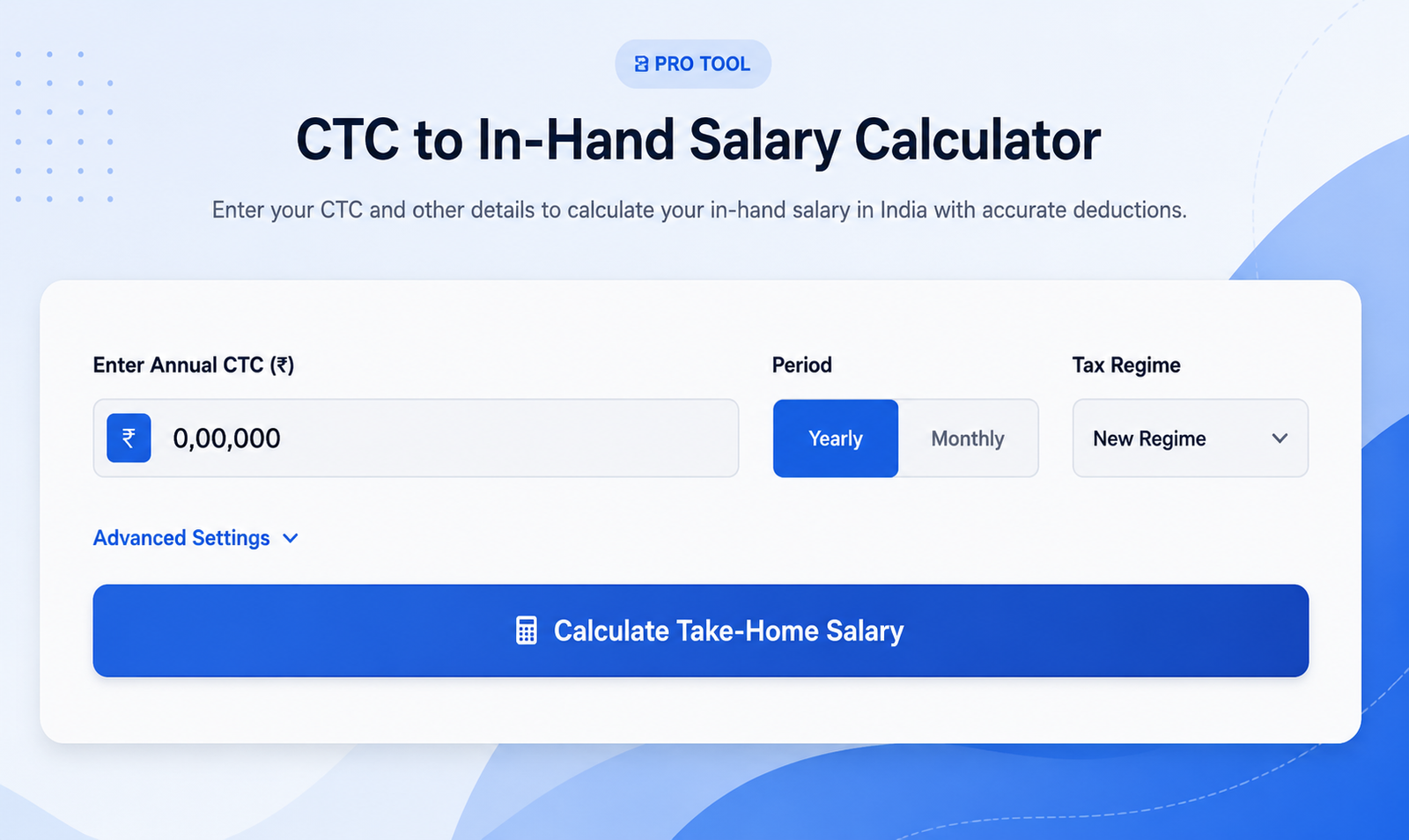
A CTC to in-hand salary calculator removes the need for manual math every time you compare job offers. You simply enter your annual CTC, and the tool applies standard deduction rates for tax and PF to generate an estimated monthly take-home figure.
Most calculators ask for basic details such as annual CTC, bonus percentage, city of employment, and preferred tax regime. The output gives a reasonably accurate estimate for standard salary structures, though it can’t factor in personal variables like voluntary PF top-ups or specific tax-saving investments. Use these tools during offer negotiations, then confirm the final number with your company’s payroll team before making a decision.
Mistakes Job Seekers Make While Reading CTC
- Treating CTC as identical to take-home salary and setting unrealistic monthly budgets
- Assuming variable bonus components as guaranteed fixed income
- Forgetting that gratuity requires a minimum service period before payout
- Skipping tax regime comparisons, which can noticeably change the final in-hand figure
- Comparing multiple job offers using only CTC instead of checking the fixed-to-variable pay ratio
Tips for Negotiating Your Salary Package
Always request a detailed CTC breakup before accepting any offer. A single combined number reveals very little about your actual monthly earnings. Once you have the breakup, run the numbers through the calculation steps mentioned earlier, or use a reliable calculator for a faster estimate.
Whenever there are two or more opportunities available, compare on the basis of in-hand salary and not CTC. Probably a moderate CTC with a strong fixed element is more economical than a CTC that is higher and overloaded with variable payments and non-financial benefits.
Final Thoughts
CTC demonstrates the amount of money that a company intends to pay you, but does not show what really makes it into your account every month. As soon as you are familiar with the strata within CTC, between the lowest wages and the fringe benefits offered indirectly, to long-term savings reimbursement, you will cease to find the offer letters puzzling. What really helps is turning that CTC number into a true in-hand salary estimate prior to taking any offer, as that number determines your monthly financial reality. Remember this breakdown when you next have a salary negotiation, and you will approach any offer letter in a much better light.
FAQs
CTC is the total yearly cost an employer bears for an employee, including salary, benefits, and contributions.
It means the full annual package value quoted by the employer, not the monthly cash salary.
No, Gross salary is a component within CTC and excludes employer-only contributions like retirement matching or insurance premiums.
Because CTC includes non-cash benefits, employer contributions, and deductions like PF and income tax, all of which reduce the actual cash you receive.
Subtract employer-only contributions from CTC to get gross salary, then subtract employee deductions like PF, professional tax, and income tax to get your net in-hand salary.
Typically between 65% and 80%, depending on your salary structure and applicable deductions.
Yes, performance bonuses and incentives are counted as part of direct benefits within CTC.
No, Income tax is a deduction applied after gross salary is calculated; it reduces in-hand pay but isn’t a separate CTC component.
It gives a close estimate but may not reflect personalized deductions like voluntary investments or specific tax exemptions.
Not necessarily. A higher CTC with more allocation to variable pay or non-cash perks can result in similar or even lower guaranteed monthly income compared to a lower CTC with a higher fixed component.
Explore Our Tools:

Hi, I’m Kashish Arora, an SEO specialist and finance content researcher passionate about simplifying salary and compensation topics. I create well-researched content on CTC, in-hand salary, salary structure, pay scales, salary slips, tax calculations, EPF, gratuity, bonuses, deductions, and employee benefits.
My articles are based on official government guidelines, employer policies, tax regulations, and other reliable public sources. I aim to explain complex payroll and taxation concepts in simple language so that employees, job seekers, HR professionals, and students can easily understand how salaries are calculated and how deductions affect take-home pay.
Along with payroll and taxation topics, I also cover salary insights for government employees, private-sector professionals, executives, and public personalities whenever reliable information is available.


Leave a Reply