
Last Updated: September 21, 2026
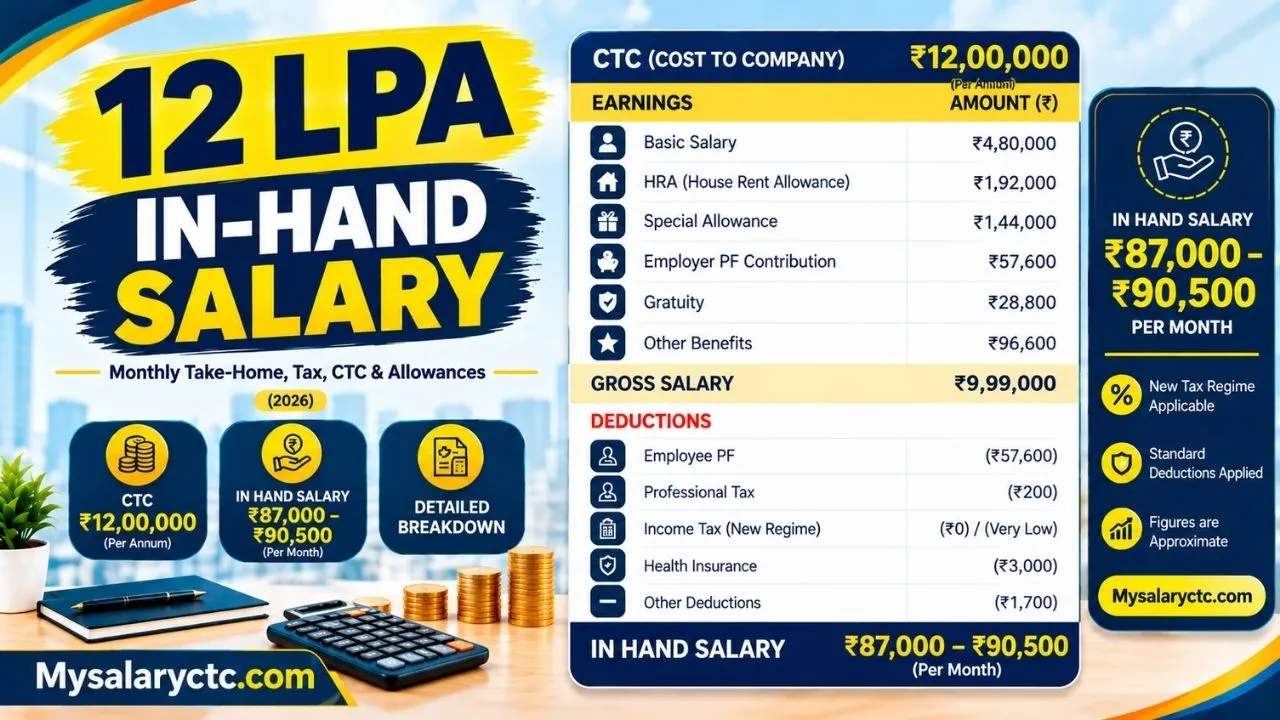
Open an offer letter that says 12 LPA and the first instinct is to do the math: twelve lakh, divided by twelve months, equals a clean one lakh rupees landing in your account every payday. It doesn’t quite work that way. For a 12 LPA package under typical conditions, you’re looking at roughly ₹87,000 to ₹90,500 actually reaching your bank account each month — and interestingly, the gap has less to do with tax than most people assume. Let’s walk through where the rest of it goes.
Breaking Down What 12 LPA Actually Means
“LPA” is shorthand for Lakhs Per Annum, and it describes the total value your employer places on your compensation over a year — not the sum of twelve monthly paychecks. A 12 LPA figure is your CTC, or Cost to Company: the full price tag your employer attaches to employing you, including things that never once touch your salary account.
Here’s the arithmetic version:
| Calculation | Amount |
| Annual CTC | ₹12,00,000 |
| Divided by 12 Months | ₹1,00,000 |
| Gross Monthly Salary | ₹92,000 – ₹95,000 |
Notice the gross figure already sits below the clean ₹1,00,000 mark — and that’s before your own deductions even enter the picture.
12 LPA In Hand Salary Per Month: The Realistic Figure
If your main question is what actually shows up in your account each month, plan around a range of ₹87,000 to ₹90,500, with most people landing close to ₹88,500. What makes this bracket unusual compared to lower salaries is how small a role income tax plays in that gap — for a large share of earners at this exact level, the entire shortfall between gross and net pay comes down to Provident Fund and a token professional tax deduction.
How Much In Hand Salary For 12 LPA — The Direct Answer
So, how much in hand salary for 12 LPA, stripped of all the caveats? Budget for somewhere between ₹87,000 and ₹90,500 monthly if your package is structured in a fairly typical way — basic salary around 40% of CTC, no unusually large bonus component, and PF calculated the standard way. Offers with heavier variable pay or an atypical basic-to-CTC ratio can shift this figure by a few thousand rupees in either direction, which is why a quick conversation with HR about the exact split is worth having before you assume a specific number.
Where Does Your CTC Actually Go?
A CTC figure is built from several pieces, and quite a few of them are invisible on your bank statement. At 12 LPA, the typical mix includes:
- Basic salary — usually the anchor figure that PF and gratuity are calculated from
- HRA and other allowances
- Performance-linked bonus, where applicable
- The employer’s own contribution to your Provident Fund
- Gratuity, which only gets paid out after a minimum tenure
- Group insurance premiums, if your company provides them
The employer’s PF share and the gratuity provision are the two biggest reasons a CTC figure looks bigger on paper than it ever will on your payslip — both count toward the company’s total spend on you, but neither is cash you’ll see monthly.
Working Out Your Monthly Number, Step by Step
Begin with the simple division:
₹12,00,000 ÷ 12 = ₹1,00,000
From there, subtract the employer’s PF contribution and the gratuity provision — both stay inside your CTC on paper but never leave the company’s books to reach you — which brings your real gross pay down to somewhere around ₹92,000 to ₹95,000 a month. Employee PF and professional tax come off next, and for most salaried employees at this bracket, income tax adds little to nothing on top. What’s left, typically ₹87,000 to ₹90,500, is your actual monthly credit.
The Deductions List, Item by Item
- Employee PF: Roughly 12% of your basic salary, which usually works out to ₹4,500–₹5,000 a month at this income level
- Professional Tax: A modest, state-specific charge, generally close to ₹200 monthly
- Income Tax (TDS): Frequently zero for standard salary structures under the current New Tax Regime
- Insurance Premiums: Only deducted if your employer runs a group cover scheme
| Salary Component | Approximate Amount |
| Gross Monthly Salary | ₹92,000 – ₹95,000 |
| Employee PF Contribution | ₹4,500 – ₹5,000 |
| Professional Tax | ~₹200 |
| Income Tax (TDS) | ₹0 (typically, under New Regime) |
| Estimated In-Hand Salary | ₹87,000 – ₹90,500 |
Why Two People on the Same CTC Can Take Home Different Amounts
Picture two employees hired at the same company, on paper both earning 12 LPA. One walks away with ₹90,000 a month; the other, ₹85,000. Neither number is a mistake — the difference usually traces back to how each person’s basic salary was set, since a higher basic means higher PF, which reduces net pay even as it builds a larger retirement corpus.
This is really the crux of why a bare CTC figure tells an incomplete story. Before accepting any offer at this level, it’s worth requesting the exact percentage split between basic, HRA, and other allowances — that single detail predicts your take-home far more reliably than the headline CTC number ever will.
12 LPA In Hand Salary: New Tax Regime Impact
Here’s the part that genuinely sets 12 LPA apart from most other salary brackets: under the New Tax Regime, following the changes introduced in the Union Budget 2025, salaried income up to ₹12,00,000 is effectively shielded from tax entirely, thanks to the Section 87A rebate.
The reason this matters so precisely at 12 LPA comes down to a distinction people often miss — your CTC and your taxable income are not the same figure. By the time employer PF, gratuity, and the ₹75,000 standard deduction are stripped out, a 12 LPA CTC typically leaves you with a taxable income somewhere near ₹10–10.5 lakh, safely under the ₹12 lakh cutoff.
The practical upshot: a large share of people earning exactly 12 LPA under a conventional salary structure end up owing nothing at all in income tax. That’s a genuinely different situation from pre-Budget 2025 rules, when the rebate cut off at just ₹7 lakh.
| Detail | Approximate Value |
| CTC | ₹12,00,000 |
| Estimated Gross Annual Salary | ₹11,10,000 – ₹11,40,000 |
| Standard Deduction | ₹75,000 |
| Estimated Taxable Income | ₹10,35,000 – ₹10,65,000 |
| Section 87A Rebate Threshold (New Regime) | ₹12,00,000 |
| Estimated Income Tax Payable | ₹0 |
One caveat worth flagging clearly: this outcome assumes your taxable income genuinely stays under ₹12 lakh. A hefty bonus, unusually high variable pay, or taxable perks stacked on top can push you over that line, in which case tax applies only to the portion above the threshold — so treat zero tax as the likely outcome for a standard package, not an automatic guarantee.
Opting for the Old Regime instead removes this particular rebate structure, and your final bill will hinge on how much you can claim through HRA, Section 80C, home loan interest, and similar deductions.
Breaking 12 LPA Down to a Daily and Hourly Rate
Sometimes a smaller unit makes a salary easier to compare, particularly against freelance or contract work.
| Time Unit | Approximate Amount |
| Per Day | ₹3,288 |
| Per Hour (8-hour workday) | ₹411+ |
These figures are drawn from a straight 365-day gross calculation, so weekends, holidays, and deductions aren’t factored in — use them as a loose benchmark rather than a precise number.
What Kind of Roles Pay Around 12 LPA?
This bracket tends to suit professionals somewhere in the four-to-seven-year experience range, or standout early-career hires in especially competitive fields. Roles commonly seen at this level include:
- Senior Software Engineer
- Data Scientist or Senior Data Analyst
- Product Manager, early-to-mid stage
- DevOps Engineer
- Financial Analyst or Associate
- Senior Business Analyst
- Marketing Manager
- UI-UX Design Lead
Is 12 LPA a Strong Offer for a Fresh Graduate?
For someone just starting out, landing 12 LPA is well above the norm — typically the territory of graduates from highly selective institutes, or those who’ve come out of a genuinely competitive hiring process in tech or consulting. If you’re still early in your career, treat it as an ambitious future milestone rather than a realistic opening offer.
Does City of Residence Change What 12 LPA Feels Like?
It absolutely does. Living costs vary enough across India that the same paycheck can feel completely different depending on where you’re based.
Major Metros: Cities like Bengaluru, Mumbai, Delhi NCR, Hyderabad, and Pune carry noticeably higher rent and everyday expenses, though 12 LPA still generally leaves comfortable room for saving.
Smaller Cities: In Tier-2 and Tier-3 locations, the same income tends to stretch considerably further, often supporting a genuinely upgraded lifestyle alongside stronger savings.
Stepping Up: 12 LPA Versus 15 LPA
Looking at the next bracket up is useful context if you’re negotiating a move — and it also illustrates exactly what happens once you cross back over the ₹12 lakh tax-free line.
| Package | Gross Monthly | Net In-Hand Monthly |
| 12 LPA | ₹92,000 – ₹95,000 | ₹87,000 – ₹90,500 |
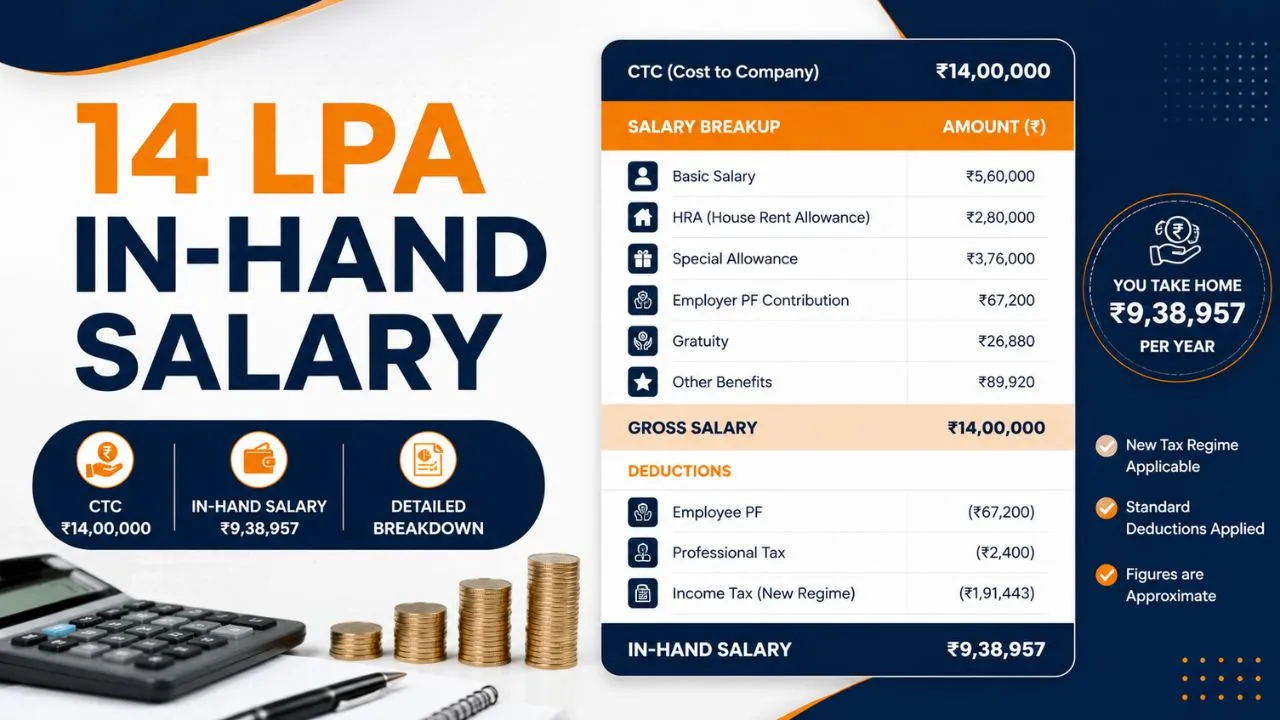
| 15 LPA | ₹1,15,000 – ₹1,18,000 | ₹1,02,000 – ₹1,06,000 |
At 15 LPA, taxable income typically climbs back above the rebate threshold, so income tax re-enters the picture — which is exactly why the jump in take-home pay looks smaller, proportionally, than the CTC increase itself. It’s the reverse of the tax-free bump many people expect when they picture climbing from 12 to 15 LPA.
Making the Most of a 12 LPA Paycheck
With tax largely out of the equation at this bracket, there’s real room to build savings quickly — provided everyday spending doesn’t quietly rise to swallow the advantage. A few habits worth adopting:
- Set up an automatic SIP as soon as a raise lands, before lifestyle spending has a chance to catch up
- Keep a 6-month emergency fund on hand, made easier by the extra breathing room a tax-free bracket provides
- Watch whether a bonus or salary hike might push your taxable income past ₹12 lakh, and plan your investments with that in mind
- Steer clear of EMIs that eat into the very savings advantage this bracket offers
- Revisit your regime choice yearly, since your optimal option can shift as income or deductions change
Where a 12 LPA Salary Can Take You Next
Reaching 12 LPA usually reflects solid, established footing in the middle of a career, not a ceiling. Continued skill-building tends to open doors into senior or specialist territory within a few years.
A common trajectory looks like: 12 LPA → 18 LPA → 25 LPA → 35 LPA+
Moving up from here generally comes down to a few things:
- Going deeper into a specialization that’s genuinely in demand
- Taking on more ownership, or early leadership responsibilities
- Building a visible, provable track record of impact
- Investing time in a real professional network
- Picking up certifications that carry weight in your specific field
Sectors Where Pay Climbs Faster
Growth isn’t uniform across industries. If long-term earning potential matters to you, these areas tend to move quicker:
- Artificial Intelligence and Machine Learning
- Product Management
- Cloud Architecture and DevOps
- Cybersecurity
- Data Science and Analytics
What This Bracket Can Still Be Tricky About
Even with the tax advantage in your favor, 12 LPA comes with its own friction — rising costs in bigger cities, mounting responsibility as your role grows, and the quiet temptation to let spending rise in step with income instead of banking what you save on tax. It’s also worth keeping an eye on how future raises or bonuses might nudge your taxable income across that ₹12 lakh line.
The Experience Behind the Number
Arriving at 12 LPA says more about accumulated skill and judgment than the figure itself suggests. The habits that got you here — technical depth, independence, the ability to own a problem end to end — are what keep paying off long after this particular salary number has been left behind.
Conclusion
Pulling it together: a 12 LPA package typically puts ₹87,000 to ₹90,500 in your account each month, out of a gross monthly figure closer to ₹92,000–₹95,000. What makes this bracket worth understanding closely is the New Tax Regime’s effect on it — for a fairly standard structure, taxable income lands just under the ₹12 lakh Section 87A threshold, which means a meaningful share of people at this level pay no income tax at all. With a little attention to how your specific offer is structured, a 12 LPA in hand salary per month can be one of the more tax-efficient stretches of an entire career.
Frequently Asked Questions
Typically between ₹87,000 and ₹90,500, depending on how your basic salary and PF are structured.
Most standard salary structures put it between ₹87,000 and ₹90,500 a month, assuming basic salary sits around 40% of the total CTC.
Usually not. For most standard structures, taxable income after the standard deduction falls under the ₹12 lakh Section 87A rebate threshold, resulting in zero tax for many earners at this level.
Roughly ₹92,000 to ₹95,000, once employer PF and gratuity are set aside from the annual CTC.
Yes — it’s a strong, comfortably above-average salary, made more attractive by the near-total tax relief available at this exact income level under current rules.
Not necessarily. A large bonus, high variable pay, or additional taxable perks can push taxable income above ₹12 lakh, in which case tax applies to the excess.
Around ₹3,288 on a gross basis, based on a 365-day year.
Around ₹3,288 on a gross basis, based on a 365-day year.
15 LPA typically nets ₹1,02,000 to ₹1,06,000 monthly — higher than 12 LPA, but with tax back in the picture since taxable income at that level usually exceeds the ₹12 lakh rebate cutoff.

Hi, I’m Kashish Arora, an SEO specialist and finance content researcher passionate about simplifying salary and compensation topics. I create well-researched content on CTC, in-hand salary, salary structure, pay scales, salary slips, tax calculations, EPF, gratuity, bonuses, deductions, and employee benefits.
My articles are based on official government guidelines, employer policies, tax regulations, and other reliable public sources. I aim to explain complex payroll and taxation concepts in simple language so that employees, job seekers, HR professionals, and students can easily understand how salaries are calculated and how deductions affect take-home pay.
Along with payroll and taxation topics, I also cover salary insights for government employees, private-sector professionals, executives, and public personalities whenever reliable information is available.

Leave a Reply