
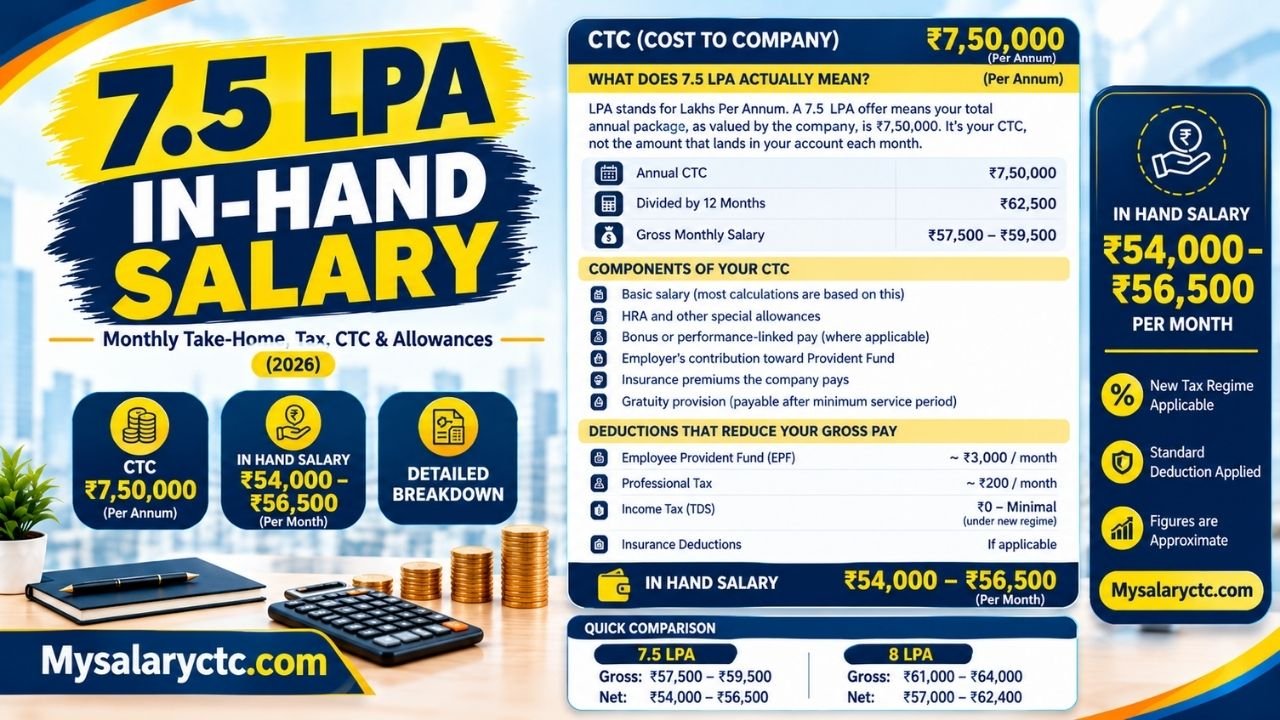

A 7.5 LPA offer sits in that comfortable early-to-mid career zone where the numbers are finally starting to feel real. But like any CTC figure, ₹7,50,000 a year isn’t what shows up in your bank account every month. Your 7.5 LPA in hand salary typically works out to somewhere between ₹54,000 and ₹56,500 per month, once PF and professional tax are deducted — and for most people at this level, income tax barely enters the picture. Here’s the full breakdown.
What Does 7.5 LPA Salary Actually Mean?
LPA stands for Lakhs Per Annum — the standard way Indian companies express yearly compensation. A 7.5 LPA offer means your total annual package, as valued by the company, is ₹7,50,000. That’s your CTC (Cost to Company), not the amount that lands in your account each month. It’s an easy number to misread if you simply divide it by 12 and expect that full amount on payday — the real figure is a bit lower once standard deductions are applied.
In simple terms:
7.5 LPA = ₹7,50,000 annual CTC
| Calculation | Amount |
| Annual CTC | ₹7,50,000 |
| Divided by 12 Months | ₹62,500 |
| Gross Monthly Salary | ₹57,500 – ₹59,500 |
Even this gross figure isn’t your final take-home — it’s what you earn before deductions are applied.
Check This Also: 4 LPA In Hand Salary – Monthly Take-Home Pay, & CTC Breakup
7.5 LPA In Hand Salary Per Month: What You’ll Actually Get
If you’re specifically searching for 7.5 LPA in hand salary per month, here’s the realistic answer: expect somewhere between ₹54,000 and ₹56,500 credited to your account each month. Most professionals in this bracket land close to the ₹55,000 mark. The gap between this and your CTC comes down mainly to PF and a small professional tax deduction — not hidden company charges, just standard statutory contributions everyone pays.
What Components Make Up Your CTC?
Your CTC is a bundle of components, and not all of them show up in your bank account. At this salary level, it typically includes:
- Basic salary, which most other calculations are based on
- HRA and other special allowances
- Bonus or performance-linked pay, where applicable
- Employer’s contribution toward your Provident Fund
- Insurance premiums the company pays on your behalf
- Gratuity provision, payable only after a minimum service period
Since employer PF and gratuity inflate your CTC without touching your monthly salary, it’s always worth asking HR for a full component-wise breakup before signing your offer letter.
How Is Your 7.5 LPA In Hand Salary Calculated?
Start with the basic math — divide your annual CTC by 12:
₹7,50,000 ÷ 12 = ₹62,500 per month
From there, your employer sets aside employer PF and gratuity (which stay within your CTC but never reach your account), bringing your gross monthly pay down to roughly ₹57,500–₹59,500. After employee PF and professional tax are deducted, your final in-hand salary typically settles between ₹54,000 and ₹56,500 a month.
Deductions That Reduce Your Gross Pay
Here’s what typically comes out of your salary before it reaches you:
- Employee Provident Fund (EPF): Usually 12% of basic salary, working out to roughly ₹2,800–₹3,200 a month at this CTC level
- Professional Tax: A small, state-specific deduction, generally around ₹200 a month
- Income Tax (TDS): Little to nothing for most salaried employees under the current New Tax Regime
- Insurance Deductions: Applicable only if your employer runs a group insurance scheme
| Salary Component | Approximate Amount |
| Gross Monthly Salary | ₹57,500 – ₹59,500 |
| Employee PF Contribution | ~₹3,000 |
| Professional Tax | ~₹200 |
| Income Tax (TDS) | ₹0 – Minimal |
| Estimated In-Hand Salary | ₹54,000 – ₹56,500 |
CTC vs Take-Home Pay: Why the Confusion Happens
Almost everyone mixes up CTC with actual take-home pay at some point, especially early in their career. Companies advertise CTC because it reflects their total spend on you — PF contributions, insurance, and gratuity provisions included — while your payslip only shows what’s left after every deduction.
Two people with an identical 7.5 LPA offer at different companies can still walk away with different in-hand amounts, simply because each company structures basic pay, allowances, and variable components differently. That’s exactly why relying on the CTC headline alone can be misleading — always ask for a detailed breakup before accepting an offer.
Income Tax On 7.5 LPA Salary
Here’s the reassuring part: your 7.5 LPA in hand salary attracts little to no income tax for most salaried employees. Under the New Tax Regime, income up to ₹12 lakh is effectively tax-free thanks to the Section 87A rebate introduced in the Union Budget 2025. Add the ₹75,000 standard deduction available to salaried employees, and gross salaries up to roughly ₹12.75 lakh end up paying nil tax under the new regime.
Since a 7.5 LPA package sits comfortably below that threshold, most employees at this salary pay zero income tax — meaning Provident Fund, not TDS, remains your main recurring deduction.
That said, your actual outcome still depends on a few things:
- Which tax regime you (or your employer, by default) select
- Whether you’re claiming Section 80C or other deductions
- HRA exemption eligibility, if you’re on the old regime
- Any additional loan or insurance-linked deductions
If your employer deducts a small amount of TDS early in the financial year as a precaution, it typically gets reconciled once your full annual income is confirmed.
7.5 LPA Salary Per Day And Per Hour
Breaking your annual number into smaller units makes it easier to compare against freelance or contract rates.
| Time Unit | Approximate Amount |
| Per Day | ₹2,055 |
| Per Hour (8-hour workday) | ₹257+ |
These are gross figures calculated on a 365-day basis, so they don’t account for weekends, holidays, or deductions — treat them as a rough benchmark rather than an exact calculation.
Job Roles That Typically Offer 7.5 LPA Salary
A 7.5 LPA package is common for professionals with roughly one to four years of experience, across a mix of industries. You’ll typically see this range offered for:
- Software Developer / Engineer
- Data Analyst
- Business Development Executive (senior)
- Financial Analyst
- UI-UX Designer
- Digital Marketing Specialist
- HR Business Partner (early career)
- Quality Assurance Engineer
Is 7.5 LPA A Good Salary For Freshers?
For a fresher, 7.5 LPA is a solid, above-average starting package — particularly for graduates from well-regarded engineering or management institutes. It comfortably covers living expenses in most cities, allows for meaningful savings, and gives you a strong base to negotiate from at your next appraisal or job switch. That said, how far it stretches will depend a lot on where you’re based.
How Location Affects Your 7.5 LPA Take-Home Value
The city you’re working from plays a big role in how comfortable this salary actually feels.
In Metro Cities: Bengaluru, Mumbai, Hyderabad, Pune, and Delhi NCR come with higher rent and living costs, so budgeting carefully matters from your very first paycheck.
In Tier-2 and Tier-3 Cities: A 7.5 LPA salary goes considerably further here, often supporting a comfortable lifestyle alongside solid monthly savings.
7.5 LPA vs 8 LPA: How Take-Home Pay Scales
Seeing how take-home pay scales with a slightly higher CTC helps set realistic expectations for your next raise or job move.
| Package | Gross Monthly | Net In-Hand Monthly |
| 7.5 LPA | ₹57,500 – ₹59,500 | ₹54,000 – ₹56,500 |
| 8 LPA | ₹61,000 – ₹64,000 | ₹57,000 – ₹62,400 |
Even a modest CTC bump translates into a noticeably better in-hand figure, since fixed deductions like PF and professional tax don’t scale up proportionally with your salary.
How To Save Money On A 7.5 LPA Salary
Saving consistently at this income level is very achievable, but it takes discipline from your very first paycheck. Many professionals spend freely in the early months and only start budgeting once expenses pile up. A few things that genuinely help:
- Start a monthly SIP early — consistency matters more than the amount
- Build an emergency fund covering three to six months of expenses
- Avoid EMIs for non-essential purchases in your early working years
- Track your monthly spending to catch small, unnecessary leaks
- Reinvest part of any bonus payout instead of spending it all at once
A scheduled savings habit, set up once, tends to work far better than trying to cut costs reactively each month.
Check This Also: 3 LPA In-Hand Salary = ₹21,000–₹24,000/month 2026 (CTC & Tax)
Career Growth After 7.5 LPA Salary
Think of a 7.5 LPA package as an early milestone, not a ceiling. With consistent skill-building, most professionals move into higher salary brackets fairly quickly from here.
Typical growth path: 7.5 LPA → 11 LPA → 16 LPA → 25 LPA+
To speed up that progression, it helps to focus on:
- Building in-demand technical or functional skills
- Sharpening communication and stakeholder management
- Earning relevant industry certifications
- Taking on high-visibility, hands-on projects
- Networking actively within your field
Industries With Faster Salary Growth
Not every sector moves at the same pace. If long-term earning growth is a priority, it’s worth building skills in areas like:
- Artificial Intelligence
- Cloud Computing
- Cybersecurity
- Data Science
- Product Management
- Product-Based IT Companies
Challenges Of A 7.5 LPA Salary
It’s not without its pressures. Professionals at this level often deal with rising rent in metro cities, growing work responsibilities as they gain experience, and, in certain sectors, slower-than-expected salary growth. Even so, this stage of your career is really about deepening your expertise — the income tends to follow.
Why Experience Matters More Than Salary Initially
The role behind your 7.5 LPA package will teach you far more than any single paycheck could. It’s where you build foundational skills, learn to navigate workplace dynamics, and get genuine exposure to how your industry actually functions. In the long run, that experience compounds a lot faster than the number printed on your offer letter.
Conclusion
To sum up: your 7.5 LPA in hand salary typically lands between ₹54,000 and ₹56,500 per month, against a gross monthly salary of roughly ₹57,500 to ₹59,500. That gap comes mainly from PF and professional tax rather than heavy taxation, since most earners at this level pay little to no income tax under the current New Tax Regime. It’s a solid package to build a career on — pair it with disciplined budgeting and continuous upskilling, and your 7.5 LPA in hand salary per month can grow substantially within just a few years.
Frequently Asked Questions
Your monthly take-home typically ranges between ₹54,000 and ₹56,500, depending on your company’s deduction structure.
Yes, most companies factor in both employee and employer PF contributions as part of your overall CTC, though only your own contribution is deducted from your in-hand pay.
Minimally, if at all. Under the New Tax Regime, income up to ₹12 lakh is effectively tax-free thanks to the Section 87A rebate, so most people earning 7.5 LPA pay little to no income tax.
Your gross monthly salary comes to approximately ₹57,500 to ₹59,500 before PF, professional tax, and any applicable deductions.
Yes — it’s considered a strong, above-average starting package, especially for graduates from reputed institutes.
Your daily earnings come to roughly ₹2,055 on a gross basis, calculated over a 365-day year.
Yes. Professionals who build in-demand skills, take on high-impact projects, and network actively often move into significantly higher brackets within a few years.
8 LPA typically offers ₹57,000 to ₹62,400 monthly in-hand, a solid step up from the ₹54,000 to ₹56,500 range at 7.5 LPA.
Read Our Tools: CTC Calculator | Download Salary Slip | Salary Tax Calculator

Hi, I’m Kashish Arora, an SEO specialist and finance content researcher passionate about simplifying salary and compensation topics. I create well-researched content on CTC, in-hand salary, salary structure, pay scales, salary slips, tax calculations, EPF, gratuity, bonuses, deductions, and employee benefits.
My articles are based on official government guidelines, employer policies, tax regulations, and other reliable public sources. I aim to explain complex payroll and taxation concepts in simple language so that employees, job seekers, HR professionals, and students can easily understand how salaries are calculated and how deductions affect take-home pay.
Along with payroll and taxation topics, I also cover salary insights for government employees, private-sector professionals, executives, and public personalities whenever reliable information is available.


Leave a Reply