

Last update : September 26
If your offer letter says ₹8.5 LPA, the first question is usually simple: “How much will I actually receive in my bank account every month?”
The answer is not automatically ₹70,833. That figure comes from dividing ₹8,50,000 by 12, but CTC is not the same as monthly take-home salary. Employer PF, gratuity, variable pay, professional tax, insurance and the way your company structures basic salary can all change the amount credited to your account.
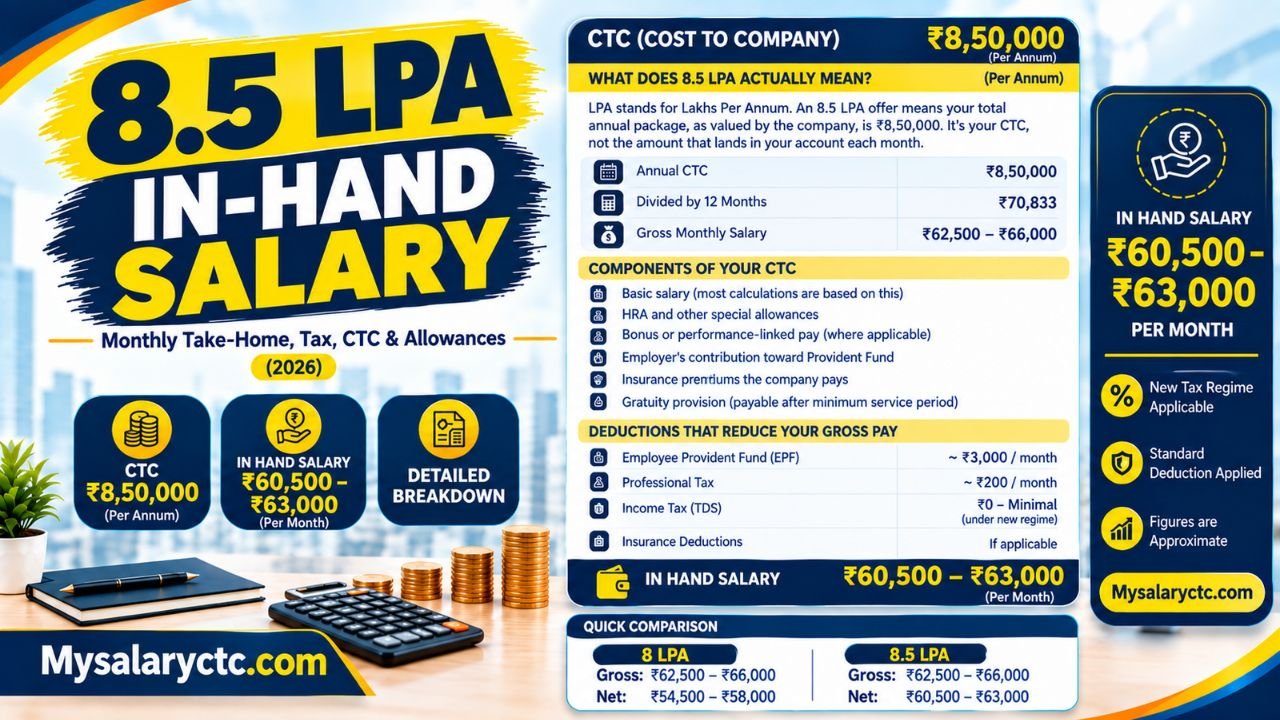
For 2026, published salary calculators show different outcomes for an ₹8.5 lakh package. One model estimates around ₹60,421–₹67,121 per month, while another worked example gives approximately ₹60,430, and another structure produces about ₹63,833.
So, this guide focuses on the more useful question: what can an 8.5 LPA in hand salary look like under different salary structures, and how can you calculate your exact take-home?
Quick answer: An ₹8.5 LPA CTC can commonly translate into roughly ₹60,000–₹67,000 per month in hand, depending on the company’s salary structure and deductions. This is an illustrative range, not a universal salary figure.
8.5 LPA In Hand Salary at a Glance
| Salary Component | Approximate Amount |
| Annual CTC | ₹8,50,000 |
| Monthly CTC equivalent | ₹70,833 |
| Possible monthly gross salary | Around ₹64,000–₹68,000 |
| Possible monthly take-home | Around ₹60,000–₹67,000 |
| Employee PF | Depends on applicable PF wages |
| Professional Tax | Depends on state |
| Income Tax | Depends on taxable income and regime |
| Variable Pay | May not be received every month |
Reference sources: Income Tax Department, EPFO, and illustrative salary-calculation models.
What Does 8.5 LPA Salary Mean?
8.5 LPA means ₹8.5 lakh per annum, or an annual compensation figure of ₹8,50,000.
If you simply divide this amount by 12:
₹8,50,000 ÷ 12 = ₹70,833 per month
However, ₹70,833 is only the monthly equivalent of the CTC. It should not automatically be treated as your take-home salary.
This distinction is particularly important when comparing job offers.
For example, an employer may advertise:
CTC: ₹8.5 LPA
But that package could contain:
- Basic salary
- House Rent Allowance (HRA)
- Special allowance
- Employer PF contribution
- Gratuity
- Performance bonus
- Variable incentives
- Insurance benefits
- Other company-provided benefits
Only the components that form part of your payable monthly salary contribute directly to your regular bank credit.
[Reference Source: Employer offer letter / salary structure]
CTC vs Gross Salary vs In-Hand Salary
Understanding these three terms is the foundation for calculating your 8.5 LPA in hand salary per month.
1. CTC
CTC means Cost to Company.
It represents the overall annual cost an employer associates with employing you. It can contain components that you don’t receive as monthly cash.
For example:
CTC = ₹8,50,000
This does not mean ₹8,50,000 will necessarily be credited to your bank account over the year.
2. Gross Salary
Gross salary is the salary amount before employee-side deductions such as PF, professional tax and applicable income-tax withholding.
A company’s gross salary can therefore be lower than its stated CTC.
3. In-Hand Salary
In-hand salary, or take-home salary, is the amount that actually reaches your bank account after applicable deductions.
A simplified formula is:
In-Hand Salary = Gross Payable Salary − Employee Deductions
Those deductions can include:
- Employee PF
- Professional Tax
- TDS/income-tax withholding
- Other applicable deductions
[Reference Source: Income Tax Department / EPFO]
Check This Also: 5 LPA In Hand Salary in India 2026: Monthly Take-Home, CTC, PF, Tax & Complete Calculation
8.5 LPA In Hand Salary Per Month: Detailed Breakdown
1. Why ₹70,833 Is Not Your Take-Home
The number ₹70,833 is mathematically correct as a monthly CTC equivalent:
₹8,50,000 ÷ 12 = ₹70,833.33
But a CTC package can include employer-side contributions and deferred or variable components.
For example, imagine an illustrative package containing:
| Component | Annual Amount |
| Basic Salary | ₹3,40,000 |
| HRA | ₹1,70,000 |
| Special Allowance | ₹2,00,000 |
| Employer PF | ₹40,800 |
| Other/benefit components | ₹99,200 |
| Total CTC | ₹8,50,000 |
This is only an example. Your employer can use a completely different structure.
The important point is that the ₹8.5 lakh figure must first be converted into salary components before estimating take-home pay.
2. How PF Can Reduce Your Monthly Salary
Provident Fund is one of the most common reasons employees see a difference between gross salary and take-home salary.
EPFO documentation identifies 12% as the standard contribution rate in the applicable EPF framework, although contribution rules and wage limits can affect the actual amount for an individual employee.
For illustration, suppose your PF-applicable basic wage is ₹28,333 per month.
A 12% employee contribution would be approximately:
₹28,333 × 12% = ₹3,400
So, around ₹3,400 could be deducted from monthly salary under that particular structure.
This is why you should not simply calculate 12% of ₹70,833 and assume that is your PF deduction.
The relevant PF wage structure matters
Employer PF is different
Your employer may also contribute toward PF. If that employer contribution is included within your ₹8.5 lakh CTC, it reduces the amount of CTC available as direct salary.
This is one reason two employees with the same ₹8.5 LPA CTC can have different take-home amounts.
[Reference Source: Employees’ Provident Fund Organisation]
3. Income Tax on an 8.5 LPA Salary in 2026
Tax is another important part of the calculation.
For AY 2026–27, the Income Tax Department lists the new-regime slabs for individuals below 60 as:
| Taxable Income | New Regime Rate |
| Up to ₹4 lakh | Nil |
| ₹4–8 lakh | 5% |
| ₹8–12 lakh | 10% |
| ₹12–16 lakh | 15% |
| ₹16–20 lakh | 20% |
| ₹20–24 lakh | 25% |
| Above ₹24 lakh | 30% |
The Income Tax Department also states that the new regime is the default regime, while eligible taxpayers can opt for the old regime subject to the applicable rules.
For AY 2026–27, the Department states that the Section 87A rebate in the new regime was increased to ₹60,000 for eligible taxpayers with total income up to ₹12 lakh.
Therefore, it would be misleading to say that every person earning ₹8.5 LPA will have exactly the same income-tax deduction.
Your actual tax situation depends on factors such as:
- Taxable income
- Salary structure
- Other income
- Eligibility for rebates
- Chosen tax regime
- Applicable deductions/exemptions
- Nature of income
[Reference Source: Income Tax Department, Government of India]
4. Professional Tax Can Also Affect Take-Home Pay
Professional Tax is another deduction that can appear on a salary slip.
However, unlike income tax, professional tax is state-specific, so you should not assume that every employee in India will have exactly the same professional-tax deduction.
For example, one ₹8.5 LPA salary model assumes ₹2,400 per year as professional tax, while another calculation can use a different state-specific assumption.
That difference may look small, but it changes annual and monthly take-home pay.
[Reference Source: Applicable State Professional Tax rules]
5. Variable Pay Can Change Your Actual Monthly Income
This is one of the most overlooked parts of an offer letter.
Suppose a company says:
CTC = ₹8.5 lakh
But ₹1 lakh is performance-linked variable pay.
Then the guaranteed fixed component is not necessarily ₹8.5 lakh.
For example:
| Component | Amount |
| Fixed CTC | ₹7,50,000 |
| Performance Variable | ₹1,00,000 |
| Total CTC | ₹8,50,000 |
If the variable component is paid annually or quarterly, you shouldn’t divide the entire ₹8.5 lakh by 12 and assume that amount will arrive every month.
Before accepting an offer, look for terms such as:
- Variable pay
- Performance bonus
- Annual bonus
- Incentive
- Joining bonus
- Retention bonus
- Target incentive
[Reference Source: Employer offer letter / compensation policy]
How Much Is 8.5 LPA In Hand Salary Per Month?
There is no single universal number.
Current online salary calculators demonstrate the variation.
One published 2026 model estimates an ₹8.5 LPA package at approximately ₹60,421 to ₹67,121 per month, depending on salary structure and assumptions.
Another worked example calculates approximately ₹60,430 per month, using assumptions including 50% basic salary, employer PF, gratuity and professional tax.
A different model calculates approximately ₹63,833 per month under its stated assumptions, including a 40% basic salary structure and ₹2,400 annual professional tax.
GreytHR’s salary calculator currently displays a range of approximately ₹65,321–₹67,233 for ₹8.5 LPA, illustrating again that calculator assumptions can produce different results.
Practical takeaway
For an 8.5 LPA CTC, a reasonable illustrative planning range is:
₹60,000–₹67,000 per month in hand
But use your actual offer letter to determine the final number.
Example Salary Structure for ₹8.5 LPA
Let’s create a practical hypothetical example.
Assume:
- Annual CTC: ₹8,50,000
- Basic salary: ₹3,40,000
- HRA: ₹1,70,000
- Other salary allowances: remaining eligible salary components
- Employer PF included in CTC
- Employee PF deducted
- Professional tax applicable
- No major additional deductions
- New tax regime
A simplified illustration could look like this:
| Particular | Annual | Approx. Monthly |
| CTC | ₹8,50,000 | ₹70,833 |
| Employer PF/other CTC components | Varies | Varies |
| Gross payable salary | Varies | Varies |
| Employee PF | Varies | Varies |
| Professional Tax | State-dependent | State-dependent |
| Income Tax | Circumstance-dependent | Circumstance-dependent |
| Estimated Take-Home | Varies | ~₹60K–₹67K |
This example is intentionally not presented as a payslip because salary structures differ significantly between employers.
Three Real-World ₹8.5 LPA Scenario
Scenario 1: Low Variable Pay
Suppose most of your ₹8.5 LPA is fixed compensation.
Your monthly salary could sit toward the upper end of the possible take-home range, depending on PF and other deductions.
Illustrative take-home: ₹64,000–₹67,000/month
Scenario 2: Employer PF and Gratuity Included
Suppose employer PF and gratuity are both included in CTC.
Your actual cash salary may be lower because part of the ₹8.5 lakh represents employment-related benefits rather than monthly cash.
Illustrative take-home: ₹60,000–₹64,000/month
One published example using this type of structure calculates approximately ₹60,430 monthly.
Scenario 3: Significant Variable Component
Suppose ₹1 lakh or more of your CTC is performance-linked.
Your regular monthly salary could be considerably different from what a simple ₹8.5 lakh ÷ 12 calculation suggests.
In this situation, you should evaluate:
Fixed CTC + variable CTC + payout conditions
rather than looking only at the headline package.
How to Calculate Your Exact 8.5 LPA In Hand Salary
If you already have an offer letter, use this five-step process.
Step 1: Find Your Annual CTC
Confirm that the stated amount is actually:
₹8,50,000
and identify whether it includes variable pay.
Step 2: Separate Fixed and Variable Pay
Write down:
Fixed CTC = ₹_____
Variable CTC = ₹_____
Step 3: Identify Employer Contributions
Check whether the CTC includes:
- Employer PF
- Gratuity
- Insurance
- Other benefits
Step 4: Find Employee Deductions
Check your salary structure for:
- Employee PF
- Professional Tax
- TDS
- Other deductions
Step 5: Calculate Monthly Take-Home
A simplified calculation is:
Monthly Take-Home = Monthly Gross − Employee PF − Professional Tax − TDS − Other Deductions
This calculation provides a much more useful number than simply dividing CTC by 12.
Common Mistakes When Calculating 8.5 LPA Salary
Mistake 1: Treating CTC as Cash Salary
₹8.5 lakh CTC does not necessarily mean ₹70,833 reaches your account each month.
Mistake 2: Ignoring Employer PF
Employer PF may be included inside CTC.
Mistake 3: Assuming Every Company Uses the Same Structure
Two companies can offer the same CTC with very different basic salary, variable pay and benefit structures.
Mistake 4: Assuming Tax Is Always the Same
Tax depends on your taxable income and applicable tax rules. The current new-regime provisions should be checked against the relevant assessment year.
Mistake 5: Ignoring Variable Pay
A performance-linked component may not form part of your regular monthly bank credit.
Check This Also: 7 LPA In Hand Salary in India 2026: How Much Will You Actually Get Every Month?
What Should You Check Before Accepting an ₹8.5 LPA Offer?
Don’t stop at the phrase “8.5 LPA package.”
Ask HR for the complete salary breakup.
Check:
- Fixed CTC
- Variable CTC
- Monthly gross salary
- Basic salary
- HRA
- Employee PF
- Employer PF
- Gratuity
- Professional Tax
- Insurance deduction/contribution
- Expected monthly take-home
- Bonus payout frequency
A simple question to HR can save you from confusion:
“Could you please share the complete salary structure and expected monthly in-hand salary after employee-side deductions?”
That is much more useful than asking only about the CTC.
Future Trends: How Salary Structures Are Changing
Salary transparency is becoming increasingly important as employees compare offers based on fixed compensation, take-home salary and benefits rather than headline CTC alone.
Digital salary calculators are also making it easier to model different combinations of PF, variable pay and tax assumptions. Current online calculators already demonstrate how substantially the estimated take-home can change based on the selected structure.
For job seekers, the practical trend is clear: read the compensation structure, not just the package number.
FAQs About 8.5 LPA In Hand Salary
An ₹8.5 LPA CTC may result in approximately ₹60,000–₹67,000 monthly take-home, depending on PF, variable pay, professional tax, employer contributions and other salary components. Current published calculators show different figures because they use different assumptions.
No. ₹70,833 is the monthly equivalent of ₹8.5 lakh divided by 12. It represents the CTC equivalent, not necessarily the amount credited to your bank account.
It depends on the PF-applicable wage and your employer’s salary structure. EPFO documentation identifies 12% as the standard contribution rate in the applicable framework, but you should check your actual basic/PF wage rather than applying 12% directly to total CTC.
The answer depends on taxable income and your circumstances. Under the AY 2026–27 new-regime rules, the Income Tax Department lists a nil slab up to ₹4 lakh and a 5% slab from ₹4 lakh to ₹8 lakh, with the Section 87A rebate available to eligible taxpayers within the specified limit.
Yes. Different basic salary percentages, PF treatment, variable compensation, professional tax, benefits and other deductions can produce different take-home salaries.
Use the detailed compensation breakup in your offer letter or payslip. Identify fixed pay, variable pay, employer contributions and employee deductions, then calculate the monthly payable amount.
Conclusion
An 8.5 LPA in hand salary cannot be determined accurately by dividing ₹8.5 lakh by 12. The calculation depends on how the employer has designed the CTC.
For 2026, published salary models put the potential monthly take-home broadly around ₹60,000–₹67,000, but individual offers can differ because of PF, gratuity, variable pay, professional tax and tax circumstances.
If you’re evaluating an ₹8.5 LPA job offer, focus on fixed CTC, monthly gross, deductions and actual expected take-home, not just the headline package.
Before accepting the offer, ask HR for the complete salary breakup. That document will give you a much more accurate picture of your real monthly income.
Read Our Tools: CTC Calculator | Download Salary Slip | Salary Tax Calculator

Hi, I’m Kashish Arora, an SEO specialist and finance content researcher passionate about simplifying salary and compensation topics. I create well-researched content on CTC, in-hand salary, salary structure, pay scales, salary slips, tax calculations, EPF, gratuity, bonuses, deductions, and employee benefits.
My articles are based on official government guidelines, employer policies, tax regulations, and other reliable public sources. I aim to explain complex payroll and taxation concepts in simple language so that employees, job seekers, HR professionals, and students can easily understand how salaries are calculated and how deductions affect take-home pay.
Along with payroll and taxation topics, I also cover salary insights for government employees, private-sector professionals, executives, and public personalities whenever reliable information is available.


Leave a Reply