
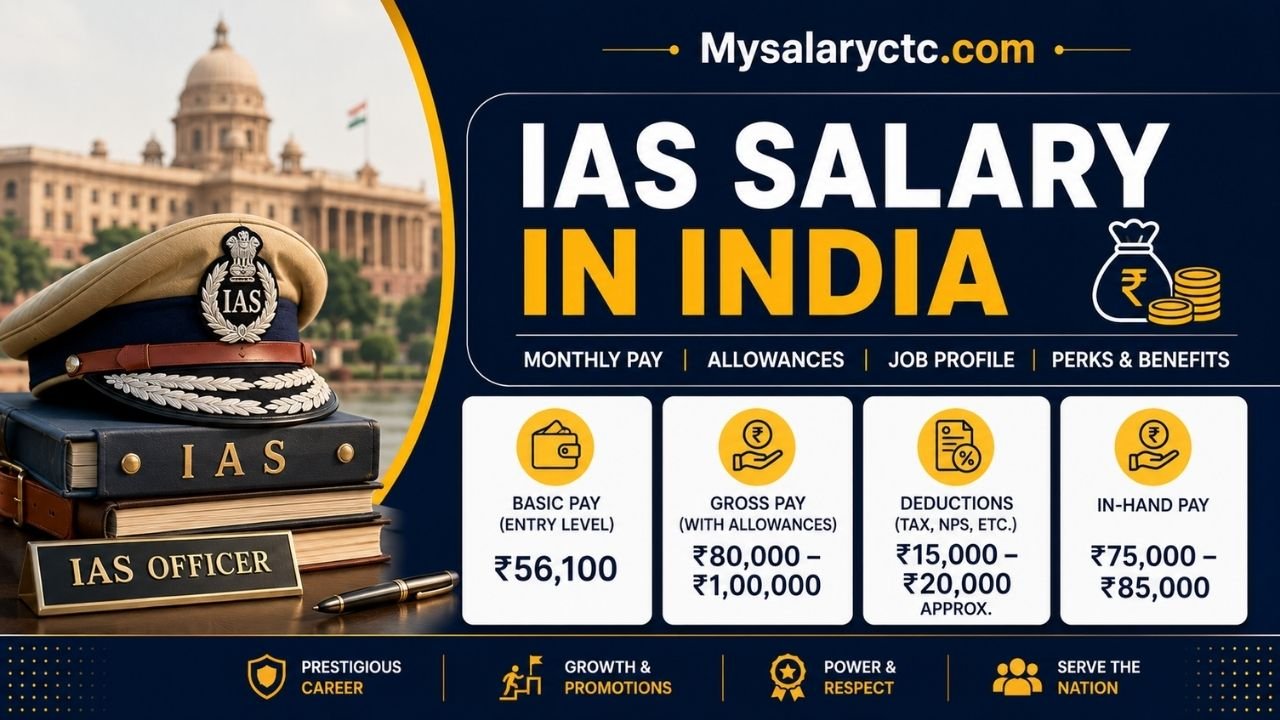

An IAS officer’s basic pay starts at ₹56,100 per month under Pay Level 10 of the 7th Pay Commission. Once allowances kick in, the gross monthly salary rises to roughly ₹80,000 to ₹1,00,000. After deductions, the in-hand pay usually settles between ₹75,000 and ₹85,000. At the very top of the ladder, a Cabinet Secretary earns a fixed basic pay of ₹2,50,000 per month.
That’s the quick version. But salary alone doesn’t tell the full story. Because IAS officers also receive housing, security, medical coverage, and pension benefits, the real value of this career stretches far beyond the number on the payslip. Additionally, the pay grows steadily through fixed promotion cycles, so officers know exactly what to expect at every stage of their career.
This guide breaks down every part of the IAS salary structure in India. So whether you’re an aspirant, a student, or simply curious about how much India’s top administrators earn, you’ll find every detail here.
What Is the Salary of an IAS Officer in India
The starting basic pay for an IAS officer is ₹56,100 per month. This figure comes directly from Pay Level 10 of the 7th Pay Commission, which the government uses to fix salaries for all central civil services.
However, basic pay is only the starting point. Once you add Dearness Allowance and House Rent Allowance, the gross monthly income climbs to nearly ₹80,000 to ₹1,00,000. Then, after standard deductions like income tax and pension contributions, the officer’s actual in-hand salary lands somewhere between ₹75,000 and ₹85,000 per month.
| Salary Component | Approximate Monthly Amount |
| Basic Pay (Entry Level) | ₹56,100 |
| Gross Pay (with allowances) | ₹80,000 – ₹1,00,000 |
| Deductions (tax, NPS, etc.) | ₹15,000 – ₹20,000 approx. |
| In-Hand Pay | ₹75,000 – ₹85,000 |
So even at entry level, this salary comfortably beats most government jobs in India. And unlike many private roles, this figure only grows from here, thanks to a fixed and transparent promotion structure.
- Check This Also: IPS Officer Salary 2026: Rank-Wise Pay Scale & Monthly Breakdown
Salary of IAS Officer Per Month in India Breakdown
Many aspirants search specifically for the salary of an IAS officer per month in India before diving into technical details. So here’s a simple table that answers that question directly.
| Career Stage | Monthly Basic Pay | Approximate Gross Pay |
| Entry Level (Fresh Officer) | ₹56,100 | ₹80,000 – ₹1,00,000 |
| Mid-Career Officer | ₹78,800 – ₹1,18,500 | ₹1,20,000 – ₹1,80,000 |
| Senior Officer | ₹1,44,200 – ₹2,05,400 | ₹2,00,000 – ₹3,00,000+ |
| Cabinet Secretary (Top Rank) | ₹2,50,000 (Fixed) | ₹3,00,000+ |
As this table shows, the range is wide. A junior officer in their first posting earns significantly less than a Cabinet Secretary with three decades of service behind them. Still, even the starting figure outpaces most fresh graduate salaries in India’s private sector.
Why the IAS Salary in India Structure Matters
Unlike private companies, the government doesn’t negotiate salaries individually. Instead, every officer gets placed on a fixed pay level based on 7th Pay Commission guidelines. As a result, there’s no guesswork involved.
Here’s why this structure works in an officer’s favor:
- Pay is fixed and transparent at every level
- Promotions follow a set timeline, not office politics
- Allowances adjust automatically with inflation
- Every officer on the same pay level earns the same basic pay
This predictability is one reason so many aspirants find the civil services appealing, beyond just the prestige.
IAS Officer Rank-Wise Basic Pay Structure
Time in service drives most of the pay growth in this career. Promotions typically happen automatically once officers complete specific years of service. Here’s the complete breakdown.
Junior and Mid-Level Pay Scale
| Years of Service | Pay Level | Position | Basic Pay (Monthly) |
| 1–4 Years | Level 10 | SDM / Junior Scale | ₹56,100 |
| 5–8 Years | Level 11 | Under Secretary / Senior Time Scale | ₹67,700 |
| 9–12 Years | Level 12 | Deputy Secretary / Junior Administrative Grade | ₹78,800 |
| 13–16 Years | Level 13 | District Magistrate / Selection Grade | ₹1,18,500 |
Senior and Apex-Level Pay Scale
| Years of Service | Pay Level | Position | Basic Pay (Monthly) |
| 16–24 Years | Level 14 | Joint Secretary / Special Secretary | ₹1,44,200 |
| 25–30 Years | Level 15 | Principal Secretary | ₹1,82,200 |
| 30–33 Years | Level 16 | Additional Chief Secretary | ₹2,05,400 |
| 34–36 Years | Level 17 | Chief Secretary / Apex Scale | ₹2,25,000 |
| 37+ Years | Level 18 | Cabinet Secretary of India | ₹2,50,000 (Fixed) |
Clearly, the jump from junior scale to district magistrate is already significant. But the biggest leap happens near the very top, where pay nearly doubles between the Additional Chief Secretary and Cabinet Secretary levels.
How IAS Salary in India Gets Calculated
Basic pay is just one piece of the puzzle. Your final in-hand salary depends on several additional components. In fact, these allowances often push total pay well beyond the basic figure alone.
Here’s the formula in simple steps:
- Start with the basic pay
- Add Dearness Allowance (DA)
- Add House Rent Allowance (HRA)
- Add Travel Allowance (TA)
- This total gives you the gross salary
- Subtract income tax, NPS contribution, and professional tax
- What remains is the final in-hand salary
Dearness Allowance and Its Role in IAS Pay
Dearness Allowance, commonly called DA, protects officers against inflation. The government revises this rate periodically, usually twice a year. Since it’s calculated as a percentage of basic pay, it directly boosts the overall salary.
As inflation rises, DA rises too. So an officer’s salary doesn’t stay flat between promotions. Instead, it quietly increases every few months, helping officers keep pace with the rising cost of living across Indian cities.
Key Points About DA
- Revised twice a year by the government
- Calculated as a percentage of basic pay
- Directly linked to inflation levels
- Applies uniformly across all pay levels
House Rent Allowance for IAS Officers
House Rent Allowance, or HRA, depends heavily on the officer’s posting location. Cities fall into X, Y, and Z categories based on population and cost of living. Naturally, bigger cities carry higher HRA rates.
| City Category | Typical Cities | HRA Impact |
| X Category | Metro cities like Delhi, Mumbai | Highest HRA rate |
| Y Category | Mid-sized cities | Moderate HRA rate |
| Z Category | Smaller towns | Lowest HRA rate |
However, most IAS officers receive official government bungalows or quarters during their posting. In such cases, HRA often doesn’t apply directly, since housing is already covered. This is one of the standout perks that sets government service apart from private sector jobs.
Travel Allowance and Daily Perks
Travel Allowance covers the cost of official transport and daily commuting. It’s a fixed component tied to the officer’s pay level and posting city. On top of that, most officers also get access to an official vehicle for government duties.
These transport benefits cut down personal spending significantly. Furthermore, combined with subsidized fuel and driver allowances at senior levels, this becomes a meaningful addition to the officer’s overall compensation package.
In-Hand Salary vs Gross Pay: What You Actually Get
There’s often confusion between gross salary and in-hand salary. So let’s clear that up. Gross salary includes basic pay plus all allowances, calculated before any deductions. In-hand salary, meanwhile, is what actually lands in the officer’s bank account each month.
| Salary Type | What It Includes | Entry-Level Range |
| Gross Salary | Basic pay + DA + HRA + TA | ₹80,000 – ₹1,00,000 |
| Deductions | Income tax, NPS, professional tax | ₹15,000 – ₹20,000 approx. |
| In-Hand Salary | Gross salary minus deductions | ₹75,000 – ₹85,000 |
As officers move into higher pay levels and tax brackets, this gap between gross and in-hand pay tends to widen slightly.
Non-Monetary Benefits That Add Real Value
Cash isn’t the only reward in this career. Officers also receive a long list of non-monetary perks that add substantial value to their overall lifestyle. Often, people overlook these benefits when they only focus on the salary figure.
Here’s what officers typically receive beyond their paycheck:
- Free government housing or official bungalows
- Official vehicles along with drivers
- Household staff and security personnel
- Subsidized electricity and water bills
- Comprehensive medical coverage for the officer and their family
- Personal security details for senior officers, based on posting and threat level
Pension and Long-Term Financial Security
IAS officers fall under the National Pension System, known as NPS. Each month, a portion of the basic salary gets deducted and matched by a government contribution. Over time, this builds a solid retirement corpus across the officer’s entire career.
This long-term security is one major reason the job stays attractive despite demanding work hours. Few private sector roles offer this level of guaranteed financial stability after retirement.
IAS Salary Growth: From SDM to Cabinet Secretary
The career journey of an IAS officer follows clear, structured stages. It starts at the district level and gradually moves toward state and national policy roles. Each stage brings both a pay hike and expanded responsibility.
Early Career Stage
A new recruit usually begins as a Sub-Divisional Magistrate. During this phase, officers handle ground-level administration and build hands-on governance experience.
Mid to Senior Career Stage
Over the next two to three decades, officers typically rise through roles like Deputy Secretary, District Magistrate, Divisional Commissioner, and Principal Secretary. Each promotion brings greater authority and a noticeably higher pay level.
Top of the Career Ladder
Eventually, the most senior and accomplished officers reach the position of Cabinet Secretary of India, the highest civil service rank in the country. This role carries the maximum basic pay of ₹2,50,000 per month.
| Career Stage | Typical Position | Years of Service |
| Early Career | Sub-Divisional Magistrate | 1–8 Years |
| Mid Career | District Magistrate, Deputy Secretary | 9–16 Years |
| Senior Career | Divisional Commissioner, Principal Secretary | 17–33 Years |
| Top Rank | Cabinet Secretary of India | 37+ Years |
Factors That Affect IAS Salary in India
Several factors influence how quickly an officer’s pay grows over time. Below are the main ones:
- Years of service, since promotions follow a fixed timeline
- State cadre, as allowance structures differ slightly by state
- Posting location, since metro cities often carry higher HRA rates
- Batch seniority, which can influence the timing of senior promotions
Years of service remains the biggest factor among all of these, since promotions generally follow a predictable schedule regardless of posting.
Comparing IAS Salary in India With Other Government Jobs
Compared to most other central government roles, the IAS pay scale sits at a clear premium. IPS and IFS officers follow a similar pay commission structure overall. However, IAS officers typically enjoy broader administrative reach and slightly faster promotion cycles at the state level.
| Service | Pay Commission Basis | Promotion Speed | Administrative Reach |
| IAS | 7th Pay Commission | Comparatively faster | Broadest |
| IPS | 7th Pay Commission | Standard | State and district level |
| IFS | 7th Pay Commission | Standard | International postings |
This difference partly explains why the UPSC exam remains so competitive every single year. Aspirants aren’t only chasing the paycheck. Instead, they’re drawn to the authority, job security, and long-term career stability that comes packaged with the role.
Is IAS Salary in India Worth the Preparation Effort?
UPSC preparation takes years of dedication for most aspirants. So naturally, it’s fair to ask whether the pay actually justifies that effort. Financially speaking, the starting salary already competes well with many private sector graduate roles.
Still, the real value shows up over time. Between steady promotions, inflation-linked allowances, government housing, and a secure pension, the total lifetime compensation often surpasses what most private sector jobs offer, especially once you factor in long-term job security.
Conclusion
To sum up, the IAS salary in India offers a strong combination of financial stability and long-term career growth. Starting at ₹56,100 basic pay, it can eventually rise all the way to ₹2,50,000 at the Cabinet Secretary level. Add in free housing, medical coverage, personal security, and pension benefits, and the total package becomes even more valuable than the headline number suggests.
For aspirants weighing years of UPSC preparation against real career outcomes, the numbers tell a clear story. The IAS salary structure in India rewards patience, dedication, and a steady climb through the ranks. Combined with the respect and influence this role carries across the country, it remains one of the most sought-after careers in India today.
Explore Our Tools: CTC Calculator |
Frequently Asked Questions
The starting basic pay is ₹56,100 per month under Pay Level 10. With allowances, the gross salary reaches nearly ₹80,000 to ₹1,00,000.
The Cabinet Secretary of India earns a fixed basic pay of ₹2,50,000 per month, the top level in the civil services pay structure.
After tax and pension deductions, most fresh IAS officers take home between ₹75,000 and ₹85,000 every month.
Yes, Most officers receive government bungalows or quarters, which reduces or removes the need for house rent allowance.
Basic pay increases with promotions roughly every four years. Additionally, Dearness Allowance gets revised separately, usually twice a year.
The pay scales are largely similar since all three follow the 7th Pay Commission. However, IAS officers often get faster promotion cycles and broader administrative roles.
Officers receive Dearness Allowance, House Rent Allowance, and Travel Allowance, along with non-monetary perks like housing, vehicles, and medical coverage.
Yes, IAS officers fall under the National Pension System, where monthly contributions build a retirement corpus over their entire career.

Hi, I’m Kashish Arora, an SEO specialist and finance content researcher passionate about simplifying salary and compensation topics. I create well-researched content on CTC, in-hand salary, salary structure, pay scales, salary slips, tax calculations, EPF, gratuity, bonuses, deductions, and employee benefits.
My articles are based on official government guidelines, employer policies, tax regulations, and other reliable public sources. I aim to explain complex payroll and taxation concepts in simple language so that employees, job seekers, HR professionals, and students can easily understand how salaries are calculated and how deductions affect take-home pay.
Along with payroll and taxation topics, I also cover salary insights for government employees, private-sector professionals, executives, and public personalities whenever reliable information is available.

Leave a Reply