
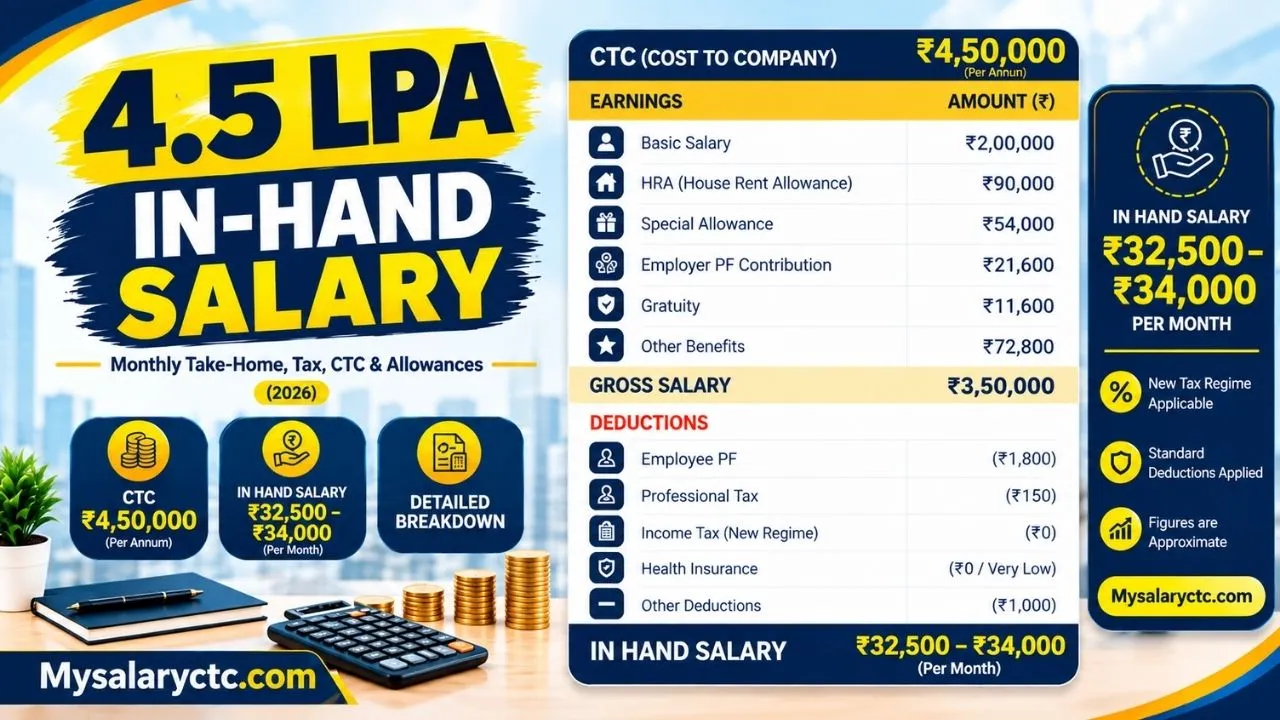

Signing your first offer letter at 4.5 LPA feels like a milestone — and it comes bundled with a question nearly every fresher ends up googling within days: what does ₹4,50,000 a year actually mean for the money hitting your bank account each month? Run the numbers properly, and you’ll land somewhere around ₹32,500 to ₹34,000 monthly, once PF and a token professional tax are accounted for. Income tax, interestingly, barely enters the picture at this level. Here’s exactly how the math plays out.
What Does 4.5 LPA Salary Actually Mean?
“LPA” is simply shorthand for Lakhs Per Annum, the way Indian employers express a year’s worth of compensation in one figure. When an offer letter reads 4.5 LPA, it’s telling you the company values your total yearly package at ₹4,50,000 — this is your CTC, or Cost to Company, and it is not identical to the sum of twelve monthly paychecks. A fairly common rookie mistake is dividing that figure by 12 and expecting ₹37,500 to show up every payday; the actual credited amount ends up noticeably smaller once the usual deductions are applied.
Written out plainly:
4.5 LPA = ₹4,50,000 annual CTC
| Calculation | Amount |
| Annual CTC | ₹4,50,000 |
| Divided by 12 Months | ₹37,500 |
| Gross Monthly Salary | ₹33,500 – ₹35,500 |
Even that gross figure sits below your final take-home — your own personal deductions haven’t even come off yet at this stage.
4.5 LPA In Hand Salary Per Month: What You’ll Actually Get
If the number you’re really after is the 4.5 LPA in hand salary per month, plan for something in the ₹32,500 to ₹34,000 range, with most people settling close to ₹33,000. What surprises a lot of first-time earners is where that gap actually comes from — at this salary bracket, it’s almost entirely Provident Fund doing the work, not income tax, which barely registers here at all.
What Components Make Up Your CTC?
A CTC figure is stitched together from multiple pieces, and a fair number of them never show up as cash in your account. At the 4.5 LPA level, you’ll typically find:
- Basic salary, the reference point most other calculations build from
- HRA and assorted allowances
- Bonus or incentive pay, where the role includes it
- The employer’s own share of your Provident Fund contribution
- Insurance coverage, if the company provides a group policy
- Gratuity, which only pays out once you’ve completed a minimum tenure
Employer PF and gratuity are the main reason a CTC number looks bigger than what eventually reaches your salary account — both add to what the company spends on you, but neither is money you’ll see monthly. Even on a modest package like this, it’s worth requesting the exact breakup from HR before you sign anything.
How Is Your 4.5 LPA In Hand Salary Calculated?
The calculation starts with straightforward division:
₹4,50,000 ÷ 12 = ₹37,500 per month
From that starting point, the employer’s PF contribution and gratuity provision get carved out first — both stay on the company’s books as part of your CTC but never actually transfer to you — leaving a real gross figure closer to ₹33,500–₹35,500. Employee PF and a modest state-level professional tax come off next, and your final monthly credit typically settles between ₹32,500 and ₹34,000.
Deductions That Reduce Your Gross Pay
Here’s what generally gets subtracted before the money reaches you:
- Employee Provident Fund (EPF): Roughly 12% of your basic salary. At this exact CTC level, basic pay often lands right around the ₹15,000 PF wage ceiling, putting the deduction near ₹1,800 a month
- Professional Tax: A small, state-specific charge, usually somewhere between ₹150 and ₹200
- Income Tax (TDS): Effectively nil for almost anyone earning this income under the New Tax Regime
- Insurance Deductions: Only relevant if your company runs a group insurance scheme
| Salary Component | Approximate Amount |
| Gross Monthly Salary | ₹33,500 – ₹35,500 |
| Employee PF Contribution | ~₹1,800 |
| Professional Tax | ~₹150 |
| Income Tax (TDS) | ₹0 |
| Estimated In-Hand Salary | ₹32,500 – ₹34,000 |
CTC vs Take-Home Pay: Why the Confusion Happens
There’s a reason this trips up so many first-jobbers specifically: without an earlier payslip to compare against, the CTC figure on the offer letter is the only number you’ve got, so it’s natural to assume it’s what you’ll actually receive. Employers lean on CTC because it captures their full cost of employing you — PF, insurance, gratuity and all — while your payslip only ever reflects what’s left standing after every deduction has done its work.
Put two people on an identical 4.5 LPA offer at two different companies, and their in-hand figures can still differ by a bit, purely because each employer splits basic pay and allowances its own way. That’s the real argument for looking past the CTC headline and asking for the actual breakup, even when the offer itself feels modest.
Income Tax On 4.5 LPA Salary
Here’s the part that should ease any first-job tax anxiety: a 4.5 LPA in hand salary comes with essentially zero income tax attached, for nearly every salaried employee earning it. Following the Union Budget 2025, the New Tax Regime shields income up to ₹12 lakh from tax entirely through the Section 87A rebate. A salary of ₹4,50,000 sits so comfortably beneath that line that tax simply isn’t part of the equation — Provident Fund does all the heavy lifting when it comes to shrinking your take-home.
A few related points worth knowing:
- The New Tax Regime applies automatically unless you specifically opt for the old one
- Even under the Old Regime, a salary at this level would typically fall inside the basic exemption limit for most people
- There’s no real basis for TDS to be deducted here, since no tax liability exists to withhold against
If your employer mistakenly withholds a small TDS amount early in the financial year anyway, it should come back to you once you file your income tax return.
4.5 LPA Salary Per Day And Per Hour
Zooming into smaller units can make this salary easier to size up against internship stipends or freelance work.
| Time Unit | Approximate Amount |
| Per Day | ₹1,233 |
| Per Hour (8-hour workday) | ₹154+ |
These figures come from a plain 365-day gross calculation, so weekends, holidays, and deductions aren’t factored in — treat them as a loose reference point rather than a precise figure.
Job Roles That Typically Offer 4.5 LPA Salary
This bracket tends to suit freshers and professionals with somewhere between zero and two years of experience, spread across a fairly wide range of industries. Roles commonly seen at this level include:
- Junior Software Developer / Trainee Engineer
- Customer Support Executive
- Junior Data Analyst
- Sales Executive
- Junior Content Writer / Marketing Associate
- HR Executive (entry-level)
- Operations Executive
- Graphic Designer (entry-level)
Is 4.5 LPA A Good Salary For Freshers?
As a starting package, 4.5 LPA sits comfortably in the middle of the pack — not among the standout campus offers, but nowhere near the bottom either. It’s generally enough to cover core living costs in most Indian cities, though how much you can actually save will hinge on your city and personal spending habits. A lot of people treat a package like this as a stepping stone, building a year or two of solid experience before pushing for something considerably higher.
How Location Affects Your 4.5 LPA Take-Home Value
The city you’re working in has a real say in how far this salary actually stretches.
In Metro Cities: Places like Bengaluru, Mumbai, Hyderabad, Pune, and Delhi NCR come with steeper rent and everyday costs, so a 4.5 LPA salary demands careful budgeting, particularly if you’re covering your own accommodation.
In Tier-2 and Tier-3 Cities: The same paycheck stretches noticeably further here, usually covering everyday expenses comfortably while still leaving some room to save.
4.5 LPA vs 5 LPA: How Take-Home Pay Scales
Looking at the next bracket up gives you a realistic sense of what to expect from your first appraisal or a future job change.
| Package | Gross Monthly | Net In-Hand Monthly |
| 4.5 LPA | ₹33,500 – ₹35,500 | ₹32,500 – ₹34,000 |
| 5 LPA | ₹37,500 – ₹39,500 | ₹36,000 – ₹37,500 |
Even a small increase in CTC produces a fairly noticeable jump in take-home pay here, mainly because PF remains the only real deduction standing between gross and net at this income level.
How To Save Money On A 4.5 LPA Salary
Building savings on a first-job salary is entirely realistic, and the habits you form now tend to pay off disproportionately once your income starts climbing. A few approaches that genuinely make a difference:
- Kick off a small SIP early, even at just ₹1,000–₹2,000 a month — building the habit matters more than the amount at this stage
- Set aside a basic emergency cushion covering two to three months of expenses
- Steer clear of EMIs or credit card debt for anything non-essential this early on
- Keep a rough eye on monthly spending to catch small, easily avoidable leaks
- Bank at least part of any bonus or incentive payout rather than spending all of it right away
Starting small now tends to compound meaningfully by the time your salary has doubled or tripled a few years down the line.
Career Growth After 4.5 LPA Salary
Treat a 4.5 LPA package as a launchpad rather than a destination. With steady effort toward building relevant skills, most people see real salary movement within their first couple of years.
Typical growth path: 4.5 LPA → 6.5 LPA → 9 LPA → 14 LPA+
A few things tend to accelerate that climb:
- Picking up practical skills that go beyond the minimum your role asks for
- Volunteering for tasks slightly outside your formal job description
- Earning certifications relevant to your specific field
- Building informal connections within your industry
- Actively seeking feedback and asking about growth paths early on
Industries With Faster Salary Growth
Growth isn’t uniform across sectors, especially at entry level. If climbing quickly matters to you, it’s worth aiming toward fields like:
- Information Technology and Software Development
- Data Analytics
- Digital Marketing
- E-commerce
- Fintech and Financial Services
Challenges Of A 4.5 LPA Salary
This bracket comes with its own set of pressures — tight budgets in expensive cities, little room for discretionary spending, and the general challenge of saving anything meaningful while still early in a career. It’s also easy to feel like you’re lagging behind peers in higher-paying fields, but this stage is genuinely more about accumulating the experience that unlocks faster growth down the road than about the number itself.
Why Experience Matters More Than Salary Initially
Nothing teaches you quite like your first job does. It’s where the real fundamentals get built — communicating clearly, managing your time, picking up technical know-how, and understanding how your particular industry actually runs day to day. A 4.5 LPA starting figure tells you very little about where you’ll eventually land; how fast you absorb and apply what you learn tells you a lot more.
Read More: 7.5 LPA In Hand Salary: Monthly Take-Home, Tax, CTC & Allowances (2026)
Conclusion
Putting it all together: a 4.5 LPA in hand salary typically works out to somewhere between ₹32,500 and ₹34,000 a month, against a gross monthly figure of roughly ₹33,500 to ₹35,500. Nearly all of that gap traces back to PF alone, since income tax isn’t really a factor at this level — the Section 87A rebate under the New Tax Regime covers income well past ₹4.5 lakh. It’s a solid place to begin. Combine it with early saving habits and continuous skill-building, and this 4.5 LPA in hand salary per month is likely to be just the opening chapter of a much longer growth story.
Frequently Asked Questions
Expect somewhere between ₹32,500 and ₹34,000, depending on exactly how your company structures deductions.
Expect somewhere between ₹32,500 and ₹34,000, depending on exactly how your company structures deductions.
Yes — both employee and employer PF contributions typically factor into your overall CTC, though only your own share is actually deducted from your in-hand pay.
Practically never. The Section 87A rebate under the New Tax Regime shields income up to ₹12 lakh from tax, and 4.5 LPA sits well within that zone.
Roughly ₹33,500 to ₹35,500, before PF and professional tax come off.
It’s a fairly typical, middle-of-the-road starting package — enough to manage essential costs in most cities and begin building early saving habits.
Around ₹1,233 on a gross basis.
Yes, particularly for people who build relevant skills early and take initiative — meaningful jumps within the first two to three years are common.
5 LPA typically nets ₹36,000 to ₹37,500 monthly, a clear step up from the ₹32,500 to ₹34,000 range
Read Our Tools: 12 LPA In Hand Salary: What Actually Lands In Your Account (2026)

Hi, I’m Kashish Arora, an SEO specialist and finance content researcher passionate about simplifying salary and compensation topics. I create well-researched content on CTC, in-hand salary, salary structure, pay scales, salary slips, tax calculations, EPF, gratuity, bonuses, deductions, and employee benefits.
My articles are based on official government guidelines, employer policies, tax regulations, and other reliable public sources. I aim to explain complex payroll and taxation concepts in simple language so that employees, job seekers, HR professionals, and students can easily understand how salaries are calculated and how deductions affect take-home pay.
Along with payroll and taxation topics, I also cover salary insights for government employees, private-sector professionals, executives, and public personalities whenever reliable information is available.


Leave a Reply